

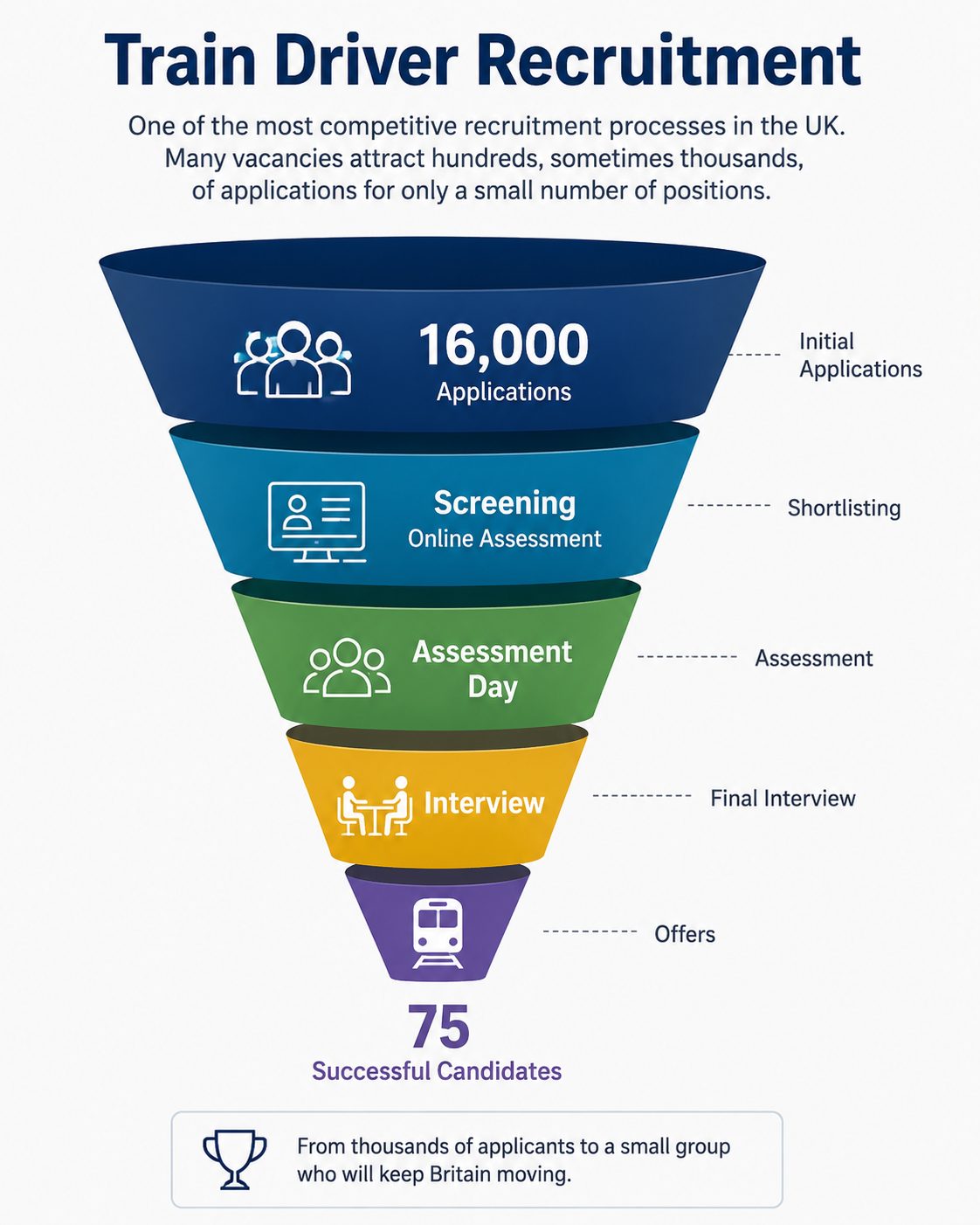
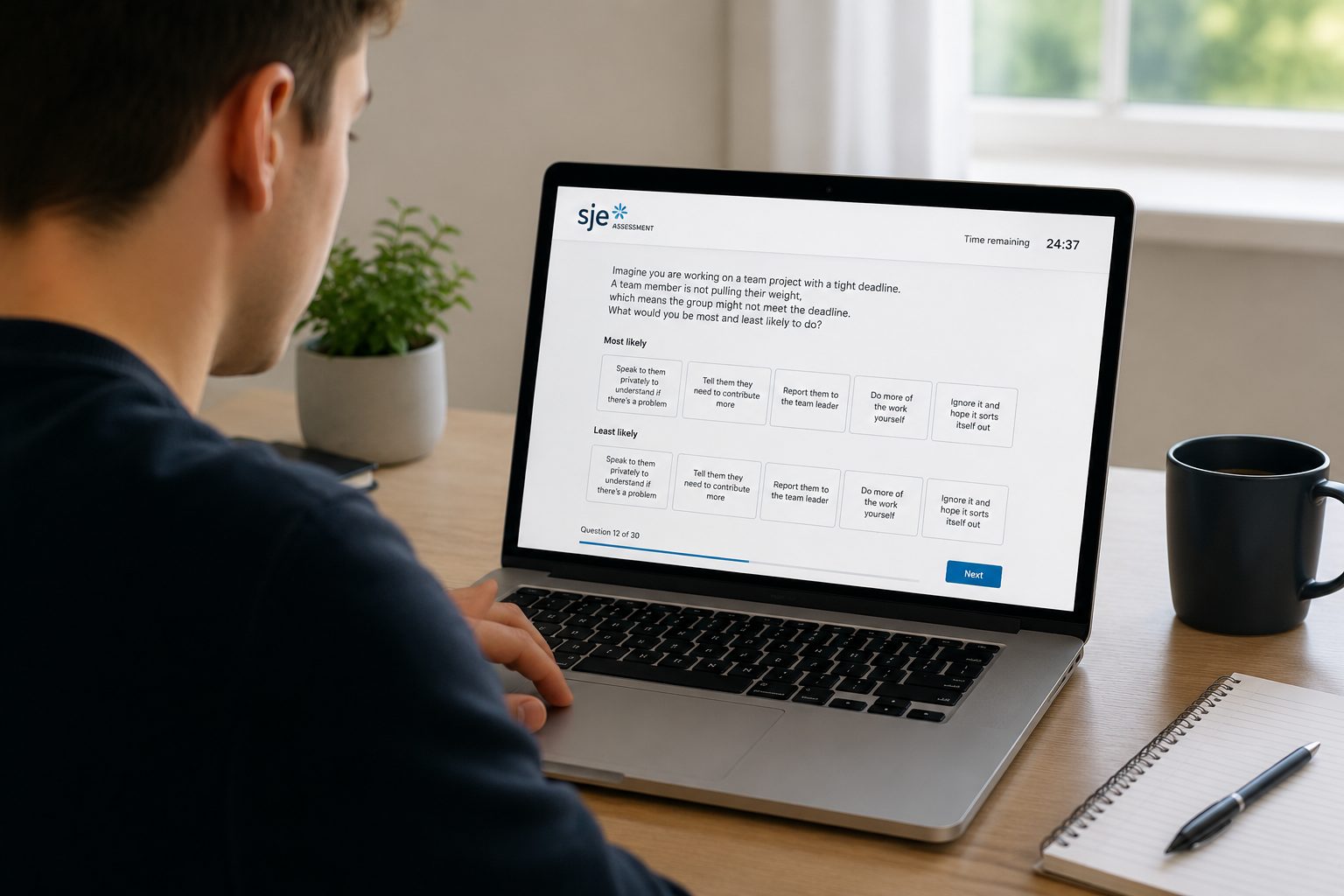



An assessment centre is where preparation becomes visible. Your application may have shown that you meet the basic criteria, but this stage allows a Train Operating Company (TOC) to see how you communicate, prioritise, listen and respond when expectations are clear and time is limited. Effective assessment centre preparation is not about performing a rehearsed version of yourself. It is about showing, consistently, that you can bring the judgement, discipline and professional approach required in a safety-critical railway role.
For aspiring trainee train drivers, this can feel like one of the least predictable stages of recruitment. The format varies between TOCs and campaigns, and your invitation is always the most reliable source of information. Yet the underlying purpose is usually consistent: assessors want evidence that you can work responsibly with others, follow instructions, make reasoned decisions and communicate in a calm, structured way.
What an assessment centre is designed to assess
A TOC is not looking for the loudest person in the room or the candidate with the most polished corporate language. Train driving involves independent responsibility, but it also sits within a wider operational railway. That means assessors may be considering how you contribute to a team, how you handle information, and whether your behaviour remains professional when there is pressure or uncertainty.
You may be asked to complete a combination of individual and group-based activities, alongside an interview or written exercise. These can include a group discussion, a prioritisation task, a scenario-based exercise or a short presentation. Not every assessment centre includes every format, so avoid preparing for a supposed standard script. Read the joining instructions closely and focus on the capabilities the process is likely to test.
The strongest candidates tend to demonstrate several qualities at once: they listen before responding, use the information provided, explain their thinking clearly and remain respectful where views differ. They can make a decision when one is required, but they do not rush past relevant facts or dismiss other people’s contributions.
Professional behaviour is assessed throughout the day
Assessment does not begin only when the first exercise is handed out. Be punctual, appropriately presented and courteous to everyone you meet. Follow directions, keep your mobile phone away unless instructed otherwise, and treat breaks as part of a professional recruitment setting.
This is not about trying to appear overly formal. It is about showing reliable judgement. In a safety-critical career, small habits matter because they indicate how seriously you take standards, instructions and the impact of your actions on others.
Prepare your evidence before you practise
Structured interviews and assessment-centre discussions become much easier when you have already reflected on your experience. You do not need a railway background to provide useful examples. Career changers, Armed Forces service leavers, transport workers and applicants from customer-facing or technical roles may all have relevant evidence.
Start by identifying situations where you have worked to procedures, managed competing priorities, noticed a potential issue, communicated clearly with a colleague or customer, and remained composed under pressure. Also consider occasions when you made an error, received feedback or changed your approach. A credible answer is not one where everything went perfectly. It is one that shows accountability and learning.
Use a simple structure when developing each example: explain the situation, clarify your responsibility, describe the action you took and state the outcome. Keep the focus on your own contribution without claiming sole credit for a team result. Where the outcome was not ideal, explain what you learned and what you would do differently next time.
For train driver recruitment, choose examples that demonstrate care rather than bravado. An assessor will gain more from hearing how you paused, checked and escalated an issue appropriately than from a story about taking unnecessary risks to meet a deadline.
Build examples around relevant behaviours
Your examples should help an assessor understand how you operate. Useful themes include following a process accurately, handling routine work with sustained concentration, responding to changing information, managing conflict respectfully and maintaining standards when tired, busy or under scrutiny.
Avoid vague statements such as, “I am very safety conscious.” Instead, provide a specific example that shows what safety consciousness looked like in practice. What did you notice? What did you do? Who did you inform? How did you ensure the task was completed correctly? Specific detail is more persuasive than broad claims.
Approach group exercises with operational maturity
Group exercises can make candidates anxious because they involve other people’s performance as well as their own. The aim is not to control the room. It is to contribute in a way that helps the group work through the task safely, logically and within the time available.
Begin by reading the brief carefully. Establish the objective, the constraints and the decision the group needs to reach. If information is unclear, ask a relevant question rather than making an assumption. As the discussion develops, refer back to the facts in the brief and make your reasoning visible.
Good contributions are usually concise. You might identify a priority, invite a quieter person to share their view, summarise where the group has reached or bring the conversation back to the time limit. These are practical signs that you can cooperate without becoming passive.
There is a balance to strike. Speaking too little can make it difficult for assessors to see your contribution, while speaking over others or repeating points can suggest poor listening. If another candidate makes a useful point, acknowledge it and develop it where appropriate. If you disagree, explain why using the information available rather than turning the exchange into a personal challenge.
A useful question to keep in mind is: “What would help this group make the most reasoned decision?” That mindset naturally leads to clearer, more measured behaviour.
Treat written and prioritisation tasks as accuracy exercises
Where an assessment centre includes written information, candidates can lose marks through avoidable errors rather than a lack of ability. Read the question first, then review the material with a clear purpose. Separate facts from assumptions and identify any deadlines, risks, dependencies or instructions that affect the decision.
Do not assume that the most urgent-looking item is automatically the highest priority. Consider consequence, safety, available information and whether a matter needs escalation. Explain your rationale in a logical order. A short, well-supported answer is generally stronger than an overcomplicated response that does not address the task.
Practise working from written briefs before the day, particularly if you have not completed timed exercises for some time. The purpose is not to memorise answers. It is to build the habit of reading carefully, identifying key information and recording a clear conclusion.
Prepare for the day as carefully as the exercises
Practical planning reduces unnecessary pressure. Confirm the location, journey time, identification requirements and start time well in advance. Plan to arrive with time to spare, allowing for disruption on the network or road. Choose professional, comfortable clothing that allows you to focus on the assessment rather than your appearance.
Sleep, food and hydration are also part of preparation. An assessment centre can require sustained concentration across several hours. Avoid treating the day as a test of endurance. Give yourself the best chance of arriving alert and settled.
If you need reasonable adjustments, raise this through the recruitment process as early as possible. Asking for appropriate support is a professional step that helps ensure you can demonstrate your ability fairly.
Use practice to improve, not to manufacture answers
It is sensible to rehearse a two-minute introduction, practise structured interview responses and discuss sample scenarios aloud. Record yourself if possible. You may notice that your answers lack a clear outcome, include too much background or move too quickly to a conclusion.
However, do not try to memorise full responses word for word. Under pressure, memorised wording can sound unnatural and may prevent you from responding properly to the question asked. Prepare the evidence, the structure and the key learning points, then speak naturally.
Targeted preparation can be particularly valuable if you are returning to recruitment after a long period, moving from the Armed Forces into civilian employment, or unfamiliar with group selection methods. Train Driver Foundation's preparation resources are designed around the standards and professional behaviours relevant to trainee train driver recruitment, helping candidates practise with purpose while maintaining assessment integrity.
On the day, focus on the next task
You may feel that one answer was weaker than you wanted or that another candidate spoke more confidently in a group exercise. Do not allow that judgement to affect the rest of the day. Assessment centres normally consider evidence across multiple activities, not one isolated moment.
Listen to each instruction, take a breath before responding and keep your attention on what the task requires now. If you do not understand a direction, ask for clarification at the appropriate point. If you make a mistake, correct it calmly rather than becoming defensive.
The most useful mindset is simple: you are not there to outshine other people through force of personality. You are there to show that you can be trusted to prepare properly, think clearly, communicate professionally and keep standards in view. Those qualities are built long before assessment day, one considered habit at a time.