





If you are searching for the best course for trainee train drivers, the real question is not simply which course sounds most impressive. It is which course helps you become a stronger candidate for a safety-critical role, while also building knowledge that stands up during the recruitment process and early training.
That distinction matters. Many applicants assume any rail-related course will improve their chances. In practice, some courses are far more useful than others. A good course should support recruitment readiness, strengthen your understanding of operational standards, and help you present yourself credibly at application, assessment and interview stage. A weak course may give you information, but little that translates into selection performance.
What makes the best course for trainee train drivers?
The best course for trainee train drivers is usually one that sits between career preparation and operational education. It should not pretend to replace employer training, and it should not be so generic that it adds nothing to your application. The strongest options help you understand the role, the standards expected in a safety-critical environment, and the behaviours that train operating companies look for when they recruit.
That means course quality is less about flashy branding and more about relevance. A worthwhile course should reflect the reality of the job. It should cover concentration, rule adherence, situational judgement, operational discipline, communication and decision making under pressure. These are recurring themes in recruitment because they are central to safe train operation.
There is also a practical point here. Recruiters are not looking for candidates who have collected random certificates. They are looking for evidence of suitability, maturity and commitment. A course only becomes valuable if it helps you demonstrate those qualities in a credible way.
Not all train driver courses do the same job
One of the biggest mistakes applicants make is treating all courses as if they serve the same purpose. They do not. Some are best for understanding the railway environment. Others are better for interview preparation. Some are useful CPD evidence, while others are mainly introductory.
If your immediate goal is to secure a trainee driver position, then a course should support that goal directly. A broad rail overview can be helpful, but it may not move the needle much if it does not connect to recruitment standards. Equally, a course focused only on passing an interview may leave you without the operational awareness needed to speak convincingly about the job.
The strongest preparation often combines both. You need enough role-specific knowledge to show genuine understanding, and enough recruitment preparation to perform effectively when your application is assessed.
The courses that tend to matter most
For aspiring drivers, the most useful course areas usually fall into a small number of categories. Introductory train driving education can help you understand the shape of the role and the expectations that come with it. Operational thinking and risk-based decision making are particularly relevant because they align closely with the judgement and discipline expected in safety-critical work. Operational maturity also matters, especially for applicants changing career or entering rail for the first time.
These subjects are valuable because they do more than give you facts. They help you think in the right way. That is often what separates a strong applicant from someone who simply says they are interested in trains.
There is a place too for supporting courses such as personal track safety awareness or traction and rolling stock introductions, but their value depends on context. They can strengthen your understanding of the wider rail environment, yet they should not be mistaken for a direct substitute for recruitment preparation. If your budget or time is limited, choose learning that improves your readiness for the actual selection process first.
How to judge whether a course is actually useful
A useful course should answer three questions clearly. First, does it relate to the realities of trainee train driver recruitment? Second, does it help you explain your suitability more effectively? Third, does it develop knowledge or judgement that supports long-term progression rather than just short-term confidence?
Look closely at the course content. If it focuses on operational awareness, safety responsibility, human factors, structured decision making and the demands of the driver role, that is usually a good sign. If the description is vague, overpromising or detached from how drivers are actually selected, be cautious.
It is also worth asking whether the course is pitched at the right level. Some introductory learning is useful precisely because it is accessible and practical. You do not need highly technical material that has little bearing on entry-level recruitment. Equally, material that is too basic may not add much if you already understand the broad outline of the role.
Best course for trainee train drivers if you are at application stage
If you have not yet applied, the best course for trainee train drivers is often one that helps you build informed motivation and role awareness. At this stage, you need to understand what train driving involves, what employers assess, and how your previous experience might transfer into a safety-critical railway setting.
This is where introductory train driving education and operational maturity training can be especially useful. They help you move beyond general enthusiasm and start speaking the language of professionalism, standards and responsibility. That can strengthen both your application and your interview examples.
For many candidates, this stage also exposes skills gaps. You may realise that your work history gives strong evidence of rule compliance or customer responsibility, but weaker evidence of sustained concentration or independent operational judgement. Recognising that early helps you prepare more honestly and effectively.
Best course for trainee train drivers if you are nearing assessment
Once you are approaching psychometric tests or structured interviews, your priorities shift. At that point, a course is most useful when it sharpens the behaviours and thinking patterns that sit behind assessment performance.
Operational thinking and risk-based decision making become highly relevant here. They can improve the quality of your interview responses because they teach you to frame situations in terms of safety, procedure, consequence and judgement. That matters in structured interviews, where vague answers rarely score well.
There is a trade-off, though. A course alone will not replace targeted preparation for psychometric tests, application questions or competency-based interviews. If selection is imminent, your learning should complement practical recruitment preparation rather than compete with it for time.
Should you choose rail knowledge or interview preparation?
Often, candidates think they must pick one. In reality, the best choice depends on where you are in the process.
If you still need a stronger understanding of the role, start with role-relevant learning. It is difficult to interview well for a position you do not properly understand. If you already understand the role but struggle to evidence your suitability, preparation focused on application quality, assessment support and structured interviewing may be more valuable.
For serious applicants, the strongest route is usually a combination. Rail knowledge gives your answers credibility. Recruitment preparation helps you communicate that credibility under pressure. One without the other can leave gaps.
What to avoid when choosing a course
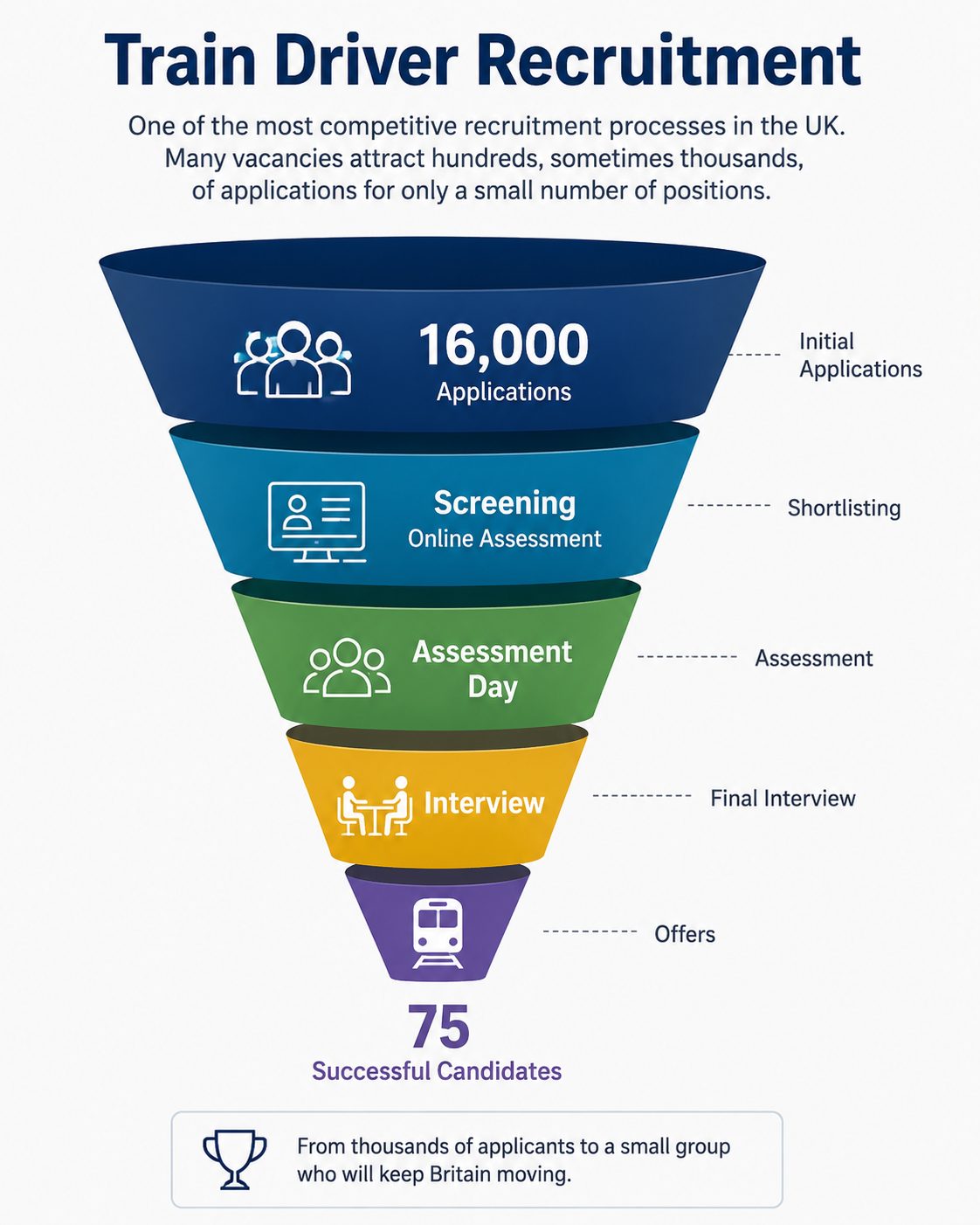
Be careful of any course that suggests it can fast-track you into the cab or make the process easy. Train driver recruitment is competitive because the role carries significant responsibility. Any serious training provider should reflect that reality.
You should also avoid courses that are too broad to be useful. General employability training may help with confidence, but it is rarely enough for a specialist safety-critical career. The same applies to courses that focus heavily on theory without helping you apply that learning to recruitment situations.
Another warning sign is a course that cannot explain its practical value. You should be able to say exactly how the learning supports your application, interview performance or wider professional development.
A sensible way to choose your next step
The best decision usually starts with honest self-assessment. Ask yourself whether your main gap is knowledge, application quality, interview structure, psychometric familiarity or overall operational understanding. Once you know the problem, the right course becomes much easier to identify.
For some applicants, especially career changers and Armed Forces leavers, a CPD-style course can be a strong first step because it provides structure and role-specific language. For others, particularly those already applying to TOCs, the priority may be interview preparation and assessment support backed by targeted operational learning.
Train Driver Foundation takes this more realistic approach by focusing on both recruitment readiness and early-stage rail education, rather than treating a course as a magic answer. That is the right mindset for candidates as well. Choose learning that fits your stage, strengthens your weak points and reflects the standards of the role you want.
The best course is rarely the one with the broadest claims. It is the one that helps you become more credible, more prepared and more operationally aware when the opportunity arrives.