

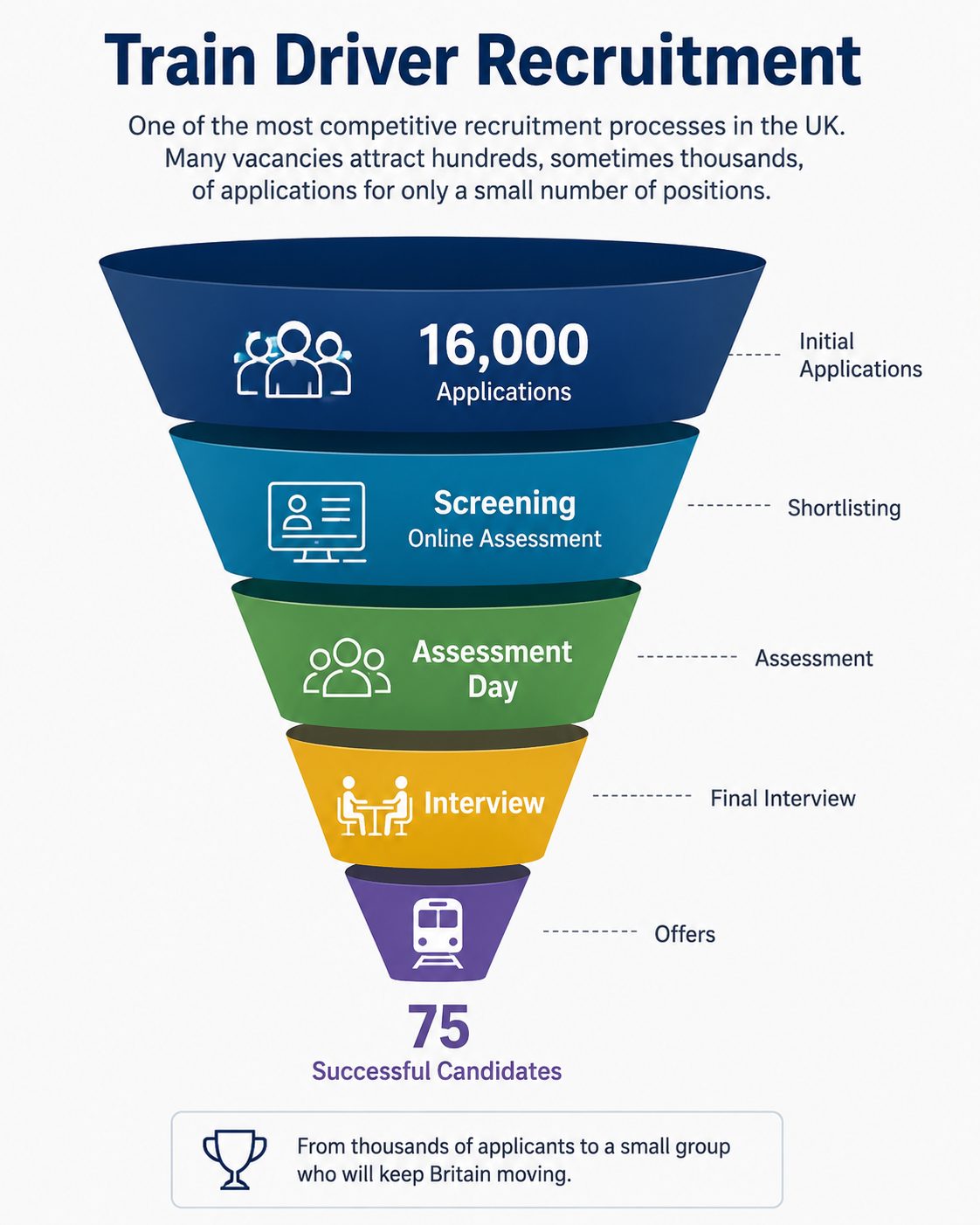




A trainee driver advert can receive a very high volume of applications, sometimes within days of appearing. That makes knowing where to look more than a convenience. The best websites for train driver vacancies are the ones that give you early, accurate information and lead you to the employer’s official application process.
There is no single vacancy board that captures every opportunity. Train Operating Companies (TOCs) recruit to meet their own depot, route and operational requirements, and each manages its campaigns differently. A disciplined search across a small number of reliable sources is far more effective than relying on one generic job alert.
The best websites for train driver vacancies
For aspiring UK train drivers, official TOC careers pages should always be the starting point. They are the primary source for trainee train driver campaigns, qualified driver roles and other operational vacancies. They also provide the clearest information on the depot location, closing date, eligibility criteria and stages of the selection process.
A vacancy may appear first on a TOC’s own recruitment portal, then later be copied to a job board. By the time an aggregator alert reaches your inbox, the role may already have a large applicant pool. Applying through the official careers site also reduces the risk of acting on an outdated advert or missing a specific instruction.
TOC careers pages: the priority source
Build a watchlist of operators whose routes and depots are realistic for your home location and commuting pattern. This is not simply about choosing the largest operator. A trainee driver role is normally tied to a named depot, and the practical realities of early starts, late finishes and disrupted services matter throughout a driving career.
Check the careers pages of relevant TOCs directly at least once or twice a week. Where the site offers a talent community or vacancy alert, register with an email address you check regularly. Use terms such as “trainee train driver”, “train driver”, “driver talent pool” and “operations”. Some campaigns use slightly different job titles, so an overly narrow alert can miss a suitable opening.
Read the employer’s stated criteria carefully. Requirements can differ between campaigns, particularly around depot proximity, work history, licences, shift flexibility and prior applications. Do not assume that criteria published by one TOC will apply unchanged to another.
Find a Job: a useful official cross-check
The government’s Find a Job service is worth including in your routine. It can feature vacancies posted directly by employers or recruitment providers, and its search and alert functions can help identify roles outside the TOCs you already follow.
Use location searches sensibly. Searching the whole country can create noise and encourage applications to depots that are not genuinely sustainable for you. Start with a manageable travel radius, then expand only where you could realistically meet the working pattern over the long term. A train driver’s working day does not always begin when public transport is available.
Rail-specific job boards: useful for wider awareness
Rail-focused job boards can be valuable for monitoring the wider market. They may carry trainee driver adverts, driver manager positions, conductor and other safety-critical operational roles. They can also show which employers are actively recruiting in particular regions.
Their limitation is that adverts may be reposted, removed late or presented without the full context available on the employer’s own portal. Treat them as a discovery tool, not the final authority. If you see a vacancy that interests you, verify it on the TOC’s careers site before investing time in an application.
Major job boards and professional networks
General platforms such as Indeed, Totaljobs and LinkedIn can broaden your coverage, particularly when employers syndicate their vacancies. They are also useful for setting location-based alerts and following TOCs for recruitment updates.
However, generic searches can return non-driving roles that use similar wording, including engineering, freight, agency and overseas posts. Refine alerts with exact phrases where possible, and check that the employer, depot and contract type are clear. A role described as “rail driver” is not automatically a passenger train driver vacancy.
Professional networks can also be helpful for following official employer accounts, but they should not replace the formal vacancy portal. A social post may announce an upcoming campaign, while the application itself is still made through a separate recruitment system.
How to use the best websites for train driver vacancies
The strongest approach is a simple search system that you can maintain consistently. Create a tracker with the operator, depot, vacancy title, date found, closing date, application status and any stated eligibility requirements. This prevents duplicate applications and helps you recognise when a new campaign is genuinely different from one you have seen before.
Set alerts, but do not become passive. Alerts depend on the terms used by the advertiser and may arrive after a role has gone live. A short scheduled check of your priority TOC careers pages is often more reliable. For high-interest campaigns, applying early is sensible, provided your application is complete and accurate.
Avoid submitting the same generic CV and supporting statement repeatedly. Your work history should be truthful and consistent, but the way you present it should respond to the advert. Safety awareness, concentration, following procedures, managing fatigue, independent working, communication and dependable attendance are all relevant themes where they are supported by your real experience.
Read each advert as an assessment brief
A train driver vacancy is not only a job description. It is an early indication of what the employer will assess throughout the recruitment process. Look for the essential criteria, the depot requirement, the expected working pattern and the behaviours the TOC emphasises.
If the advert refers to safety-critical working, do not respond with broad claims that you are “safety conscious”. Give concise evidence from your employment, military service, transport background or other responsible roles. Explain the situation, your actions and the disciplined outcome. The strongest examples show that you can follow a process, recognise when something is outside tolerance and communicate appropriately.
Take eligibility questions seriously. Recruitment systems may ask about right to work, licences, attendance history, location, previous applications or shift availability. Answer accurately. Trying to second-guess the process or conceal a limitation creates problems later and does not reflect the professional standards expected in a safety-critical role.
What not to rely on
Vacancy rumours, unofficial discussion groups and old screenshots are poor foundations for a job search. They can be useful prompts to check an official careers page, but they are not confirmation that a campaign exists or that its criteria have remained the same.
Be cautious with websites that make sweeping claims about guaranteed placements, hidden recruitment routes or ways around assessment standards. Train driver recruitment is competitive because the role carries significant responsibility. There is no credible substitute for meeting the criteria, preparing properly and demonstrating the required behaviours through the proper process.
Similarly, do not overlook vacancies because they are not labelled as a direct route to train driving. For some candidates, a suitable operational railway role can build relevant understanding and evidence of working in a regulated environment. It is not a guaranteed progression route, and it should be chosen because it is a role you would genuinely be prepared to perform well.
Prepare before the vacancy appears
The best time to improve an application is before a campaign opens. Keep your CV current, ensure dates and job titles are accurate, and prepare examples that demonstrate reliability, situational awareness, rule adherence, decision making and professional communication. You should be able to explain your motivation for train driving in a grounded way, without relying on salary assumptions or vague statements about wanting a change.
It is also sensible to understand the likely recruitment journey. Depending on the employer, this can include an initial application review, online assessments, psychometric tests, structured interviews, medical assessment and further selection stages. Preparation should develop genuine familiarity with the demands of the process, not attempt to bypass its integrity.
Train Driver Foundation supports candidates who want to approach this work systematically, from vacancy discovery and CV quality through to assessment and interview preparation. The objective is readiness: presenting relevant evidence clearly, understanding what employers are testing and treating every stage with the level of professionalism the role requires.
A well-managed search will not create vacancies where none exist, but it will ensure you see genuine opportunities promptly and are ready to respond. Focus on official sources, choose depots you can realistically serve, and let the quality of your preparation carry more weight than the quantity of applications you submit.