




A missed signal aspect is not a minor error in a driving cab. It can affect decisions at speed, in poor weather and under pressure. That is why candidates often ask, can colour-blind people drive a train? The honest answer is that it depends on the type and extent of colour vision deficiency, the role being applied for and the outcome of a railway occupational health assessment.
For aspiring train drivers, this is an eligibility question worth addressing early. It is not a matter of finding a workaround or relying on an assumption based on everyday driving. Train driving is a safety-critical role, and visual standards exist to make sure drivers can reliably interpret the information needed to operate safely.
Can colour-blind people drive trains?
Some people with a colour vision deficiency may be able to hold a driving licence for a car and drive safely on the road. That does not automatically mean they meet the visual requirements for train driving.
Railway driving involves recognising coloured signals, indicator lights, cab displays and other visual information accurately and promptly. Although modern railways use multiple safeguards and drivers do not make decisions based on colour alone, reliable colour perception remains a relevant part of the medical assessment for many safety-critical rail roles.
A colour vision deficiency is not one single condition. It can affect how a person distinguishes particular colours, and the degree of impact varies considerably. Someone may have a mild difficulty they rarely notice in daily life, while another person may be unable to distinguish colour combinations that are critical in an operational environment.
For this reason, there is no responsible universal answer such as “all colour-blind people can drive trains” or “all colour-blind people cannot”. The decision must be based on an appropriate occupational assessment rather than self-diagnosis, an online screening test or the fact that you have passed a standard car eyesight test.
Why colour vision matters in train driving
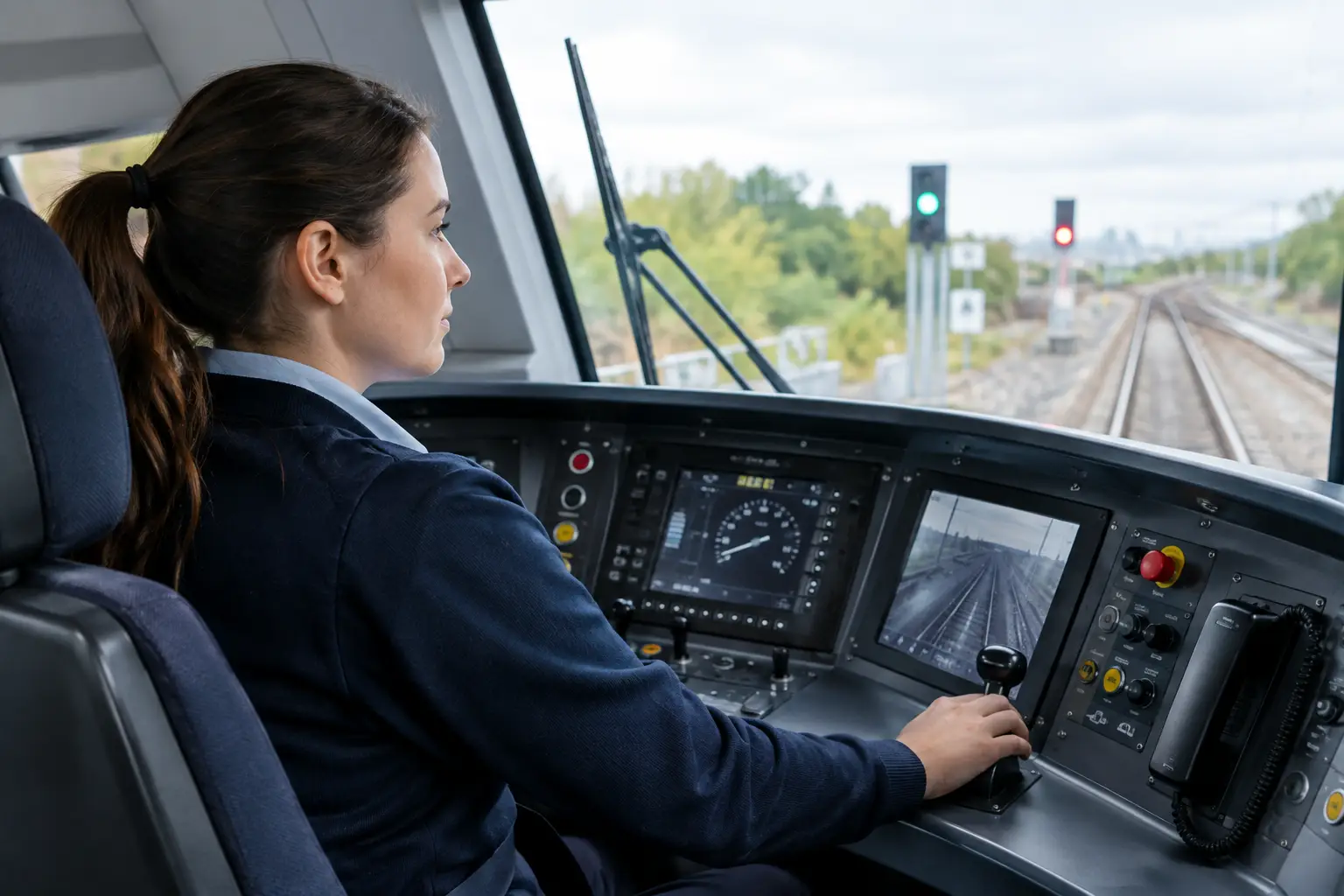
Train drivers work in a tightly controlled operating environment, but it remains one where attention, perception and disciplined decision-making are essential. Signals are a clear example. A driver must be able to identify the aspect displayed and respond correctly, without hesitation or uncertainty.
Colour recognition can also be relevant to illuminated controls, warning indications and trackside information. Conditions are not always ideal. Light levels can change rapidly when entering or leaving tunnels, glare may be present, and a driver may need to process information during an abnormal or demanding situation. Medical standards are designed around dependable performance in those real working conditions, not simply whether a person can identify colours in a familiar setting.
This does not mean colour vision is assessed in isolation. A pre-employment railway medical commonly considers several areas relevant to safe work, such as distance vision, near vision, hearing, general health, medication, fatigue-related conditions and medical history. The exact assessment process can vary according to the employer and role.
What happens at a railway colour vision assessment?
If you progress through a trainee train driver recruitment process, a Train Operating Company will normally arrange the relevant medical assessment at the appropriate stage. The assessment is carried out by occupational health professionals, not by the recruitment manager or interview panel.
Colour vision may be checked using recognised clinical methods, often beginning with a plate-based test. Where a result needs further clarification, the clinician may use an additional approved assessment. The purpose is to establish whether your colour vision meets the standard required for the work, rather than to catch candidates out.
It is important to approach this stage openly. Declare relevant medical information accurately and answer questions honestly. Trying to conceal a known issue would be inappropriate in any role, but especially in a safety-critical career where trust, professional judgement and personal responsibility matter from the first application onwards.
A previous diagnosis of colour blindness does not allow an applicant to predict the final outcome with certainty. Equally, having never received a diagnosis does not guarantee a pass. The occupational health assessment is the point at which your suitability against the required standard is determined.
Check your position before investing heavily
If you already know that you have a colour vision deficiency, do not assume your train driver plans are over. Equally, do not spend months preparing for assessments while avoiding a question that may affect your eligibility.
Start by gathering accurate information about your own eyesight. An optometrist can discuss your colour vision and general eye health, although their advice is not a substitute for a railway occupational medical decision. If you are applying to a specific TOC, read the vacancy information carefully and ask the recruitment contact a clear, factual question about the role’s visual requirements and when medical screening takes place.
Keep the question professional. You do not need to provide a detailed personal medical history in an initial enquiry. It is reasonable to ask whether the role is subject to a colour vision standard and whether candidates with a known deficiency should seek guidance before applying.
This early step can help you plan realistically. If your assessment later shows that you do not meet the standard for train driving, it is better to know that clearly than to interpret it as a reflection on your capability or work ethic. Railway operations contains a broad range of careers, and each role has its own medical and functional requirements.
Do not rely on online colour tests
Online colour vision tests can be useful prompts to arrange an eye examination, but they cannot confirm fitness for train driving. Screen brightness, device calibration, ambient light and the test design itself can all affect what you see. A result may also be interpreted incorrectly without clinical context.
More importantly, attempting repeated online tests in the hope of improving a result is not useful preparation. Colour vision is not a psychometric skill that can be practised into a different outcome. The right approach is to understand your position, follow the employer’s process and focus your preparation on the areas you can develop properly.
For a trainee driver application, those areas typically include understanding the safety-critical nature of the role, presenting relevant evidence in your application, preparing for structured interviews and approaching psychometric assessments with disciplined, honest preparation. Medical fitness is one part of the selection process, but it should be addressed with the same maturity as every other part.
Colour vision, reasonable adjustments and safety standards
Candidates sometimes ask whether reasonable adjustments can remove a colour vision requirement. Adjustments are an important part of fair recruitment and may support candidates through elements of a selection process. However, they cannot remove an essential requirement where that requirement is necessary for safe performance of the role.
The relevant question is not whether a candidate is committed, intelligent or otherwise well suited to railway work. It is whether they can meet the defined functional standard for the safety-critical duties of the post. Employers must make decisions carefully and fairly, but they also carry a responsibility to passengers, colleagues and the wider railway.
If you need an adjustment during recruitment for a condition unrelated to colour vision, raise it early through the employer’s stated process. Be specific about the support you need and provide any requested evidence. This gives the recruitment team the best opportunity to consider your request appropriately without compromising assessment integrity or operational standards.
If train driving is not the right medical fit
A medical outcome that prevents entry to train driving can be disappointing, particularly after you have committed time to a career change. It is still useful information. A long-term railway career depends on finding a role in which you can meet the demands safely and confidently.
Consider related operational and support roles only after reviewing their individual requirements. Station operations, control, customer service, fleet support, planning and administration are not interchangeable jobs, and some may also have medical or competence criteria. Treat each opportunity on its own merits rather than assuming one railway role automatically leads to another.
Your transferable strengths may remain highly valuable: calm decision-making, rule compliance, communication, situational awareness and the ability to work reliably within procedures. These qualities matter across the industry, whether you are coming from the Armed Forces, logistics, transport or another operational background.
A train driver career demands more than motivation. It requires demonstrable readiness for a safety-critical environment, including the medical standards attached to the work. If colour vision is a concern, deal with it early, seek qualified advice and use the answer to make a well-informed next move in your railway career planning.