



A career change to train driver appeals to people for good reasons. It offers long-term structure, real responsibility and a role where standards matter. It also attracts many applicants who underestimate how competitive and specific the recruitment process can be. If you are serious about moving into train driving, it helps to treat the decision as a professional transition, not simply a job swap.
Why a career change to train driver attracts experienced adults
Many successful applicants do not come from rail. They come from the Armed Forces, logistics, emergency response, customer operations, engineering, manufacturing and transport. What they often share is not previous train driving experience, but a proven record of discipline, situational awareness, rule-following and consistent performance under pressure.
That matters because train driving is a safety-critical profession. Employers are not just filling vacancies. They are assessing whether a candidate can work to procedure, remain composed over long periods, manage routine without complacency and make sound decisions when conditions change. For career changers, this is often encouraging. It means your previous role may be more relevant than you think, provided you can explain that relevance clearly.
The appeal is also practical. Many adults looking for a second or third career want stability, a respected role and a clear long-term direction. Train driving can offer that, but the route in is structured and demanding. A strong work history helps, yet it will not replace preparation.
What employers actually look for
A common mistake is assuming that enthusiasm for trains is enough. Interest in the railway can support motivation, but recruitment decisions are based on suitability for a safety-critical operational role.
Train Operating Companies typically look for evidence of concentration, responsibility, rule compliance, operational awareness and professional maturity. They also want to see that you understand the reality of the job. That includes irregular hours, solo working, route learning, sustained concentration and accountability for safety.
For career changers, the strongest applications usually connect past experience to those requirements in a specific way. Someone from the military may demonstrate procedure, composure and safety culture. A bus or coach professional may evidence customer responsibility, shift work and operational discipline. A candidate from manufacturing might show process adherence, hazard awareness and consistency. The key is not your job title. It is whether you can show behaviours that transfer well into train driving.
The recruitment process is not casual
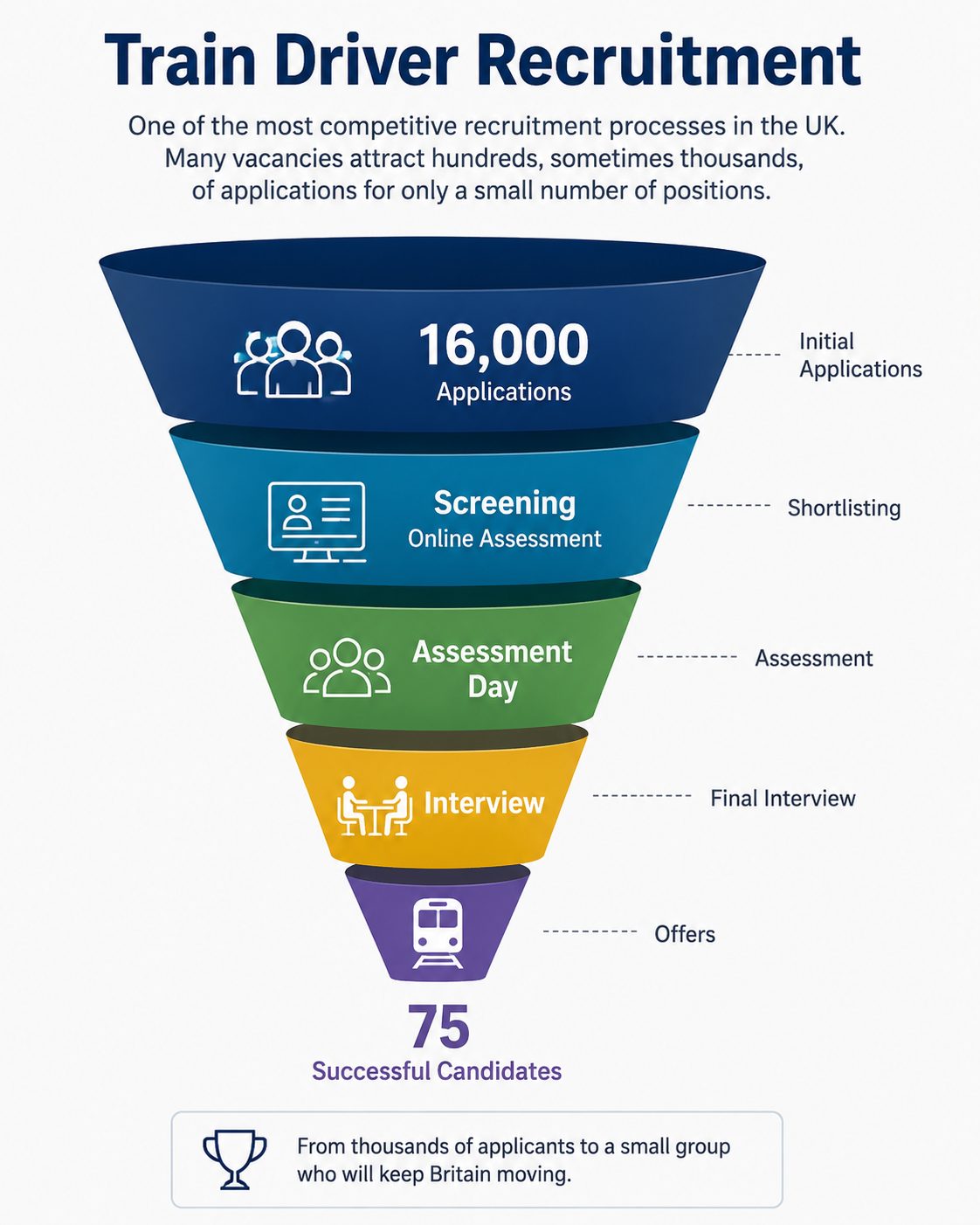
If you are considering a career change to train driver, you should expect a multi-stage recruitment process rather than a standard interview and offer. While exact stages vary, most campaigns involve an application review, structured assessment activity and formal interviews focused on behaviour, judgement and motivation.
This catches many first-time applicants out. They submit a generic CV, answer competency questions vaguely and then wonder why they do not progress. In train driver recruitment, weak preparation is easy to spot. Employers want concise, relevant examples and a clear understanding of the role.
Psychometric assessments are another point where career changers can struggle if they approach them casually. These assessments are used because the role demands concentration, attention control and the ability to process information accurately. Preparation should focus on understanding the assessment environment, practising appropriately and improving familiarity with timed conditions. It should never be treated as a shortcut or a way around standards.
Structured interviews are equally important. You may be asked to give evidence of following rules, handling pressure, staying alert during routine work, dealing with setbacks or communicating professionally in operational situations. Strong answers are specific, measured and relevant. Weak answers drift into opinion, general enthusiasm or unsupported claims.
Your current experience may be stronger than your CV suggests
One of the biggest barriers in a career change is translation. People often have suitable experience but present it in a way that sounds too broad or too informal. A train driver application needs a different standard of clarity.
If your CV says you are hardworking, reliable and good with people, that tells an employer very little. If it shows that you worked rotating shifts, followed strict procedures, managed safety responsibilities, remained calm during service disruption and maintained standards without direct supervision, it becomes far more relevant.
This is where career changers benefit from slowing down and auditing their own experience properly. Think less about your duties and more about the behaviours behind them. Did you work in a regulated environment? Did errors carry consequences? Were you expected to maintain concentration for long periods? Did you make decisions based on procedure rather than guesswork? Those are the details that help employers assess train driver potential.
What the role is really like
It is worth being honest here. Train driving is appealing, but it is not suited to everyone. The role can be highly rewarding, yet the same features that attract one person may frustrate another.
There is a strong element of routine, repetition and self-management. You may spend long periods working alone. Start times can be very early, finishes can be late, and rosters can affect social patterns. Concentration cannot drop because the task feels familiar. In fact, familiarity creates its own risk if it leads to complacency.
For some career changers, that structure is a major positive. People leaving chaotic workplaces often value clear standards, predictable rules and a direct link between competence and trust. Others miss the variety or constant interaction of their previous role. This is why a realistic understanding matters before you apply.
How to prepare properly for a career change to train driver
Preparation starts well before any vacancy appears. The strongest candidates usually build readiness in stages rather than rushing once an advert opens.
Begin with eligibility and role understanding. Make sure you meet the basic requirements for the opportunities you are targeting and that you understand what trainee train driver recruitment involves. Then review your CV and application approach. Generic career documents rarely perform well in this sector.
Next, focus on assessment readiness. That includes becoming familiar with timed testing conditions, practising concentration-based tasks appropriately and improving your confidence under pressure. Interview preparation should run alongside this. You need evidence-based examples from your own work history, organised in a way that answers structured questions clearly.
There is also value in role-specific learning. Early CPD in areas such as operational thinking, risk-based decision making and professional standards can help career changers understand the mindset expected in rail. It will not replace recruitment standards, but it can improve the quality of your application and interview performance by giving you stronger operational language and context.
Patience matters more than speed
Many candidates want a quick move, especially if they are leaving an unstable or unsatisfying role. That is understandable, but train driver recruitment rarely rewards impatience. Campaigns can be spaced out, selection processes can take time and rejection does not always mean you are unsuitable long term.
Sometimes the issue is timing. Sometimes it is location. Sometimes a candidate has potential but has not yet learned how to present it. Treating the process professionally means accepting that progress may come through steady improvement rather than immediate success.
That is often where specialist preparation becomes useful. Focused support can help you identify weak points in your CV, interview structure or assessment readiness before they cost you opportunities. For many career changers, that level of structure turns an overwhelming process into a manageable one.
Is train driving the right career change for you?
The honest answer is that it depends on what you want from your next role. If you are looking for a profession built on safety, responsibility, standards and long-term development, train driving may be a strong fit. If you prefer constant variety, informal working practices or loosely defined expectations, it may feel restrictive.
The best career changers into rail are usually those who respect the seriousness of the role from the start. They do not assume previous experience guarantees success, but they also do not dismiss the value of what they already bring. They prepare methodically, learn the recruitment process and present themselves as people ready for a safety-critical environment.
That is the right mindset to carry forward. A move into train driving is not about reinventing yourself overnight. It is about proving, with evidence and preparation, that your experience, judgement and professional habits are suited to the demands of the role.