



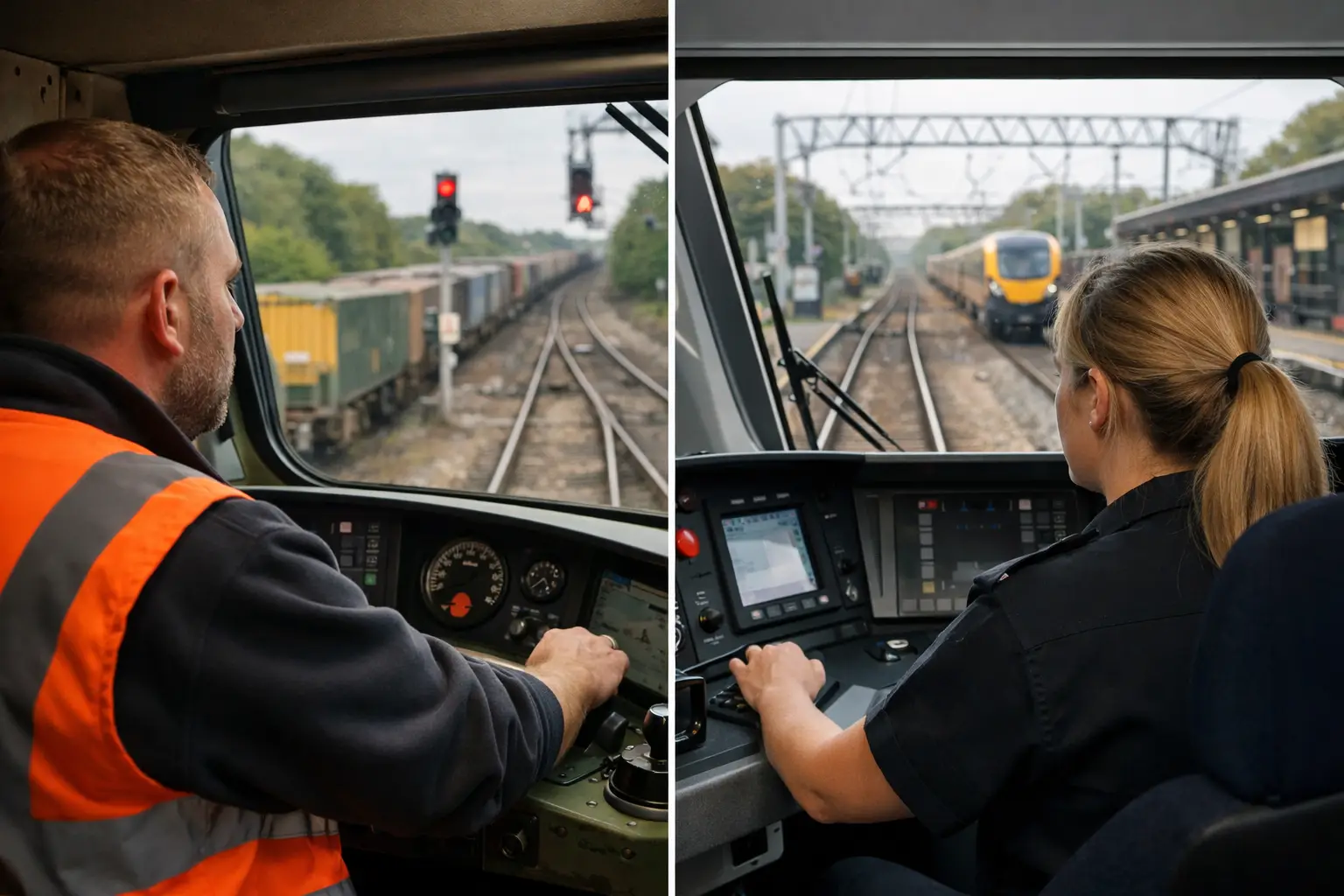
A freight driver versus passenger driver comparison is not simply a choice between moving goods or carrying people. Both are safety-critical train driving roles requiring concentration, rule compliance, sound judgement and the ability to work independently. The day-to-day purpose of the service, the operating environment and the demands of the roster can, however, feel very different.
For candidates considering a long-term railway career, the right question is not which role is easier. Neither is. It is which operating environment suits your strengths, lifestyle and professional motivations.
What Both Train Driving Roles Have in Common
Whether working for a passenger Train Operating Company (TOC) or a freight operator, drivers carry significant responsibility. They must prepare correctly, remain alert for the full duration of a shift, respond calmly to changing conditions and apply instructions consistently. A lapse in attention can have serious consequences, which is why recruitment standards are demanding.
Both roles also involve unsocial hours. Early starts, nights, weekends and public holidays are normal parts of railway rostering. Applicants need to show that they understand this before applying, rather than viewing shift work as a minor detail.
The selection process commonly assesses the qualities that support safe performance: concentration, vigilance, rule adherence, communication, risk awareness and the ability to make measured decisions under pressure. Psychometric tests and structured interviews are designed to examine these behaviours fairly and consistently. Preparation should help you understand the required standard and evidence your suitability honestly, not look for shortcuts.
Freight Driver Versus Passenger Driver: The Core Difference
The clearest difference is the service being operated. Passenger drivers run trains to a public timetable, usually with regular station calls and a direct impact on customers' journeys. Freight drivers move commodities, containers, construction materials and other goods across the network, often over longer distances and at different times of day.
That difference affects the rhythm of the work. Passenger operation can involve frequent stopping, busy station approaches, intensive route knowledge and the pressure of maintaining a reliable service where small delays are visible to thousands of people. Freight work may involve fewer stops on some services, but it brings its own operational demands, including heavier trains, varying train formations, access to terminals and close attention to the conditions affecting a load.
Neither role should be viewed as more or less professional. They are different applications of the same safety-first discipline.
Passenger driving and the public timetable
A passenger driver is part of the customer experience, even though most communication with passengers is handled by station teams, onboard colleagues and control. A punctual, smooth and safe journey matters to people travelling to work, appointments, education and family commitments.
Passenger routes can be highly repetitive, particularly on commuter or regional diagrams. That repetition is not a reason to relax. It requires sustained concentration: recognising signals, observing speed restrictions, managing stopping patterns and maintaining awareness in a familiar environment. In safety-critical work, familiarity can be a risk if it leads to assumptions.
Disruption can also be highly visible. A signalling issue, congestion or adverse weather may quickly affect several services. Drivers must remain composed, communicate through the proper channels and focus on the safe operation of their own train rather than becoming distracted by the wider pressure of delay.
Freight driving and operational variety
Freight driving can offer a different pattern of work. Services may operate overnight, travel across wider geographical areas or run between ports, terminals, depots, quarries and distribution sites. The work can involve a broader mix of traction and operating locations, depending on the company and depot.
Train characteristics matter greatly. A freight train's length, weight and load can affect how it handles, how it is driven and the operational considerations around the journey. Drivers need a disciplined understanding of the equipment they operate and must work within the applicable rules, instructions and restrictions.
There can be periods where a freight driver works with less public-facing activity and more terminal or depot interaction. That does not mean less communication. Clear, accurate exchanges with signallers, controllers, ground staff and operational colleagues remain essential. The setting may be quieter than a busy station, but the standard of attention cannot drop.
Rosters, Lifestyle and Location
For many applicants, the practical difference between freight and passenger work comes down to the depot rather than the job title. Two passenger depots can have very different diagrams, just as two freight depots can have different route coverage, start times and rest-day patterns.
Passenger services often have a strong peak-time focus. This can mean very early starts, late finishes and work built around commuter demand. Some roles may offer regular route patterns, while others involve a wider spread of services. Freight operations commonly make significant use of nights because goods can move when parts of the network are less busy, although this varies by operator, commodity and location.
Before applying, consider the commute as seriously as the role. Train driver recruitment is often depot-specific, and reliable attendance is fundamental. A career that appears attractive on paper may become difficult to sustain if the journey to sign on is long, expensive or unreliable at unsocial hours.
Ask yourself practical questions. Can you consistently manage sleep around changing shifts? Does your household understand that weekends and holidays may be working days? Are you comfortable travelling independently to a depot before public transport is running? Honest answers are more valuable than choosing a role based on assumptions about pay, prestige or perceived ease.
Recruitment: Similar Standards, Different Evidence
Freight and passenger employers both need people who can perform safely in a tightly controlled operational environment. Vacancies may use different wording, but strong applications normally demonstrate responsibility, procedural discipline, independent working and mature decision-making.
Your previous industry does not have to be rail. Candidates from the Armed Forces, logistics, emergency services, manufacturing, aviation, driving, engineering and customer-facing operations may have relevant examples. The key is to explain those examples in a way that shows what you did, why the risk mattered, how you followed process and what result you achieved.
For a passenger driver application, useful evidence might include maintaining focus during repetitive tasks, managing competing priorities without losing standards, or communicating calmly when customers are affected by disruption. For freight, evidence of working alone, adhering to strict controls, managing equipment responsibly or recognising the consequences of poor load or vehicle checks may be particularly relevant.
Do not force your experience into a script. Structured interviews are more convincing when examples are specific, truthful and clearly linked to the behaviour being assessed. Good preparation means reviewing your work history, identifying credible safety and responsibility examples, and practising how to explain them in a logical order.
What assessment preparation should focus on
Psychometric assessments are not a test of railway knowledge alone. They examine underlying abilities and behaviours relevant to safe work, such as maintaining attention, processing information accurately and applying instructions. The format can feel unfamiliar, especially for career changers who have not sat formal assessments for many years.
The sensible approach is to practise under realistic conditions, understand the instructions carefully and develop consistency. Sleep, timekeeping and a calm routine on assessment day also matter. Trying to rush, second-guess every answer or present a version of yourself that does not match your normal working style is rarely helpful.
CPD learning can strengthen your understanding of operational thinking, risk-based decision making and railway working environments. It will not replace an employer's assessment process, but it can help you speak more confidently about why safety-critical standards exist and how you would contribute to them.
Which Role Is the Better Fit?
Choose passenger driving if you are motivated by delivering a dependable public service, can remain composed in a busy timetable environment and are comfortable with the responsibility that comes from carrying large numbers of people. Choose freight driving if you are drawn to logistics, varied operational locations, overnight work or the technical and planning considerations of moving goods.
There is also room for uncertainty. You may be well suited to both, and vacancy availability may influence your first opportunity. Applying only to one type of operator can unnecessarily narrow your options, particularly if you are willing to travel or relocate for the right depot. Equally, there is no value in applying widely to roles whose roster or location you could not realistically sustain.
Train Driver Foundation encourages candidates to treat each vacancy as a professional decision. Read the person specification closely, check the depot location, assess your evidence against the required behaviours and prepare for the process with care.
A rewarding railway career is built on more than choosing freight or passenger work. It starts with knowing the environment in which you can stay alert, dependable and committed shift after shift.