



Competition for trainee train driver roles is strong, and most applicants do not fall short because they lack interest. They fall short because they underestimate the process. This guide to train driver application stages explains what typically happens from first application to final offer, and where preparation makes the biggest difference.
While each Train Operating Company can structure recruitment slightly differently, the core pattern is usually the same. You will be assessed not only on motivation, but also on your suitability for a safety-critical role that demands concentration, rule compliance, situational awareness and consistent professional behaviour. That means every stage matters.
Guide to train driver application stages: what to expect
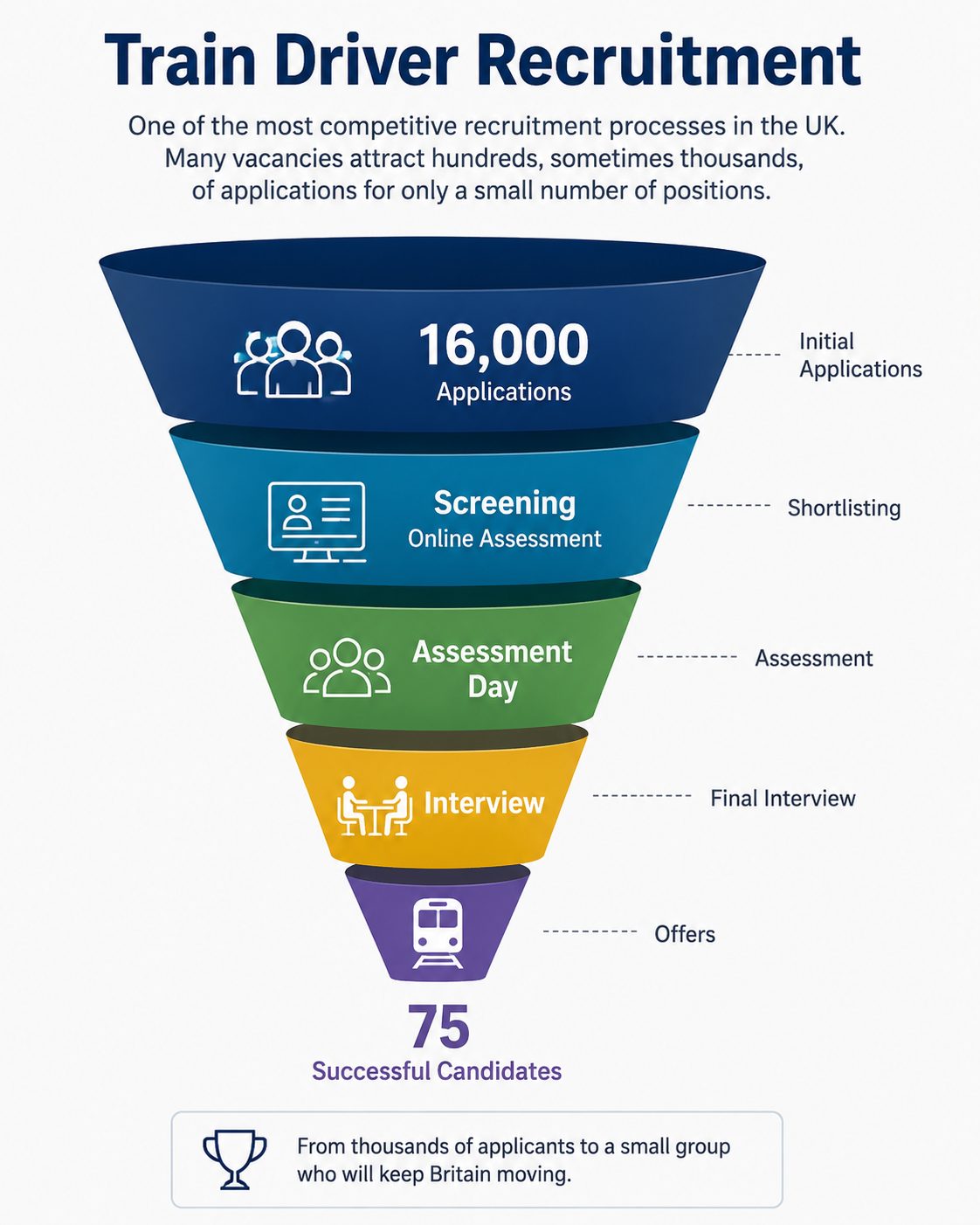
A trainee train driver application is rarely a single interview followed by a decision. More often, it is a sequence of screening steps designed to reduce a large applicant field and identify people who can meet a very specific operational standard.
The stages usually begin with eligibility and application review, then move into online assessments or psychometric testing, structured interviews, medical checks and background screening. In some campaigns, there may also be a manager interview, assessment centre activity or talent pool period before an offer is made.
The exact order depends on the employer. Some assess first and interview later. Others complete an initial interview before inviting candidates to formal testing. The principle, however, stays the same: each stage is there to check whether you can perform reliably in a disciplined railway environment.
Stage 1: Eligibility and vacancy matching
Before writing a CV or preparing interview examples, it is worth checking the basics carefully. Many applicants are rejected early because they have not matched themselves properly to the vacancy.
A trainee train driver role may include requirements around minimum age, right to work, location, travel distance to depot, shift flexibility, previous employment history and the ability to meet medical standards for a safety-critical post. Some employers also look closely at whether you can realistically commute for very early starts, late finishes and weekend working.
This stage sounds straightforward, but it has consequences. If you apply casually to every advert without checking depot location or shift practicality, that lack of judgement can undermine your application before it has properly started. Strong candidates show that they understand the reality of the role, not just the appeal of it.
Stage 2: The application form and CV screen
At this point, your written application needs to do two things. First, it must show that you meet the stated criteria. Second, it must present your experience in a way that is relevant to train driving rather than generic employment history.
This is where many people undersell themselves. A background in transport, the forces, logistics, emergency response, engineering, customer operations or other regulated environments can be highly relevant - but only if you explain it properly. Recruiters are not simply looking for job titles. They are looking for evidence of concentration, responsibility, procedure following, hazard awareness, communication discipline and the ability to work calmly under pressure.
A good application is specific. Instead of saying you are a hard worker, show where you followed rules precisely, handled fatigue responsibly, made safe decisions, managed distractions or maintained performance in routine but high-stakes conditions. Train driving involves long periods of disciplined focus, so examples of consistency often carry more value than dramatic stories.
Stage 3: Online assessments and psychometric testing
For many candidates, this is the stage that feels most unfamiliar. Psychometric assessments are used because train driving requires underlying cognitive and behavioural qualities that cannot be judged from a CV alone.
Tests may assess concentration, vigilance, memory, attention control, rule adherence, reaction under pressure and the ability to process information accurately. Some employers also use questionnaires or assessment exercises to explore behavioural fit for a safety-critical environment.
Preparation matters, but it needs to be the right kind. You are not trying to game the process or memorise answers. What helps is understanding test formats, improving your familiarity with timed conditions and practising calm, accurate performance. Candidates who have never seen this type of assessment often waste time adjusting to the format rather than demonstrating their true ability.
It is also worth recognising the trade-off here. Over-practising in a frantic, unrealistic way can increase stress and lead to inconsistency. Productive preparation is structured and measured. It should build confidence with the demands of the assessment while keeping your focus on accuracy, discipline and composure.
Stage 4: The structured interview
If you progress to interview, you should expect more than a general conversation about why you want the job. A structured interview is usually designed to test whether your past behaviour shows the right fit for train driver standards.
You may be asked for examples of following rules, dealing with monotonous tasks, responding to pressure, challenging unsafe situations, maintaining standards without supervision or communicating clearly in difficult circumstances. Questions are often evidence-based, so broad statements will not carry much weight unless they are supported by real examples.
This is where candidates from outside rail sometimes worry that they are at a disadvantage. In practice, relevant experience can come from many sectors. What matters is how closely your example reflects the demands of a safety-critical role. A warehouse supervisor, bus driver, military team member or control room operator may all have useful evidence if they present it clearly and in the right operational context.
Good interview preparation is less about scripting and more about structuring. You need examples that are factual, concise and directly connected to the behaviours being assessed. Rambling answers, exaggerated claims or vague language can weaken otherwise solid experience.
Stage 5: Manager interview or final selection stage
Some employers add a further interview with operational managers. This stage often looks at motivation, understanding of the role, depot fit and long-term suitability.
You may be asked why train driving appeals to you specifically, what you understand about shift work, how you manage routine, and why you believe you are suited to an environment where standards must be maintained every day, not only when things become difficult. This is also a stage where maturity matters. Recruiters are looking for grounded commitment, not romantic ideas about the railway.
A common mistake here is focusing too heavily on salary, job security or the status of the role. Those factors may be part of your motivation, but they should not be the centre of it. Stronger answers show respect for the responsibility of carrying passengers safely, working within rules and developing into a dependable operator.
Stage 6: Medical, background checks and final clearances
A conditional offer is not always the end of the process. Safety-critical recruitment usually includes medical screening and employment checks before a start date is confirmed.
Medical standards may cover vision, colour vision, hearing and general fitness to undertake the role safely. There may also be checks on employment history, references and other compliance requirements. This stage is not there to catch people out unfairly. It is part of ensuring that operational standards are upheld consistently.
The practical point is simple: be accurate throughout your application. If dates, qualifications or work history are unclear or inconsistent, delays can follow even where your performance in earlier stages has been strong.
When the process pauses: talent pools and waiting periods
One part of the guide to train driver application stages that often surprises applicants is the waiting period after a successful assessment process. In some cases, candidates are placed into a talent pool rather than given an immediate start date.
This can be frustrating, but it does not necessarily reflect a problem with your performance. Training capacity, depot demand and internal workforce planning all affect timing. It is one of the reasons train driver recruitment requires patience as well as preparation.
If you reach this point, maintain professionalism. Keep records, monitor communications and remain ready for next steps. Candidates who stay organised tend to manage the process better than those who switch off once an interview is over.
How to prepare for each stage properly
The most effective approach is to prepare in layers. Start with eligibility and depot realism. Then strengthen your CV and application evidence. After that, focus on assessment familiarity, interview examples and your understanding of the role itself.
This layered approach matters because weaknesses compound. A good interview cannot rescue an unfocused application, and strong motivation cannot replace the underlying standards needed for psychometric testing. Preparation should reflect the actual recruitment journey, not just the stage you happen to be thinking about today.
For many applicants, especially career changers, specialist support can help bring structure to that process. Used properly, it should sharpen your understanding, improve your presentation and help you prepare in line with rail expectations rather than generic job advice.
Train driver recruitment is demanding because the role is demanding. That is not a reason to be discouraged. It is a reason to approach each stage with clarity, professionalism and respect for what the job requires.