


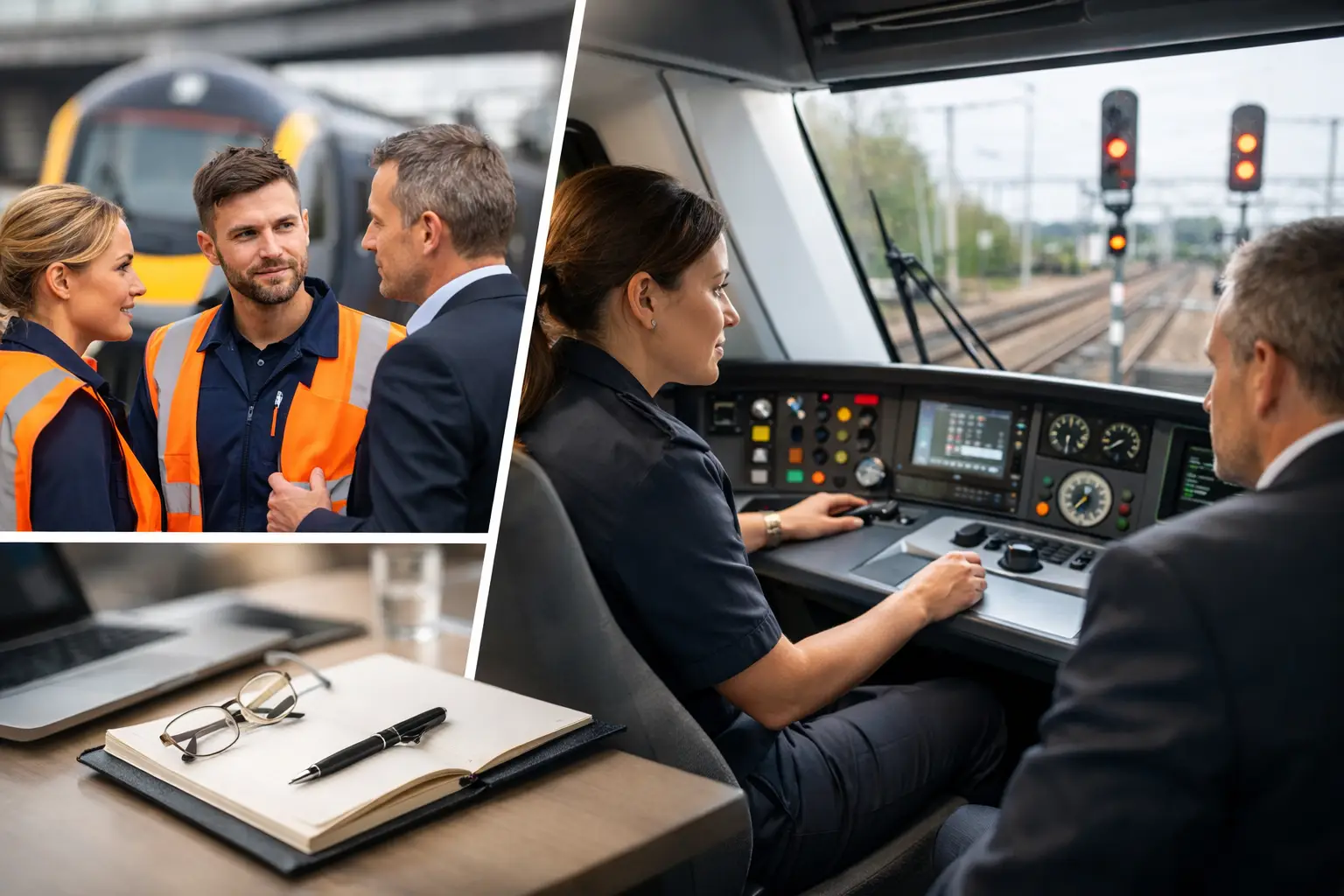
A manager interview is not simply a conversation about whether you like rail. It is a structured assessment of whether your past behaviour, judgement and working style indicate that you can develop into a dependable professional in a safety-critical role. This guide to train driver manager interview preparation will help you focus on the evidence that matters rather than relying on generic interview answers.
For many trainee train driver applicants, this stage follows a long period of eligibility checks, applications and assessments. That can make it tempting to treat the interview as the final hurdle. A better approach is to see it as an opportunity to demonstrate the same habits the role requires: preparation, concentration, calm communication and respect for rules.
What a train driver manager interview is assessing
The exact format varies between Train Operating Companies (TOCs), and recruitment campaigns can differ. Some interviews are led by a driver manager, while others involve more than one interviewer or form part of a wider assessment day. Questions may be competency-based, strength-based or a mixture of both.
Whatever the format, the underlying themes tend to remain consistent. Interviewers need to understand how you behave when responsibility is high, information is incomplete, plans change or pressure builds. They are looking for credible examples, not a polished performance or a list of railway phrases.
A trainee driver has to learn technical knowledge and route-specific competence, but the starting point is personal suitability. Your interview should show that you can follow procedure, maintain attention, communicate clearly, work independently and raise concerns appropriately. It should also show that you understand the job involves disciplined routine, irregular hours and sustained concentration, not just driving a train.
The evidence behind a strong answer
Strong candidates do not try to force every answer towards rail. They use relevant experience from their own working life and explain it precisely. Military service, logistics, emergency services, manufacturing, customer operations, driving, engineering and supervisory roles can all provide useful evidence. So can less obvious roles, provided the example demonstrates sound judgement.
Choose examples where the consequences mattered. A story about arriving late to a meeting rarely proves as much as an occasion when you identified a risk, followed a process under time pressure, challenged an unsafe decision or managed an unexpected disruption without losing focus.
Use the STAR structure to keep your response clear:
- Situation - briefly set out the context and why it mattered.
- Task - explain your responsibility, not only what the team needed to achieve.
- Action - describe exactly what you did, in sequence, and why.
- Result - give the outcome and, where relevant, what you learned or changed afterwards.
The action section carries most of the value. Avoid saying, “we dealt with it” or “the team made sure it was safe”. The interviewer needs to hear your individual contribution. If you checked information, stopped work, escalated a concern, used a checklist, briefed a colleague or recorded an issue, say so directly.
Keep safety practical, not rehearsed
Safety is likely to feature throughout the interview, but broad statements such as “safety is my top priority” do not prove much on their own. Make safety visible through your decisions.
For example, you might describe noticing an equipment issue before starting a task, isolating the immediate risk, informing the appropriate person and following the required reporting process. The point is not to make your example dramatic. It is to demonstrate that you do not ignore uncertainty, take informal shortcuts or assume somebody else will act.
Good safety evidence usually includes three elements: you recognised the risk, acted within your responsibility and communicated or escalated appropriately. It also shows proportion. Stopping a task may be the correct decision, but explain how you maintained control and followed the relevant process rather than presenting yourself as someone who reacts impulsively.
Questions you should expect to prepare for
You cannot predict the wording, and memorising scripts can make answers sound rigid. You can, however, prepare for the themes. Expect questions about working alone, staying alert during repetitive work, following rules, responding to a mistake, dealing with conflict, receiving feedback, managing fatigue and adapting when a plan changes.
You may also be asked why you want to become a train driver. This is not an invitation to focus solely on pay, job security or a childhood interest in trains. Those factors may be part of your motivation, but they should not be the centre of your answer. Explain why the operational demands suit you: personal accountability, structured standards, concentration, safety responsibility and a long-term commitment to learning.
A useful answer connects your understanding of the role to demonstrated behaviour. For instance, if you value working independently, support that with an example of managing a responsible task without close supervision while knowing when to seek guidance. If you mention routine, explain how you maintain standards when work becomes familiar rather than assuming familiarity reduces risk.
Prepare for questions about errors and feedback
Many applicants worry that admitting an error will harm their chances. In a safety-critical interview, a claim that you have never made a mistake can sound unrealistic. What matters is whether you recognised it, took responsibility, addressed the immediate issue and changed your approach.
Choose an example that is genuine but appropriate. Do not select a situation involving serious misconduct, and do not try to minimise your part in what happened. Explain the lesson without becoming defensive. A considered answer might show that you introduced a personal check, improved your planning or asked for feedback after identifying a gap in your knowledge.
The same principle applies to feedback. Driver managers need trainees who can accept coaching, reflect on it and apply it consistently. Describe a time when feedback was difficult but useful, then make the improvement clear. This demonstrates maturity and trainability.
How to prepare for a train driver manager interview
Start by studying the job description and candidate information supplied for the vacancy. Pull out the behaviours it signals, such as safety awareness, customer focus, communication, resilience or working to rules. Then match each theme to one or two real examples from your experience.
Build an evidence bank rather than writing full scripts. For each example, note the context, your actions, the outcome and what it proves. Aim for examples across different settings so you are not trying to use one story for every question. Repeating the same answer can suggest a narrow range of experience, even when the example itself is strong.
Practise speaking your answers aloud. Reading notes silently is useful at first, but it does not reveal where an answer is vague, overly long or difficult to follow. Record yourself or practise with someone who will ask follow-up questions. A structured interview often probes beyond the first response: “What did you do next?”, “Why did you make that decision?” or “What would you do differently?”
Research the TOC sufficiently to show genuine interest, including its services, operating area and stated values where relevant. Keep this research factual. You are not expected to recite company history, but you should be able to explain why the particular opportunity appeals to you and how you would represent the organisation professionally.
Train Driver Foundation’s interview preparation approach is built around this kind of role-specific evidence: understanding what is being assessed, selecting suitable examples and communicating them with clarity.
On the day: show operational readiness
Plan the practical details carefully. Confirm the location or online meeting arrangements, travel time, identification requirements and interview time well in advance. Arriving rushed can affect concentration before the first question has been asked.
Dress professionally and keep your communication measured. Listen fully before answering. If a question is unclear, ask for it to be repeated or clarified rather than guessing. Take a brief pause to organise your thoughts when needed. This is preferable to filling the silence with an unfocused answer.
Be honest about your experience. Do not claim knowledge you do not have, and do not use technical terminology simply to sound railway-aware. Interviewers are assessing your potential to train, not expecting you to perform as a qualified driver. A calm, accurate answer is stronger than an exaggerated one.
At the end, ask thoughtful questions if invited. You could ask about the trainee development pathway, the expectations during initial training or the support available as you progress. Avoid questions whose answers were clearly provided in the recruitment material.
Your aim is not to deliver a flawless speech. It is to leave the interviewer with confidence that you understand the responsibility of the role, can learn within a structured environment and will make sound decisions when standards matter. Prepare your evidence carefully, speak from real experience and let your judgement show through each answer.