




A rail application form is not a shorter version of your CV. For trainee train driver and other safety-critical roles, it is often the first structured test of how clearly you communicate, how carefully you follow instructions and whether your experience shows the right operational behaviours. If you are asking how to improve a rail application form, start by treating every answer as evidence - not an opportunity to make a broad claim about yourself.
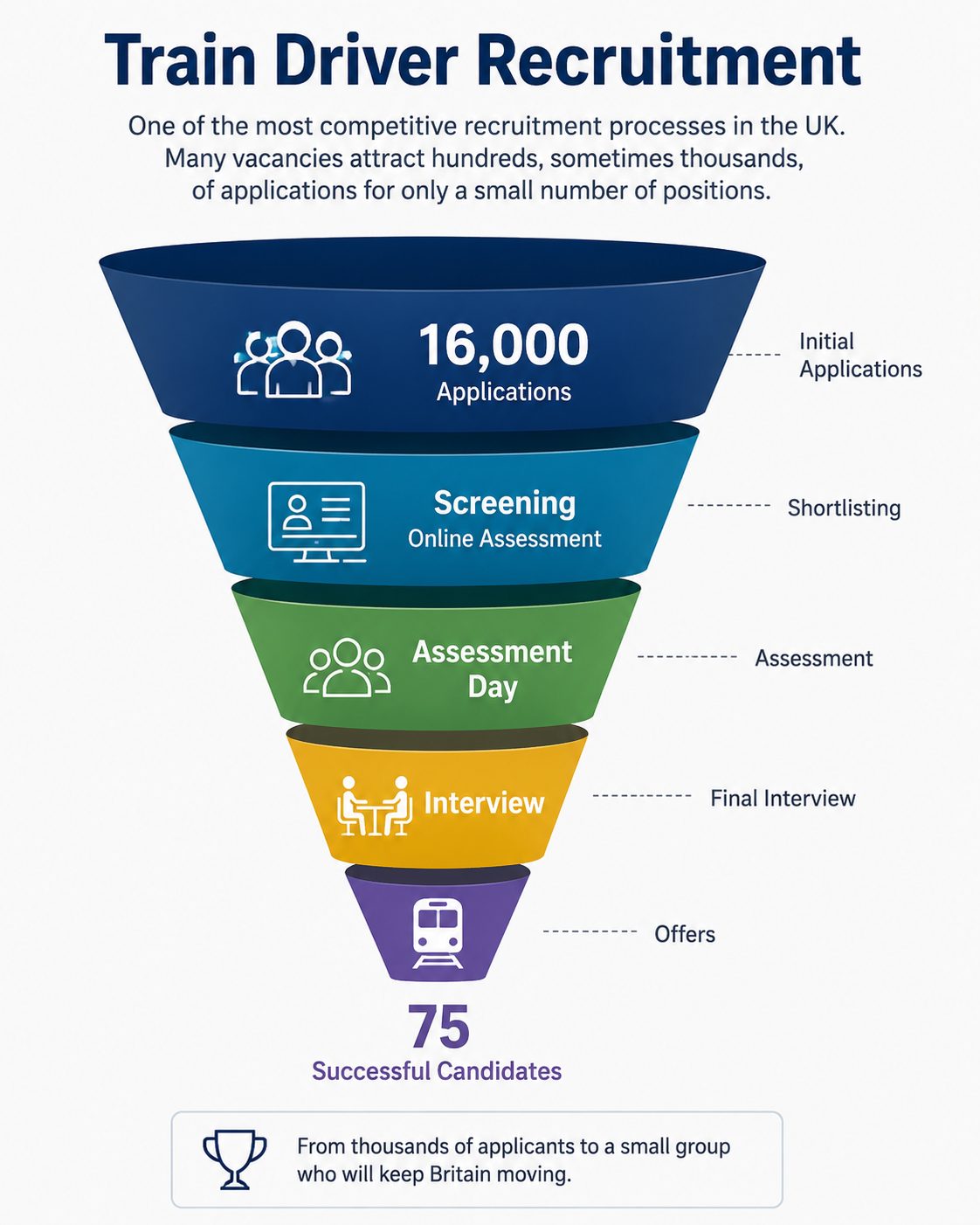
Recruitment teams may receive a high volume of applications for a limited number of positions. A well-presented form helps them identify candidates who meet the essential requirements and can demonstrate a measured approach to safety, rules, responsibility and customer service. The strongest applications are specific, honest and easy to assess.
Start with the vacancy requirements
Before drafting an answer, read the job advert, candidate information and application questions more than once. Train Operating Companies (TOCs) do not all use identical wording or selection processes, but trainee driver vacancies commonly look for evidence of safety awareness, concentration, working to procedures, reliability, independent working and effective communication.
Highlight the requirements that appear repeatedly. Then match each one to a genuine example from your employment, military service, education, volunteering or other responsible commitments. Do not assume rail experience is required to demonstrate rail-relevant behaviours. A warehouse operative who followed loading controls, a bus driver managing passenger safety, a member of the Armed Forces working within a clear command structure, or an office worker handling sensitive records may all have useful evidence.
The key is relevance. Saying that you are a “hard worker” gives the assessor little to score. Explaining how you completed a time-critical task while following a defined checking process gives them something meaningful to assess.
Use evidence, not generic statements
An application form is stronger when each answer explains what you did, why it mattered and what the outcome was. A simple structure can help: describe the situation briefly, explain your responsibility, set out the actions you took and state the result.
For example, consider the difference between these two approaches:
“I am safety conscious and always follow rules.”
“While working in a busy operational environment, I was responsible for completing pre-use checks before equipment could be issued. When a defect was identified, I removed the item from service, reported it through the required process and updated the handover record. This prevented unsuitable equipment being used and ensured the next team had accurate information.”
The second answer does not rely on a label. It shows safety awareness, procedure compliance, reporting discipline and communication. It is also credible because it includes a clear action and consequence.
Avoid inventing dramatic examples. Most strong evidence comes from routine professionalism: noticing an error, checking information before acting, escalating a concern, managing a difficult interaction calmly, arriving prepared, or maintaining standards during a busy shift. In safety-critical recruitment, consistency is often more valuable than a dramatic story.
How to improve a rail application form question by question
Many applicants write their form in one sitting and submit it immediately. That approach can lead to repeated examples, vague answers and missed instructions. Work through one question at a time, choosing the best evidence for that specific competency.
Safety and rule compliance
Safety should be reflected through your actions rather than repeated as a slogan. Explain how you followed a process, checked work, reported a hazard or stopped to seek clarification when something was unclear. If a previous role involved formal procedures, refer to them in plain language without including confidential details.
It is useful to show judgement here. Following a process matters, but so does recognising when a situation falls outside normal conditions. An appropriate example might show that you paused work, informed the correct person and recorded the issue rather than making assumptions.
Concentration and sustained performance
Train driving requires the ability to maintain attention over extended periods, including during routine activity. You may have relevant experience from driving, monitoring equipment, quality checking, control-room work, security, logistics, healthcare or administrative roles requiring accuracy.
Describe the methods you used to maintain standards. This could include following a set sequence, completing checks at defined points, managing distractions appropriately or reviewing information before confirming it. Do not claim perfect concentration. Instead, demonstrate practical habits that support accurate work.
Working independently and taking responsibility
A trainee train driver must be dependable, prepared and able to make sound decisions within their level of responsibility. Good examples show that you could organise your workload, prioritise correctly and seek support at the right time.
Independence does not mean working in isolation or refusing help. In a professional operational setting, knowing when to escalate an issue is a strength. Your answer should make clear that you understand the boundary between routine responsibility and matters requiring guidance or authorisation.
Communication and customer focus
Even where a role is operational, communication remains central. Train drivers communicate with colleagues, follow formal instructions and may need to deal with passengers professionally when circumstances require it.
Use examples that show calm, clear and respectful communication. If you have dealt with a complaint, disruption, a vulnerable person or conflicting priorities, focus on how you listened, explained the next steps and kept within the correct process. Do not present customer service as simply being friendly. In rail, it also means being reliable, accurate and professional.
Make your work history easy to verify
Accuracy matters throughout the form. Enter job titles, dates, qualifications and employment history carefully. Check for gaps or overlaps, and explain them openly where the form allows. A career break, redundancy, caring responsibility or period of study is not automatically a problem, but unexplained information can raise questions.
Use the job title you actually held, while adding a short clarification if it helps an assessor understand your responsibilities. For example, an internal title may mean little outside your employer, whereas a concise description can show the operational context of the role.
Take particular care with attendance, disciplinary, medical and legal declarations. Answer every question truthfully and read the wording closely. Trying to second-guess what an employer wants to hear is far more risky than providing an accurate response. Recruitment requirements differ, and any relevant matter should be considered through the TOC’s stated process.
Write for the assessor, not for yourself
An assessor should not have to infer why your experience matters. Make the connection clear. If an example demonstrates timekeeping, say how you planned travel, prepared for shifts and maintained reliable attendance. If it demonstrates procedure compliance, name the checking, reporting or handover step you followed.
That does not mean forcing railway terminology into every answer. Generic phrases such as “I have a strong safety culture” can sound rehearsed if they are not backed up by evidence. Use language you can explain confidently at a later structured interview.
Keep sentences direct. Long paragraphs packed with background detail can bury the important point. Give enough context to make the situation understandable, then spend most of the answer on your decisions and actions. Where word limits apply, draft your answer first, reduce repetition, and check that the core evidence remains intact.
Check consistency before submission
Your application, CV and any later interview answers should tell the same professional story. Dates, responsibilities and qualifications need to align. This does not mean repeating identical wording, but it does mean that an assessor should see a consistent record of your experience and development.
Before submitting, read the completed form slowly from beginning to end. Check spelling, grammar, capital letters, dates and contact details. British English matters, but clarity matters more. If possible, leave the form for a few hours or overnight, then review it again with fresh attention.
Use this final check to ask four practical questions:
- Have I answered the question that was actually asked?
- Have I used a genuine example with a clear action and result?
- Have I shown the behaviour rather than merely claimed it?
- Could I discuss this answer honestly and confidently at interview?
A specialist rail-focused review can also be useful where you are unsure whether your existing experience is being translated clearly into the requirements of a safety-critical role. The aim is not to manufacture a better story, but to present your real evidence with greater precision.
A strong form will not remove the competition from trainee train driver recruitment, nor should it attempt to. What it can do is give your application a fair, professional foundation: clear evidence, accurate information and a credible demonstration that you understand the responsibility of the role.