

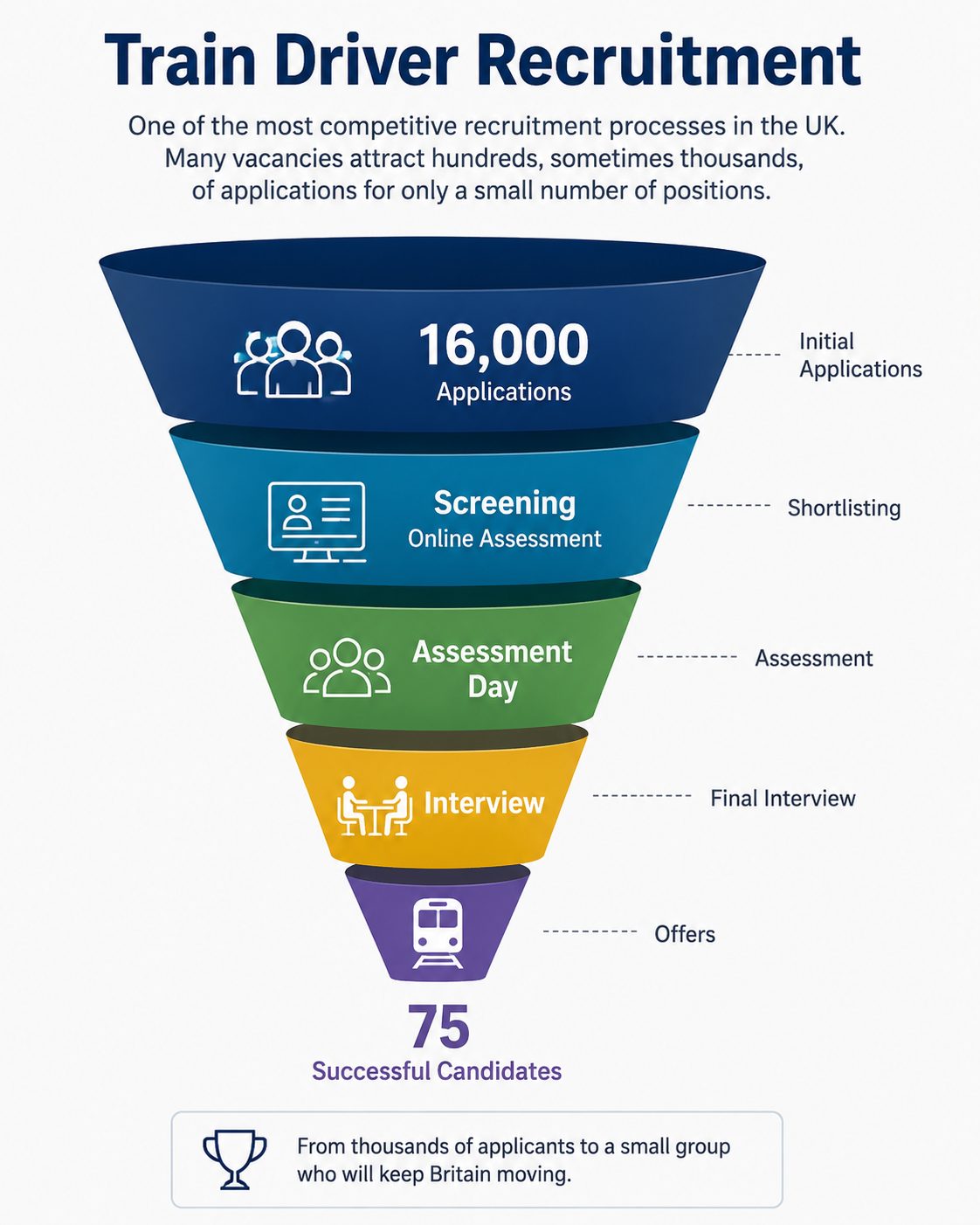




The assessment centre is often the point where capable candidates are separated from prepared candidates. Many people applying for trainee train driver roles have the right motivation and a solid work history, but they arrive at this stage without a clear plan for what they will be asked to do, how they will be observed, or what standards they are being measured against. If you are asking how to prepare assessment centre stages properly, the answer is not to rehearse stock answers. It is to prepare in a way that reflects the demands of a safety-critical role.
For train driver recruitment, the assessment centre is not just a test of confidence. It is designed to examine behaviours, concentration, rule-following, communication, attention to detail and your ability to perform consistently under structured conditions. That means your preparation needs to be disciplined, realistic and specific to the role you want.
What an assessment centre is really testing
A strong candidate understands that the assessment centre is rarely about personality alone. In trainee train driver recruitment, employers are usually looking for evidence that you can work safely, follow procedures, remain composed, and make sound decisions within a controlled framework. You may be assessed through interviews, group tasks, written exercises, role-play scenarios, concentration-based tasks or psychometric elements, depending on the campaign.
The important point is that every exercise tends to link back to the operational reality of the job. Can you listen carefully? Can you process information accurately? Can you communicate clearly without adding unnecessary detail? Can you maintain standards even when you feel pressure? Those are the themes behind many assessment activities, even when the task itself does not look railway-specific.
This is why generic interview preparation is rarely enough. A candidate applying for a broad office role might be judged more heavily on presentation style or commercial thinking. A candidate applying for a safety-critical rail role is judged through a different lens.
How to prepare assessment centre exercises effectively
The most effective preparation starts with understanding the likely exercise types and then practising the underlying skill, not just the format. If you only prepare for one exact task style, you can struggle as soon as a recruiter changes the wording or delivery.
For structured interviews, focus on evidence. Your examples should demonstrate concentration, responsibility, following procedures, dealing with fatigue or pressure appropriately, managing risk, and communicating in a calm, factual way. Strong answers are usually specific and measured. Weak answers are often vague, dramatic or too general to assess properly.
For group exercises, preparation is often misunderstood. Recruiters are not normally looking for the loudest person in the room. In many safety-critical contexts, over-talking, interrupting or dominating can work against you. A better approach is to show that you listen, contribute at the right moment, help the group stay on task, and weigh information before speaking. If the task involves reaching a decision, demonstrate sound judgement rather than trying to win the discussion.
If written exercises are included, expect to be assessed on clarity, accuracy and relevance. This means reading instructions carefully, planning your response briefly before writing, and avoiding unnecessary padding. In railway recruitment, an answer that is clear and controlled is often stronger than one that tries too hard to impress.
If psychometric or concentration-based assessments form part of the day, treat them seriously in advance. These assessments are not something to approach casually after a poor night’s sleep. Preparation should centre on familiarity, focus and consistency. You are not trying to find a trick. You are trying to perform in a steady, disciplined way under test conditions.
Build examples that match the role
One of the best ways to improve your assessment centre performance is to prepare a bank of work-based examples before the day. These should come from real situations where you demonstrated behaviours relevant to train driver recruitment.
Useful examples often involve following a process exactly, spotting an error before it became a problem, staying calm in a pressured environment, challenging unsafe behaviour appropriately, working alone without losing discipline, or dealing with conflicting priorities while maintaining standards. If you have worked in transport, logistics, the Armed Forces, emergency services, engineering, warehousing or other operational settings, you may already have strong material. The key is choosing examples that show judgement and responsibility, not just effort.
It also helps to vary your examples. If every answer comes from one story or one previous job, your evidence may start to sound narrow. Prepare enough examples to cover safety, teamwork, communication, rule adherence, resilience, learning from feedback and maintaining performance standards.
Research the employer without guessing
A common mistake is overcomplicating employer research. You do not need to arrive with insider language or speculative views about company operations. You do need a grounded understanding of the role, the TOC’s values if these are published, the nature of passenger or freight operations, and the standards expected in a safety-critical environment.
Your research should help you answer simple but important questions. Why do you want this role? Why this type of operational career? What do you understand about lone working, shift work, route discipline, public responsibility and procedural compliance? Why are you suited to a role where consistency matters more than personal flair?
Good research sharpens your answers. Poor research usually leads candidates into rehearsed statements that sound generic or overconfident.
Prepare your delivery, not just your content
Candidates often spend too much time writing perfect answers and too little time thinking about how they come across under pressure. Delivery matters because the assessment centre measures behaviour in real time.
Aim to speak clearly and directly. Listen to the full question before answering. If you need a moment to think, take it. Rushing is usually more damaging than pausing briefly. In a structured interview, answer the question asked rather than the one you hoped would come up.
Professionalism also shows in smaller details. Arrive with enough time. Read instructions carefully. Treat every interaction respectfully, including informal moments. On the day, your consistency matters. In a safety-critical recruitment process, assessors are often looking for reliable behaviours throughout, not just polished performance in one exercise.
Practical preparation in the final week
The final week before the assessment centre should be about consolidation, not panic. This is the time to review your examples, refresh your understanding of the role and make sure your practical arrangements are sorted.
Check the time, location, identification requirements and any instructions provided in advance. If the assessment is online, test your equipment, internet connection, camera and audio. If it is in person, plan your journey with contingency time. Avoid creating avoidable stress through poor organisation.
In the same week, maintain a sensible routine. Sleep, concentration and mental sharpness affect performance far more than last-minute cramming. If assessments involve focus-based tasks, your condition on the day matters. A tired candidate may know what to do and still perform below standard.
This is also a good point to practise speaking aloud. Many candidates think they know their examples until they try to explain them clearly. A spoken answer often exposes where your evidence is thin, too long or poorly structured. Refine for clarity and relevance.
Common mistakes that hold good candidates back
The most common problem is treating the assessment centre as a personality test rather than a professional assessment. Candidates then try to appear overly charismatic, overly relaxed or overly impressive. That approach can undermine the qualities the role actually requires.
Another issue is failing to read the task properly. In safety-critical recruitment, instruction-following is not a small detail. If an exercise says prioritise, summarise or choose one option, then that is what you should do. Adding extra material is not always a strength.
Some candidates also underestimate the value of restraint. In group settings, measured contributions can be more effective than frequent ones. In interviews, honest and precise answers are stronger than exaggerated claims. If you do not know something, it is better to respond carefully than bluff.
Finally, many applicants prepare only for the interview and ignore the wider assessment day. A good assessment centre performance depends on overall readiness. That means mindset, focus, logistics, communication and behavioural consistency.
The mindset that helps on the day
Confidence is useful, but controlled confidence is better. You do not need to impress assessors with force of personality. You need to show that you are capable of meeting a demanding standard in a role where safety, discipline and concentration are non-negotiable.
A useful mindset is to treat each exercise as an opportunity to demonstrate how you work, not to prove that you are perfect. If one part feels difficult, stay composed and move forward. Assessment centres are designed to build a wider picture of your suitability. One moment of uncertainty does not have to define the day.
Preparation should leave you calmer because it gives structure to what can otherwise feel unpredictable. That is where specialist support can make a real difference, especially for first-time rail applicants who need help turning relevant experience into strong evidence.
Approach the assessment centre as a professional standard to prepare for properly, and you give yourself the best chance to show that you are ready for the realities of a train driver career.