





Some rail vacancies look straightforward until you read the wording properly. A role title might suggest an entry route, but the detail underneath often tells a different story - whether the employer wants previous operational experience, a specific shift tolerance, or evidence that you understand safety-critical work.
For anyone targeting trainee train driver roles or other operational railway posts, that difference matters. Good candidates are often filtered out early not because they lack potential, but because they misread the advert, apply too broadly, or fail to match their experience to what the vacancy is actually asking for.
Why rail vacancies need careful reading
Rail recruitment is not like general jobs advertising. In many sectors, adverts are written loosely and employers are willing to reshape a role around a strong applicant. In railway operations, especially in safety-critical roles, the process is usually tighter. The standards are clearer, the sift criteria are more deliberate, and the wording often reflects operational realities rather than marketing language.
That means a vacancy is doing more than listing duties. It is signalling what the employer values, how the recruitment stages may be structured, and what kind of candidate is likely to progress. If an advert repeatedly refers to rules compliance, independent working, concentration, shift work, and customer responsibility, those are not filler phrases. They are often central to the assessment and interview process that follows.
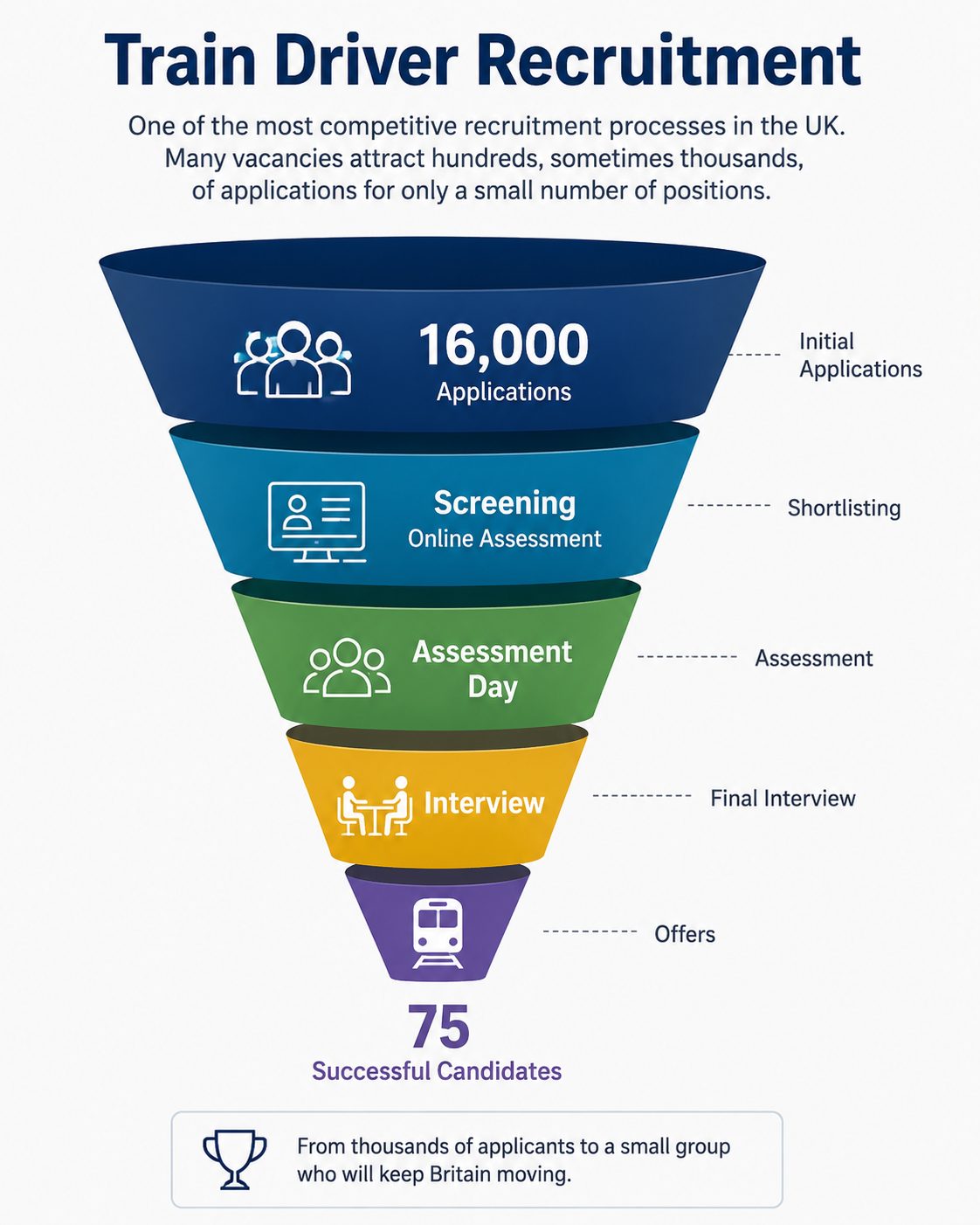
This is particularly relevant for trainee train driver applicants, because competition is high and the number of applications can be substantial. A broad, generic approach rarely stands up well in a sift. Employers want evidence that the applicant understands the role, respects its safety-critical nature, and has thought seriously about suitability.
What rail vacancies are really telling you
A strong rail vacancy normally tells you three things at once: what the employer needs, what the job will demand, and what you must prove in your application.
The first layer is the practical requirement. This includes location, depot, roster pattern, mobility expectations, and whether the role is trainee, qualified, or support grade. These points matter more than many applicants assume. A role may be attractive on paper, but if the depot is unrealistic for your travel arrangements, or the roster conflicts with family commitments you cannot flex, that issue will not disappear later.
The second layer is behavioural. Railway employers often write in terms such as calm under pressure, high standards, situational awareness, disciplined decision making, and professional communication. These are not vague preferences. They reflect the behaviours assessed throughout recruitment for operational roles.
The third layer is evidential. This is where many applicants fall short. If the advert asks for experience of working to strict procedures, dealing with responsibility, managing fatigue-related routines, or maintaining concentration over long periods, your CV and application need to demonstrate those exact themes. Simply stating that you are hard-working or reliable is not enough.
Rail vacancies for trainee train driver roles
When reviewing rail vacancies for trainee train driver positions, pay close attention to what is and is not being asked. Some adverts are genuinely open to candidates with no rail background, provided they can show transferable evidence from other safety-conscious or operational environments. Others may be labelled trainee but still favour applicants with experience in transport, logistics, emergency services, engineering, military service, or highly regulated customer operations.
That does not mean outside applicants should be discouraged. It means they need to be realistic and precise. A career changer can be a strong candidate if they can show punctuality, self-discipline, route or procedural awareness, lone working, incident reporting, and a mature approach to risk. Those qualities often matter more than simply having worked near trains before.
It also helps to recognise that trainee roles differ between employers. One operator may place greater weight on customer service because of the route environment. Another may focus more heavily on rules adherence and independent concentration. The core standard remains safety-critical professionalism, but the balance can vary.
How to judge whether a vacancy suits you
The best way to approach a vacancy is not to ask, "Do I want this job?" first. Ask, "Can I evidence what this role requires?" That shift in mindset makes your application stronger and saves time.
Start with eligibility and practicality. Can you reliably reach the depot at unsociable hours? Can you work weekends, bank holidays, early starts and late finishes? Can you maintain alertness and discipline in a highly structured environment? If the honest answer is uncertain, it is better to address that early than to ignore it.
Then look at your evidence base. Think in examples, not adjectives. If a vacancy asks for concentration, where have you worked in a role where lapses had consequences? If it asks for procedures, where have you had to follow exact steps without improvising? If it refers to communication, where have you passed on safety-relevant or operationally important information clearly and accurately?
Finally, consider competitiveness. Some rail vacancies attract a very high volume of applicants because of location, role type, or public awareness. That does not mean you should not apply. It means you should assume that generic answers will be screened out quickly.
Common mistakes applicants make
One of the most common errors is treating all rail jobs as interchangeable. A station role, conductor role, signaller role, and trainee driver role may all sit within railway operations, but the competencies emphasised can differ. Borrowing language from one type of application and pasting it into another often creates a poor match.
Another mistake is focusing too heavily on enthusiasm for trains while neglecting the operational standard of the role. Interest in the railway can be positive, but employers are recruiting for safe performance, not hobby knowledge. They need evidence of discipline, judgement, responsibility, and resilience.
Applicants also underestimate the importance of the person specification. If the advert separates essential and desirable criteria, treat the essentials as non-negotiable evidence points. A well-written application usually mirrors those criteria clearly and professionally.
There is also a tendency to rush. Because rail vacancies can open and close quickly, candidates sometimes submit the first version of their CV or application form. Speed matters, but relevance matters more. A prompt application that is poorly aligned will still struggle.
Turning a vacancy into an application plan
A useful method is to convert the advert into a working document. Pull out the repeated themes, then match each one to a real example from your work history. This is especially effective for structured application forms and competency-based interviews.
If the advert emphasises safety, punctuality, concentration, and customer responsibility, your preparation should revolve around those themes. Not broad claims, but examples with context, action, and result. That gives consistency across your CV, application answers, interview preparation, and psychometric readiness.
This is where a more disciplined approach can make a real difference. Strong candidates prepare in layers. They first establish role fit, then build evidence, then refine how that evidence is presented. That process is more effective than reacting to a vacancy at the last minute.
For some applicants, especially first-time rail candidates and service leavers transitioning into civilian careers, external structure helps. Specialist preparation can bring clarity to how railway employers interpret experience, what wording signals suitability, and where an application may currently be too generic. Train Driver Foundation, for example, focuses on exactly that gap between potential and presentation.
What to do before the next vacancy opens
The best time to prepare for rail vacancies is before one appears. Waiting until an advert goes live often leaves too little time to improve the fundamentals.
Build a CV that is aligned to safety-critical recruitment rather than general employment. Review your examples of responsibility, independent working, procedural compliance, and communication. Get clear on why you want the role in professional terms, not just lifestyle terms. If you are targeting trainee train driver positions, understand the broad stages of recruitment so that your application, interview preparation, and assessment readiness support each other.
It is also worth identifying any weaker areas in your profile. That may be limited evidence of formal procedures, unclear examples of risk awareness, or a CV that reads too generally. These are solvable issues, but only if you spot them early enough to act.
A vacancy should not be the moment you start thinking seriously about suitability. It should be the moment you recognise a role that matches preparation you have already done.
Rail recruitment rewards professionalism long before the interview stage. Read vacancies carefully, respond to what they actually ask for, and treat each application as evidence of operational readiness. That approach will always place you in a stronger position than simply hoping the job title carries you through.