





When a recruiter asks for an example of safety, judgement and decision-making under pressure, many applicants realise they understand the train driver role but struggle to explain how they think in operational terms. That is where an operational thinking course UK candidates can access becomes useful. It helps turn general professionalism into role-relevant evidence - the kind that matters in trainee train driver recruitment and other safety-critical rail pathways.
For aspiring drivers, this subject is not academic filler. Operational thinking sits close to the day-to-day reality of railway work. It is about recognising risk, following procedure, managing distractions, making sound decisions with incomplete information and understanding how your actions affect the wider operation. If you are preparing for structured interviews, manager interviews or broader career development, that mindset matters.
What an operational thinking course UK learners should expect
A strong course should not present operational thinking as a vague buzzword. It should define it in practical terms and show how it applies in safety-critical environments. In rail, that usually means disciplined judgement, situational awareness, rule-based decision-making and a consistent approach to risk.
You should expect the course to explore how people make decisions in real working conditions, not just in ideal ones. That includes time pressure, changing priorities, interruptions, fatigue management, communication standards and the need to remain compliant even when under strain. Good learning in this area gives you a clearer framework for thinking, speaking and acting professionally.
For train driver applicants, that has two benefits. First, it helps you understand what the role genuinely demands. Second, it gives you language and examples you can use when discussing competence in applications and interviews. Recruiters are not simply looking for confidence. They are looking for evidence of safe, stable and operationally mature judgement.
Why it matters for trainee train driver recruitment
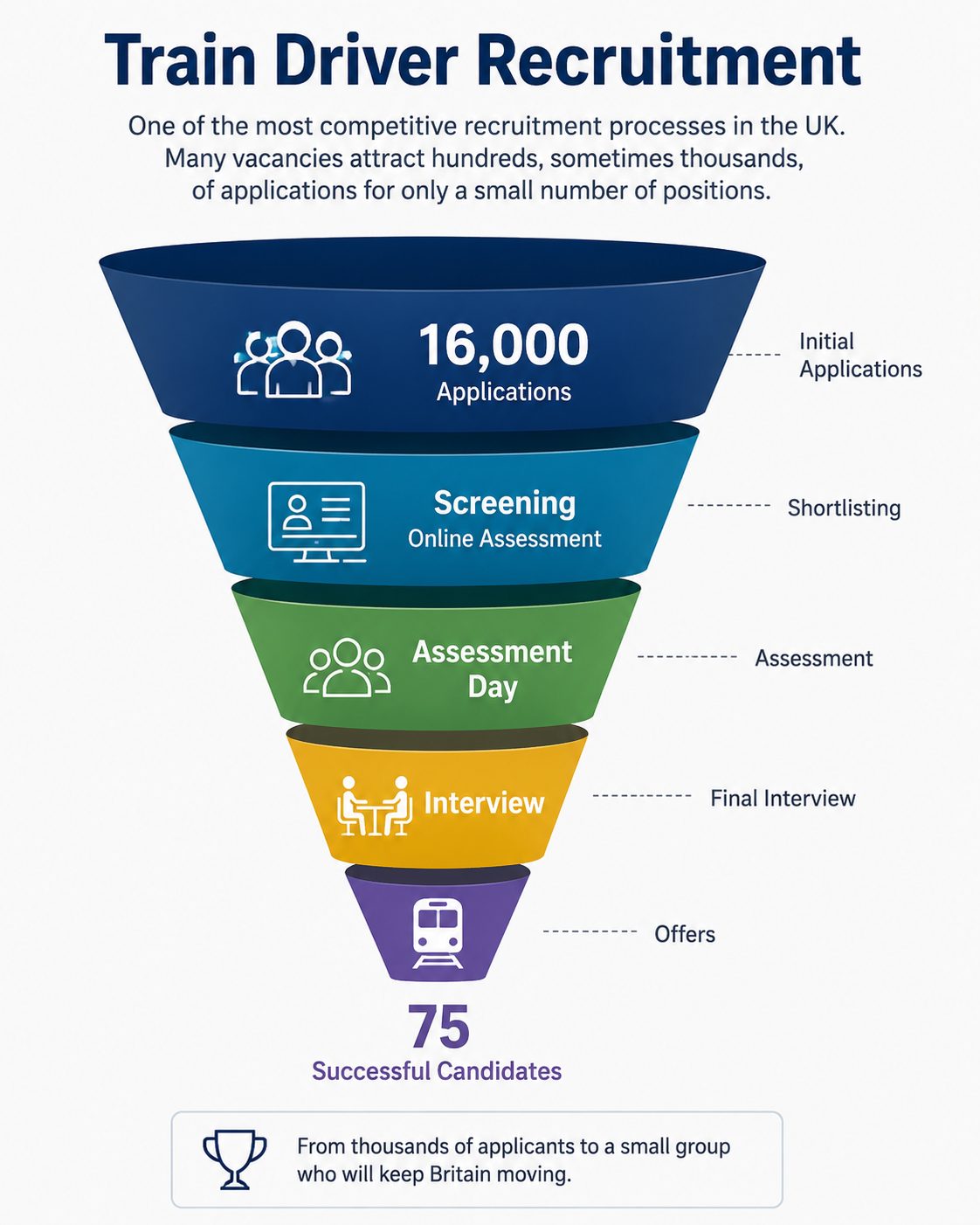
Train driver recruitment is highly competitive because the role combines strong responsibility, long-term career stability and a demanding safety standard. That means employers are not only assessing whether you want the role. They are assessing whether your judgement fits the environment.
Operational thinking supports several qualities that regularly appear in the recruitment process. These include concentration, rule adherence, risk awareness, calm decision-making and personal accountability. Even when an interview question does not use the phrase operational thinking, it often tests for it indirectly.
For example, you may be asked about a time you followed procedure despite pressure to do otherwise, or how you handled a changing situation where safety came first. You may also need to explain how you prioritised accurately, communicated clearly or responded to an unexpected problem without losing control of the process. Those are operational questions, even if they sound like standard competency questions.
This is why a focused course can be valuable. It helps you connect your past experience - whether from transport, the Armed Forces, emergency response, warehousing, customer operations or another structured environment - to the behavioural standards expected in rail.
What the course should actually teach
The best courses in this area are grounded in behavioural realism. They do not teach shortcuts, and they do not try to reduce safety-critical judgement to a few memorised phrases. Instead, they help you understand patterns of effective decision-making.
A useful operational thinking course will usually cover how to identify hazards, assess consequences, stay within process, escalate appropriately and avoid assumptions. It should also examine human factors. That means understanding how attention, routine, stress and complacency can affect performance.
In rail recruitment, this matters because candidates sometimes underestimate how often errors begin with small lapses rather than dramatic failures. Losing concentration, filling in gaps with assumptions, skipping checks because something feels familiar - these are operational weaknesses. A good course helps you see them early and build better habits.
It should also help you structure examples. Many applicants have relevant experience but explain it poorly. They talk in broad terms about being hardworking or responsible without showing how they assessed a situation, what controls they followed, what risks they recognised and why their decision was appropriate. Operational thinking training can sharpen that.
Who benefits most from this type of course
This kind of learning is particularly useful for people entering rail from outside the industry. If you have never worked in a formally safety-critical setting, the railway can appear straightforward from the outside but highly procedural once you look closer. A course helps bridge that gap.
Career changers often benefit because they need to translate existing strengths into railway language. You may already be disciplined, dependable and calm under pressure, but unless you can explain those qualities in operational terms, they may not land well in an assessment or interview.
Service leavers can also find this training relevant because many will already understand structure, accountability and risk. The value of the course is often in helping them map those strengths to civilian rail expectations and present them clearly.
Even applicants with transport or logistics experience can gain something from it. Familiarity with shifts, procedures and responsibility helps, but train driver recruitment still requires a specific standard of thinking and evidence. It is possible to have good experience and still be underprepared for how rigorously that evidence needs to be presented.
How to judge course quality
Not every course with the right title will offer the right depth. Some remain too generic and could apply to almost any office role. That is not much use if your goal is trainee train driver progression.
Look for content that is clearly relevant to safety-critical work. The language should reflect operational discipline rather than generic motivation. It should deal with judgement, procedure, situational awareness, compliance, communication and risk-based choices. If the course focuses heavily on confidence, personal branding or abstract leadership theory, it may not be aligned with your purpose.
It also helps if the learning supports CPD and professional development rather than simply giving you a certificate. A certificate has some value, but on its own it does not prove understanding. What matters more is whether the course improves how you think, how you speak about your experience and how you approach the standards of the role.
This is where specialist providers can make a difference. A course designed around rail recruitment and operational behaviour is usually more useful than broad employability training because it stays closer to the environment you are preparing for.
Operational thinking and interview performance
One of the clearest benefits of studying this subject is improved interview quality. Candidates often fail interviews not because they lack potential, but because they answer at the wrong level. They give personal opinions where structured judgement is needed, or they focus on outcomes without explaining the decision process.
Operational thinking gives you a better framework. Instead of saying you solved a problem quickly, you can explain how you assessed risk, followed process, confirmed information, communicated clearly and took proportionate action. That is a stronger answer because it reflects how safety-critical employers assess competence.
There is a balance to strike, though. You do not want answers to sound rehearsed or over-engineered. Interviewers are usually looking for genuine evidence, not textbook language. The course should help you think more clearly, not turn every answer into jargon.
Is it essential?
Not always. Some candidates already have strong operational backgrounds and can naturally demonstrate the required behaviours. Others may develop similar understanding through related CPD, direct safety-critical experience or high-quality interview preparation.
But essential and useful are not the same thing. If you are unsure how operational standards are judged, if your examples feel too general, or if you want a more credible understanding of railway expectations, this type of course can be a sensible investment in readiness.
The key question is not whether the course guarantees progress - it does not. The better question is whether it helps you present yourself as a candidate who understands the reality of the role. In a competitive process, that distinction matters.
How it fits into wider preparation
Operational thinking should not sit in isolation. It works best as part of a broader preparation plan that may include CV improvement, interview practice, psychometric readiness and role-specific CPD. Each element supports a different part of the process.
Think of it this way: psychometric preparation helps you approach formal assessments professionally, while interview preparation helps you communicate effectively. Operational thinking strengthens the substance underneath both. It helps ensure your understanding is not superficial.
For many applicants, that integrated approach is what builds confidence. Not false confidence, but the steadier kind that comes from knowing what the role requires and being able to demonstrate relevant behaviours with clarity. Providers such as Train Driver Foundation tend to add most value when they treat operational learning as part of that wider readiness picture, not as a standalone shortcut.
If you are considering an operational thinking course, judge it by one simple standard: will it help you think and present yourself more like a serious safety-critical candidate? If the answer is yes, it can be a worthwhile step. In train driver recruitment, preparation is strongest when it improves both your understanding and your evidence.