

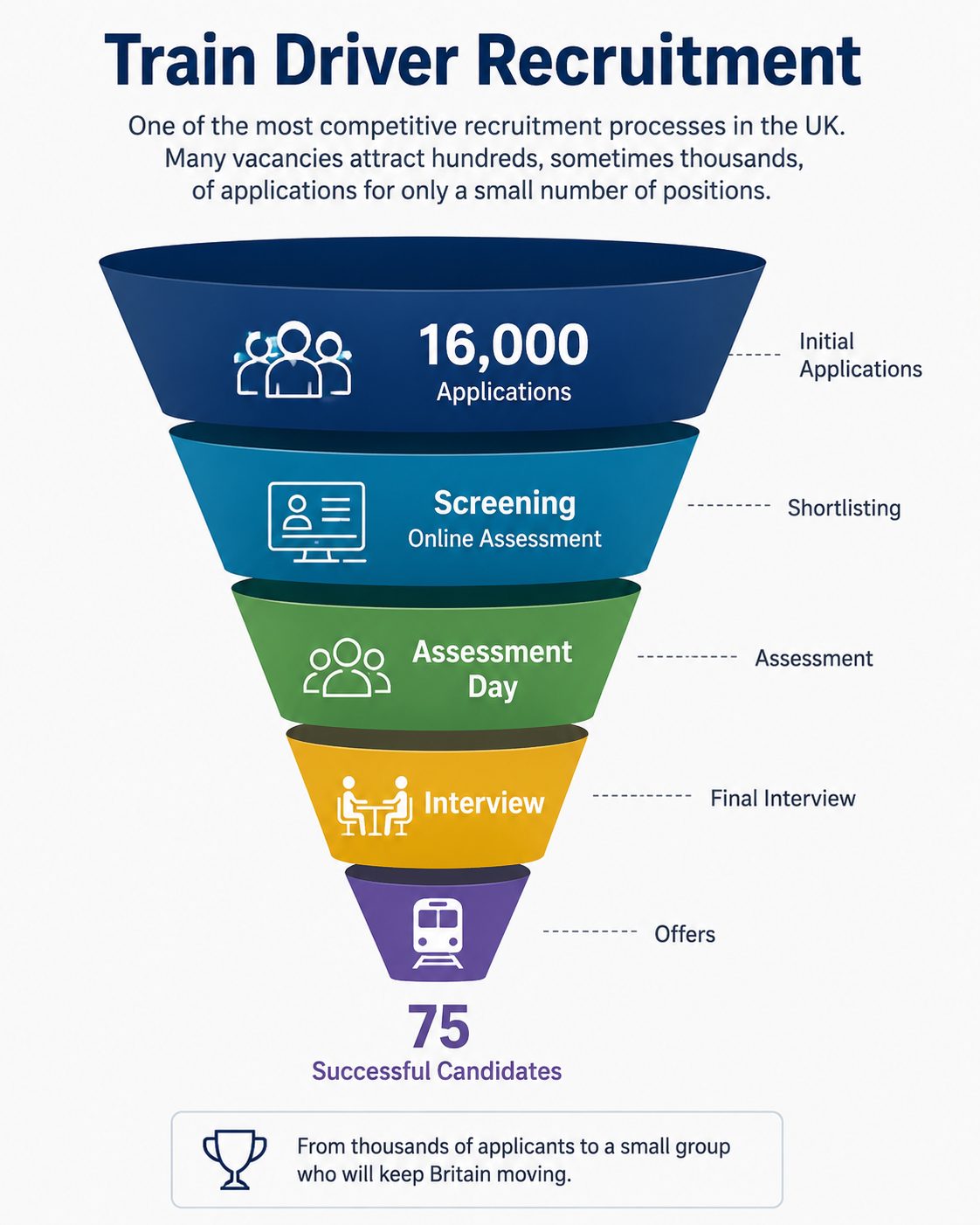




A psychometric assessment is not a test of whether you want the job badly enough. It is a structured way of assessing whether your natural approach, concentration and decision-making are suited to a safety-critical role. Effective psychometric practice helps you become familiar with assessment conditions and identify where you need to improve - without trying to second-guess or manipulate the process.
For aspiring trainee train drivers, this distinction matters. Train Operating Companies need candidates who can sustain attention, follow instructions precisely, make sound judgements and work consistently within rules. Recruitment is competitive, but preparation should be professional: understand the assessment demands, practise relevant skills and present an accurate picture of how you work.
What psychometric practice is designed to improve
Psychometric assessments used in train driver recruitment can examine several work-related capabilities. The exact format and requirements can vary by TOC and recruitment campaign, so candidates should always follow the information supplied for their own assessment process.
Rather than treating every exercise as a separate hurdle, look at the underlying behaviours being assessed. These may include concentration over a sustained period, accuracy when working at pace, ability to absorb and apply instructions, memory for information, checking behaviour and judgement in work-based situations. Some assessments may also consider your preferred working style or behavioural fit for a highly regulated environment.
Practice cannot change your fundamental suitability for the role, nor should it attempt to. What it can do is reduce avoidable mistakes caused by unfamiliarity, poor pacing or anxiety. A candidate who understands how to read instructions carefully and manage their attention is in a better position to demonstrate their genuine capability.
Start with an honest baseline
The most useful psychometric practice begins before you start repeating timed exercises. Complete an initial practice session in a quiet place and observe what actually happens. Do you rush the instructions? Does your accuracy drop after several minutes? Do you spend too long on difficult questions? Are you distracted by a mobile phone notification, noise or an uncomfortable workspace?
Write down patterns rather than simply recording a score. For example, a lower result may stem from one of three different issues: you may not understand the task, you may understand it but work too slowly, or you may work quickly but lose accuracy. Each needs a different response.
If instructions are the issue, slow down and restate the task in your own words before beginning. If pace is the issue, practise short timed sections once you are clear on the method. If accuracy falls away, focus on controlled scanning, keeping your place and taking brief resets between exercises. Repeating a test without identifying the cause of errors can create activity without progress.
Separate skill development from test simulation
Early practice should be untimed or lightly timed where possible. This gives you room to understand the task and establish a reliable method. Once your accuracy is consistent, introduce realistic time pressure.
A full simulation has a different purpose. It helps you experience the discipline required to work to instructions, maintain attention and recover if one section feels difficult. Do not run full simulations every day. They are most valuable when used periodically to measure progress and check your routine under pressure.
Build a routine that reflects safety-critical work
Train driving requires consistency. Your preparation routine should reflect that standard rather than relying on occasional intensive sessions. Short, focused practice undertaken several times a week is usually more productive than trying to complete hours of exercises in one sitting.
Begin each session by removing predictable distractions. Put your mobile phone out of reach, use a clear desk and set a defined start and finish time. Read all instructions once without acting, then read them again with the task in mind. This may sound basic, but instruction discipline is central to both assessment performance and operational work.
During timed practice, avoid developing habits that would undermine accuracy. Random guessing, skipping instructions or repeatedly changing your method may feel like a response to pressure, but it makes it harder to evaluate your performance. Use the approach required by the exercise, work steadily and learn from the outcome afterwards.
At the end of each session, spend a few minutes reviewing. Record the exercise type, timing, result and the reason for any errors you can identify. Over several weeks, this creates evidence of improvement and shows whether a particular area needs more attention.
Improve concentration without overtraining
Many candidates are comfortable with a short burst of focus but find that their concentration changes over a longer assessment session. This is not unusual. Sustained attention is a skill that benefits from gradual, controlled practice.
Use a staged approach. Start with a focused block that you can complete accurately, perhaps 15 to 20 minutes, then increase duration over time. Include a short break before beginning a new task. The aim is not to exhaust yourself; it is to build the ability to return to a task composed and attentive.
Your wider routine also affects performance. Poor sleep, irregular meals, excess caffeine and last-minute cramming can all make concentration less reliable. In the days before an assessment, favour familiar routines and sensible preparation over dramatic changes. Arriving rested, organised and punctual is part of being ready.
Treat accuracy as a habit, not a final check
Candidates sometimes believe that accuracy means working slowly. In reality, accurate work comes from a repeatable process. Keep your place on the page or screen, scan information in a consistent direction and avoid looking back unnecessarily. Where the exercise permits it, a quick check at natural stopping points can be more effective than trying to correct everything at the end.
It also helps to notice the moment when you start to hurry. Time pressure can lead to small slips: missing a word in an instruction, selecting an adjacent answer or making an assumption instead of checking the information provided. The earlier you recognise that pattern in practice, the better you can manage it in an assessment.
Prepare for situational and behavioural questions professionally
Some psychometric stages may use work-based scenarios or questionnaires about preferences and behaviours. These are not invitations to choose the answer that sounds most impressive. They are designed to explore how you are likely to respond in a workplace where safety, procedures, communication and personal responsibility matter.
Approach every question honestly and consistently. Consider what good operational behaviour looks like: following rules, escalating concerns through the correct channels, avoiding assumptions, remaining calm and recognising the limits of your authority. However, do not try to construct a fictional version of yourself. Inconsistency across assessments, application forms and structured interviews can raise questions.
Your previous experience can help here. Career changers, Armed Forces service leavers, transport workers and applicants from other operational roles may already have examples of working to procedures, managing risk or maintaining standards under pressure. Reflect on those experiences so that your understanding of safety-critical work is grounded in real behaviour, not rehearsed phrases.
Common psychometric practice mistakes
The first mistake is relying on generic aptitude practice alone. General exercises can help with familiarity, but train driver recruitment requires a safety-critical mindset. Your preparation should include careful instruction reading, sustained concentration and realistic reflection on work behaviour.
The second is chasing a perfect score. The purpose of assessment is to identify suitability, not to reward candidates who have memorised a bank of questions. Focus on steady improvement and honest performance rather than comparing results with other applicants.
The third is leaving preparation until an assessment invitation arrives. Recruitment timescales can move quickly. Building concentration and disciplined practice habits before you apply gives you more control when an opportunity appears.
Finally, do not neglect the rest of the selection process. Psychometric assessments sit alongside eligibility requirements, application quality, structured interviews and, where required, medical and other recruitment stages. A strong candidate prepares for the whole process with the same level of professionalism.
A practical final-week approach
In the final week, reduce the urge to practise endlessly. Complete a small number of purposeful sessions, review any recurring errors and keep your routine stable. Confirm the assessment arrangements, plan your journey if attendance is required and allow enough time to arrive without rushing.
The evening before, prepare what you need, then step away from practice. On the day, listen carefully, read every instruction and approach each task one at a time. If a section feels challenging, stay composed. Your job is not to prove perfection; it is to demonstrate a reliable, professional approach.
Psychometric preparation is most valuable when it develops the same qualities that matter beyond recruitment: attention, discipline, honesty and respect for procedure. Build those habits patiently, and you will be better prepared to meet the selection process on its own terms.