



If you are serious about becoming a trainee train driver, psychometric tests are not a side issue in the recruitment process - they are one of the main filters. Many capable applicants are caught out here, not because they lack potential, but because they underestimate what the assessments are designed to measure and how closely those measures relate to safety-critical work.
For train driver and other operational rail roles, these tests are used to assess whether your natural aptitudes, concentration standards and behavioural tendencies are suited to a job where attention, consistency and disciplined decision making matter every day. That can feel daunting, but it should also bring clarity. The process is not asking for charisma or guesswork. It is asking whether you can meet a defined standard in a highly controlled environment.
What psychometric tests assess
In railway recruitment, psychometric tests are used to measure abilities and characteristics that are difficult to judge accurately through a CV or interview alone. A recruiter can see your work history and hear your examples, but that does not fully show how you process information under pressure, sustain focus over time, follow rules consistently or respond when a task becomes repetitive.
That is why the assessments tend to focus on areas such as concentration, vigilance, memory, speed and accuracy, rule adherence and aspects of personality relevant to safety-critical performance. Some tests are timed and demanding. Others appear straightforward at first but are designed to measure consistency across a period of sustained mental effort.
This is an important distinction. In many industries, an assessment process rewards speed, flair or persuasive communication. Train driver recruitment is different. Here, a strong result often depends on calm discipline, careful attention and the ability to maintain standards even when a task feels monotonous.
Why psychometric tests matter so much in rail
The train driver role is built around public safety, operational compliance and reliable performance. Drivers work in an environment where distractions, assumptions and lapses in concentration can carry serious consequences. Recruitment standards reflect that reality.
Psychometric tests matter because they help employers assess whether a candidate is likely to cope with the mental demands of the role before any practical training begins. They are not there to make the process feel more difficult than necessary. They are there because train driving is safety-critical and the cost of poor judgement or inconsistent concentration is too high.
This is also why generic job interview advice rarely helps much at this stage. You are not simply trying to look employable. You are being assessed against role-specific standards linked to operational performance. A good candidate for train driving is not just motivated and professional. They must also show the right underlying aptitude profile for the job.
The main types of psychometric tests in train driver recruitment
Different employers may use slightly different assessment stages, but most processes draw from a similar set of test categories.
Concentration and vigilance tests
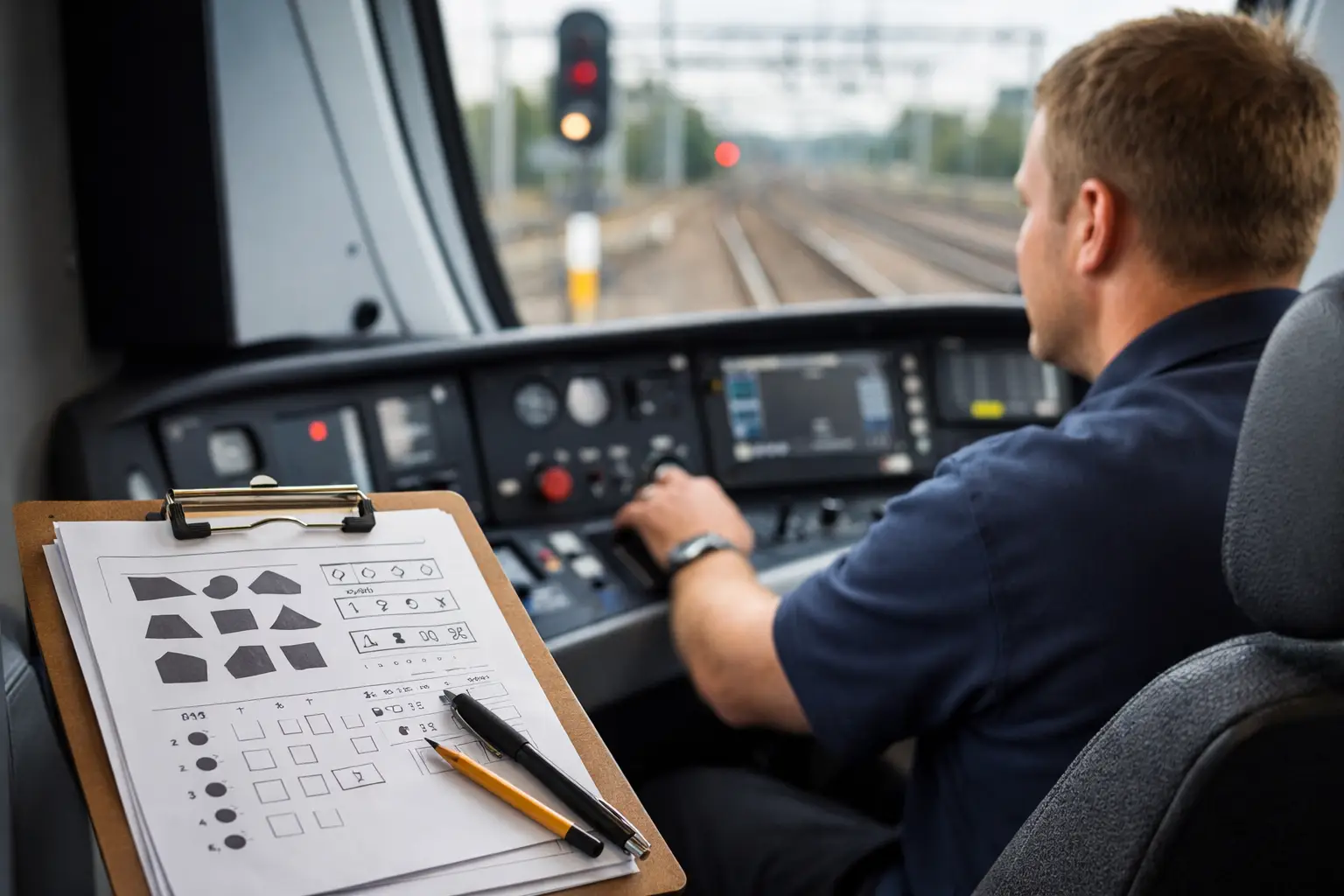
These assess your ability to notice detail, maintain focus and avoid errors during repetitive tasks. That may involve scanning symbols, comparing patterns, identifying specific sequences or working through information accurately under time pressure. The challenge is often not complexity but sustained control. Candidates can lose marks when they rush, drift mentally or let frustration affect their accuracy.
Memory and information processing tests
A train driver must absorb operational information, retain it and apply it correctly. Memory-based assessments can therefore form part of the process. These may look at short-term recall, rule-based retention or your ability to process information in the correct order. Strong performance usually depends on method and composure rather than raw confidence.
Multi-tasking and reaction-based tasks
Some assessments are designed to examine how you manage competing demands or respond to changing inputs while maintaining standards. In a safety-critical context, this is less about flashy reactions and more about controlled responses, prioritisation and stable attention.
Personality and behavioural questionnaires
These are often misunderstood. Candidates sometimes assume they can simply choose the answers that sound most professional. In reality, well-designed questionnaires check for consistency and patterns across your responses. They are usually looking at traits linked to reliability, rule-following, emotional stability and conscientious working habits.
Trying to second-guess these questionnaires can create problems. A more effective approach is to understand the behavioural expectations of the role and answer honestly, while being clear with yourself about whether a safety-critical operational career genuinely suits you.
What catches candidates out
One of the most common mistakes is treating psychometric tests like a school exam. Candidates assume revision alone will carry them through, or they focus only on getting quicker. Preparation does matter, but these assessments are not purely knowledge-based. They are measuring stable performance under specific conditions.
Another issue is poor test discipline. Applicants may start too fast, panic after a mistake, or let one difficult section disrupt the rest of the session. In train driver recruitment, consistency matters. A candidate who remains accurate and composed will usually perform better than one who begins aggressively and fades.
Fatigue is another factor that is often ignored. Concentration tests are unforgiving when you are tired, distracted or mentally overloaded. Good candidates sometimes underperform simply because they approach the day without proper rest, preparation or familiarity with the testing environment.
There is also a mindset problem. Some people view the assessments as a trick to catch them out. That usually leads to tension and overthinking. It is more productive to see them for what they are: a structured measure of suitability for a demanding role.
How to prepare properly for psychometric tests
Preparation should improve familiarity, control and performance habits. It should not be about trying to game the assessment. In rail recruitment, serious preparation means understanding the test demands and training yourself to meet them consistently.
Start by learning what kinds of tasks are commonly used in train driver selection. If you know the broad assessment categories in advance, the actual test day feels less unfamiliar. That matters because unfamiliarity can damage performance even in strong candidates.
Next, practise in a way that reflects real test conditions. Short bursts of casual practice are better than nothing, but they are not enough on their own. You need some sessions that mimic timed pressure, sustained focus and minimal distraction. This helps you understand how your concentration changes over time and whether you begin to rush when the clock is running.
It also helps to review how you work, not just how many answers you get right. Do you lose accuracy when you speed up? Do you start strongly and fade? Do you misread instructions when you are under pressure? These patterns matter because they can often be improved with disciplined practice.
For personality questionnaires, the best preparation is self-awareness. Think seriously about the behavioural demands of train driving. The role requires rule compliance, patience, operational maturity and comfort with routine. If those qualities fit you, your responses should reflect that naturally. If they do not, forcing an artificial profile is unlikely to hold up.
The balance between practice and aptitude
A fair question from many applicants is whether psychometric tests can really be prepared for at all. The honest answer is yes, but only to a point.
Practice can improve familiarity, reduce anxiety and sharpen your approach. It can help you manage time better, avoid preventable mistakes and become more comfortable with repetitive assessment tasks. For many candidates, that alone makes a significant difference.
What practice cannot do is turn every applicant into a strong match for a safety-critical role. There are underlying aptitude thresholds for a reason. If a candidate struggles repeatedly with concentration control, accuracy or behavioural fit, more practice may not fully solve that. That is not a judgement on their overall ability. It simply means the role has specific demands.
Understanding this balance is useful because it sets the right expectation. Prepare seriously, but do not expect shortcuts. Good preparation is about presenting your real capability at its best.
A better mindset for test day
Approach the assessments as a professional standard, not a personal attack. Read instructions carefully. Work with discipline. Keep your pace controlled. If one section feels difficult, reset and move on rather than carrying frustration into the next task.
It also helps to remember that train driver recruitment is designed to be selective. Feeling stretched does not mean you are failing. It means the process is doing its job. Your task is not to appear perfect. It is to demonstrate that you can operate with focus, consistency and maturity under assessment conditions.
For candidates preparing seriously for rail careers, this is where specialist guidance can be valuable. Generic aptitude advice often misses the realities of train driver selection, whereas role-specific preparation helps you understand not only the test format but the operational standards sitting behind it.
Psychometric tests deserve respect because they reflect the level of responsibility attached to the role. Treat them as part of becoming ready, not just part of getting through recruitment, and your preparation will be stronger from the outset.