

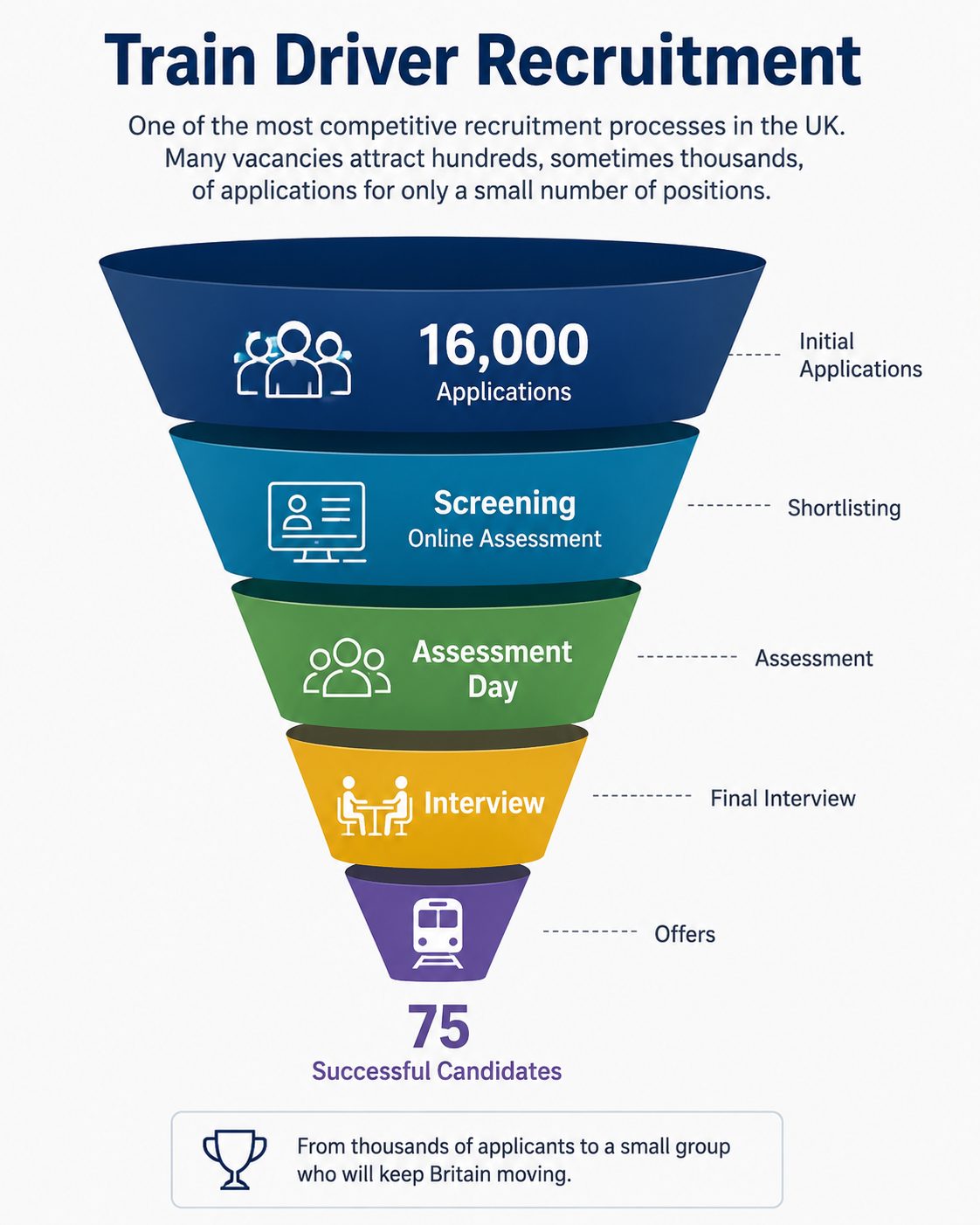




A trainee train driver application can attract strong candidates with excellent work histories, customer-facing experience and a clear motivation to join the railway. What often separates a prepared applicant is not a claim to know everything about the role. It is evidence of a realistic safety mindset, operational awareness and a willingness to develop properly. Rail CPD courses can help create that evidence before a vacancy appears.
For aspiring drivers and applicants to other safety-critical rail roles, CPD is most useful when it has a clear purpose. It should strengthen how you think about risk, rules, communication, responsibility and decision-making. It is not a substitute for a Train Operating Company’s own training programme, and it does not guarantee an interview or job offer. Used well, however, it can support a more credible application and give you stronger examples for structured interviews.
What rail CPD courses are designed to develop
Continuing Professional Development is structured learning that helps you build and maintain relevant knowledge, skills and professional behaviours. In rail, the most valuable learning is rarely about collecting certificates for their own sake. It is about developing judgement that fits a tightly controlled, safety-critical environment.
A good course should explain the context behind the subject, rather than asking you to memorise terminology without understanding it. For example, operational thinking is about seeing how a decision can affect passengers, colleagues, the timetable, equipment and safety. Risk-based decision making is about recognising hazards, considering consequences and choosing the safest appropriate action within your authority.
For a future train driver, this matters because the role demands sustained concentration, procedural discipline and the confidence to act cautiously when something is unclear. Recruitment processes are designed to assess the qualities that support those demands. CPD cannot replicate the assessment process, but it can give you a sounder foundation from which to discuss your approach.
Why CPD matters before you apply
Many people begin preparing only when they see a trainee driver vacancy. By that point, they may be trying to improve a CV, learn about the role and prepare for psychometric tests at the same time. Starting earlier allows you to develop with more intention.
Relevant rail learning can help you identify whether the operational environment genuinely suits you. The railway rewards people who are comfortable following defined procedures, reporting concerns, managing routine well and making careful decisions under pressure. Those expectations can feel very different from a role where speed, improvisation or sales targets drive daily priorities.
CPD also gives your career history a clearer direction. A warehouse supervisor, bus driver, member of the Armed Forces, engineer or customer service professional may already have valuable transferable experience. Completing focused learning helps connect that experience to railway expectations without overstating what you know.
The key is honesty. You are not presenting yourself as a qualified railway professional before you are one. You are demonstrating that you have taken sensible steps to understand the environment you wish to enter.
Choosing rail CPD courses with a practical purpose
Not every course labelled as rail-related will be equally useful for your goal. Before enrolling, consider what capability the learning is intended to develop and how it relates to the type of role you want.
For trainee train driver applicants, courses covering operational maturity, risk-based decision making, personal track safety, traction and rolling stock, or introductory train driving can each have a place. Their value differs depending on your starting point. Someone moving from an operational transport role may already understand shift work, incident reporting and public responsibility, but need more railway-specific knowledge. A career changer may benefit first from a broad introduction to the industry and safety culture.
Personal track safety learning can be useful for understanding why access to the railway is controlled and why rules around the track environment are taken seriously. It should never be treated as permission to enter railway infrastructure or carry out work for which you have not been authorised, trained and equipped.
Traction and rolling stock education can improve your appreciation of the equipment that supports train operation. At introductory level, the aim is context: understanding basic concepts, the importance of defect reporting and the relationship between the driver, the train and the wider operation. It is not about learning restricted procedures or trying to second-guess company-specific training.
Operational thinking and decision-making courses are often particularly relevant because they develop habits that transfer across industries. You may learn to pause, assess the available information, communicate clearly, follow the correct escalation route and avoid assumptions. These are useful behaviours whether you are applying for driving, station operations, control, depot work or another safety-critical position.
Look for relevance, not inflated claims
Be cautious of any training that suggests a short course can make you job-ready for a regulated railway role or provide a shortcut through recruitment. A reputable CPD course should be clear about its scope. It can prepare, inform and develop you, but formal competence in a role comes through employer-led training, assessment and ongoing monitoring.
Likewise, a certificate alone has limited impact if you cannot explain what you learned. During a structured interview, a recruiter may be more interested in how the course changed your thinking than in the course title itself. Be ready to discuss a principle you applied in your current work, such as escalating a concern, checking an instruction or managing an unexpected change calmly.
Turning course learning into application evidence
The strongest CPD becomes part of your professional story. Keep a simple record after each course: what you covered, what you learned, how it relates to rail and where you have applied the principle. This gives you useful material when tailoring a CV or preparing interview examples.
Suppose you complete learning on risk-based decision making. Rather than writing only “completed rail safety course”, you could describe how it reinforced your approach to checking information before acting, reporting anomalies and considering the consequences of a rushed decision. Then support that statement with a genuine example from your own employment.
This approach is especially useful for applicants without rail experience. Your evidence may come from logistics, aviation, emergency services, manufacturing, retail management or the military. The setting can differ, but the underlying behaviours may be relevant: following procedures, remaining alert during repetitive tasks, communicating accurately and taking responsibility for safe outcomes.
Keep your wording measured. Avoid claiming that a course has made you competent to drive a train, work trackside or diagnose faults. Focus instead on the knowledge gained, the professional behaviours strengthened and your motivation to continue learning through the proper route.
Building CPD around your recruitment preparation
CPD works best as one part of a wider plan. If you are targeting trainee train driver roles, start by checking that you understand the typical entry requirements and the demands of shift-based safety-critical work. Then build your preparation around four connected areas: relevant work evidence, railway understanding, assessment readiness and interview preparation.
Your learning should support the gaps you identify. If you struggle to explain why procedures matter, operational maturity training may help. If railway terminology feels unfamiliar, introductory rail or traction learning can provide useful context. If you have strong knowledge but weak examples, spend time reflecting on your existing work history and practising concise structured answers.
Train Driver Foundation’s CPD-focused courses are designed around these early-stage development needs, including operational thinking, personal track safety and introductory train driving education. The most productive way to use any course is to complete it carefully, reflect on it and connect the learning to your real experience.
For Armed Forces service leavers, CPD can also provide a structured bridge between established service skills and civilian railway language. Leadership, situational awareness, disciplined communication and adherence to procedures are valuable foundations. The task is to explain them in a way that is specific, grounded and relevant to the role you are pursuing.
The right expectation for professional development
Rail recruitment is competitive because the work carries significant responsibility. A well-chosen course will not remove that challenge, nor should it. Its purpose is to help you approach the process with better awareness, stronger language and more credible evidence of commitment.
Choose learning that makes you more thoughtful, not merely more confident. When you can explain what safe, professional decision-making looks like and show how you already practise it, you give your application a firmer foundation for the opportunities ahead.