

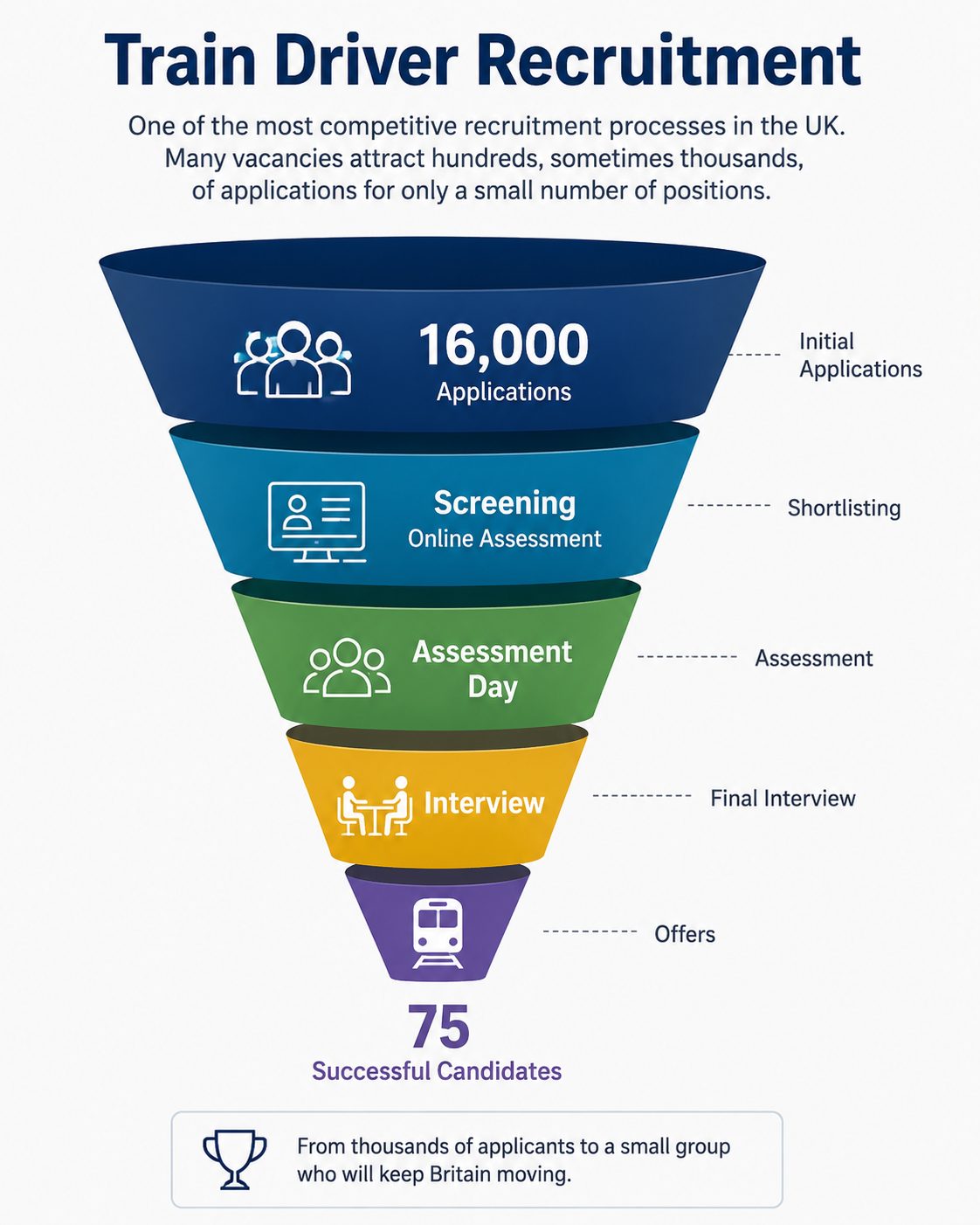




A trainee train driver vacancy can attract thousands of applicants, yet rail eligibility is not simply a question of whether you hold a driving licence or have worked in transport before. It is a combination of legal requirements, safety-critical standards, practical availability and the individual criteria set by the recruiting Train Operating Company (TOC). Understanding those distinctions early helps you apply for roles that genuinely fit your circumstances.
What rail eligibility means for trainee drivers
For trainee train driver recruitment, eligibility is the starting point. It establishes whether you can be considered for the role. Selection then determines whether you demonstrate the concentration, judgement, communication, safety awareness and professional behaviours required to progress.
This distinction matters. A candidate may meet every basic requirement but still need to prepare carefully for application screening, online assessments, psychometric tests and structured interviews. Equally, an experienced candidate may have strong transferable skills but be unable to proceed if they cannot meet a location, medical or work-pattern requirement.
TOCs set their own recruitment criteria according to their network, depots, training arrangements and operational needs. Always treat the wording in the live vacancy as the deciding standard. General guidance can help you prepare, but it cannot replace the requirements attached to a specific campaign.
Core rail eligibility requirements to check
Age and right to work
Trainee train driver roles have minimum age requirements because train driving is a regulated, safety-critical occupation. The exact position can depend on the role, the training stage and the operator’s policy, so check the vacancy carefully rather than relying on assumptions from previous campaigns.
You must also have the legal right to work in the UK for the role advertised. Recruitment teams will normally require evidence at the appropriate stage. If a vacancy specifies restrictions around sponsorship or particular right-to-work arrangements, take that wording seriously before investing time in an application.
Living within a workable distance of the depot
Depot location is one of the most common reasons otherwise capable applicants fall outside the criteria. Train drivers work early, late, night and weekend turns, often beginning or finishing when public transport is unavailable. A journey that seems manageable at midday may be unrealistic before a very early sign-on or after a disrupted late finish.
TOCs may state a maximum travelling time, a mileage radius or a requirement to live within a specified area. Others may not provide a figure but will still expect candidates to demonstrate that they can attend reliably. Do not assume you can relocate later unless the advert explicitly allows it. Your availability needs to be credible from the beginning of employment and throughout training.
Consider the route in practical terms: your own transport, parking, seasonal conditions, sleep opportunity between shifts and contingency if your usual journey is disrupted. This is not about impressing a recruiter with a long commute. It is about showing sound judgement around fatigue, attendance and safe performance.
Medical fitness and safety-critical standards
Train driving requires a safety-critical medical assessment. This is not a general workplace health check. It assesses whether you can carry out the role safely and reliably, including factors such as vision, hearing, colour vision, relevant medical history, medication and overall fitness for shift work.
A medical condition does not automatically mean someone is unsuitable. Decisions depend on the individual circumstances, the relevant standards and professional medical assessment. However, candidates should be open and accurate when asked for health information. Trying to minimise, conceal or guess at a medical issue creates risk and can lead to problems later in the process.
If you have an existing condition, use of regular medication, previous surgery, diabetes, sleep-related concerns or questions about eyesight, seek appropriate clinical advice and read the vacancy information closely. Avoid self-diagnosing your prospects based on online discussions. Only the formal assessment process can make a suitability decision.
Availability for shifts and training
Trainee train driver training is demanding and requires consistent attendance, concentration and commitment. Once qualified, the role involves rostered shifts that can include nights, weekends and public holidays. Annual leave and rest arrangements are managed within the operator’s processes, not around a standard Monday-to-Friday pattern.
Before applying, assess whether your home responsibilities, caring commitments and travel arrangements can support this reality. The question is not whether shift work sounds appealing in principle. It is whether you can sustain the routine responsibly over the long term.
You should also be prepared for training to take time. Progression is based on meeting required standards, not on rushing through a fixed timetable. Candidates who approach the role with patience, discipline and realistic expectations are better placed to manage the transition.
Conduct, employment history and documentation
TOCs expect applicants to provide a clear and truthful account of their employment history, qualifications and relevant circumstances. Gaps in employment are not automatically a concern, but they should be explained accurately where requested. Recruitment processes may include identity, right-to-work, reference and background checks appropriate to the position.
A strong application is consistent. Dates on your CV should match your application form. Job titles should be understandable. Reasons for leaving should be factual and professional. If you have been in the Armed Forces, transport, emergency services, manufacturing or another operational environment, translate your experience into relevant evidence rather than relying on the job title alone.
Eligibility is not the same as being competitive
Meeting the entry criteria gives you permission to apply. It does not mean the application will progress automatically. Trainee driver recruitment is competitive because employers are selecting people for a role where safety, independent working and sustained attention are central.
Recruiters will look for evidence that you understand the nature of the work. This includes following rules consistently, managing routine without losing focus, making considered decisions, communicating clearly and responding appropriately when conditions change. Customer-facing experience can be valuable, but so can evidence from warehouses, engineering, logistics, the military, healthcare, manufacturing or any role with accountable procedures.
The strongest examples are specific. Rather than saying you are safety conscious, explain a situation where you identified a risk, followed the correct process, escalated an issue or maintained standards under pressure. Rather than claiming you work well alone, show how you stayed organised and dependable without close supervision.
Common misunderstandings before applying
One misconception is that previous railway employment is required. It is not always required. TOCs recruit people from a wide range of sectors, provided they meet the stated criteria and can demonstrate the right behaviours and capability. Railway experience can give context, but it does not remove the need to meet the same recruitment standards.
Another is that a car driving licence automatically proves suitability. A licence may assist with getting to a depot, especially for unsocial hours, but train driving is a separate safety-critical profession with its own medical, assessment and training requirements.
It is also unwise to apply for every vacancy without considering location. Multiple applications are not a strategy if the depots are impractical or your answers become generic. Focused applications are more credible and give you the time to tailor your evidence to each TOC’s requirements.
Finally, do not treat assessments as a hurdle to outsmart. Psychometric testing and structured selection are designed to assess qualities relevant to safety-critical work. The useful preparation is to understand the format, practise working accurately under timed conditions and arrive rested, organised and familiar with the expectations.
How to assess your readiness before a vacancy opens
A sensible preparation plan starts well before recruitment opens. Review your employment history and identify examples that demonstrate procedural compliance, concentration, incident reporting, calm decision-making and responsibility. Update your CV so that these examples are visible without overstating your experience.
Then assess the practical side. Identify depots you could reach reliably at any hour, consider whether your household can accommodate shift work and ensure your key documents are current. If you are unsure about a health matter, address it responsibly rather than waiting until late in the process.
Build your understanding of the role through credible, role-specific learning. Introductory operational training and CPD can help you develop the vocabulary and mindset needed to explain why you are suited to a safety-critical railway career. Train Driver Foundation supports candidates with structured preparation that reflects the real demands of trainee driver selection, from CV evidence through to assessment and interview readiness.
Rail eligibility is the foundation, not the finish line. Check the non-negotiables honestly, prepare your evidence with care and apply when you can commit fully to the standards the role requires.