

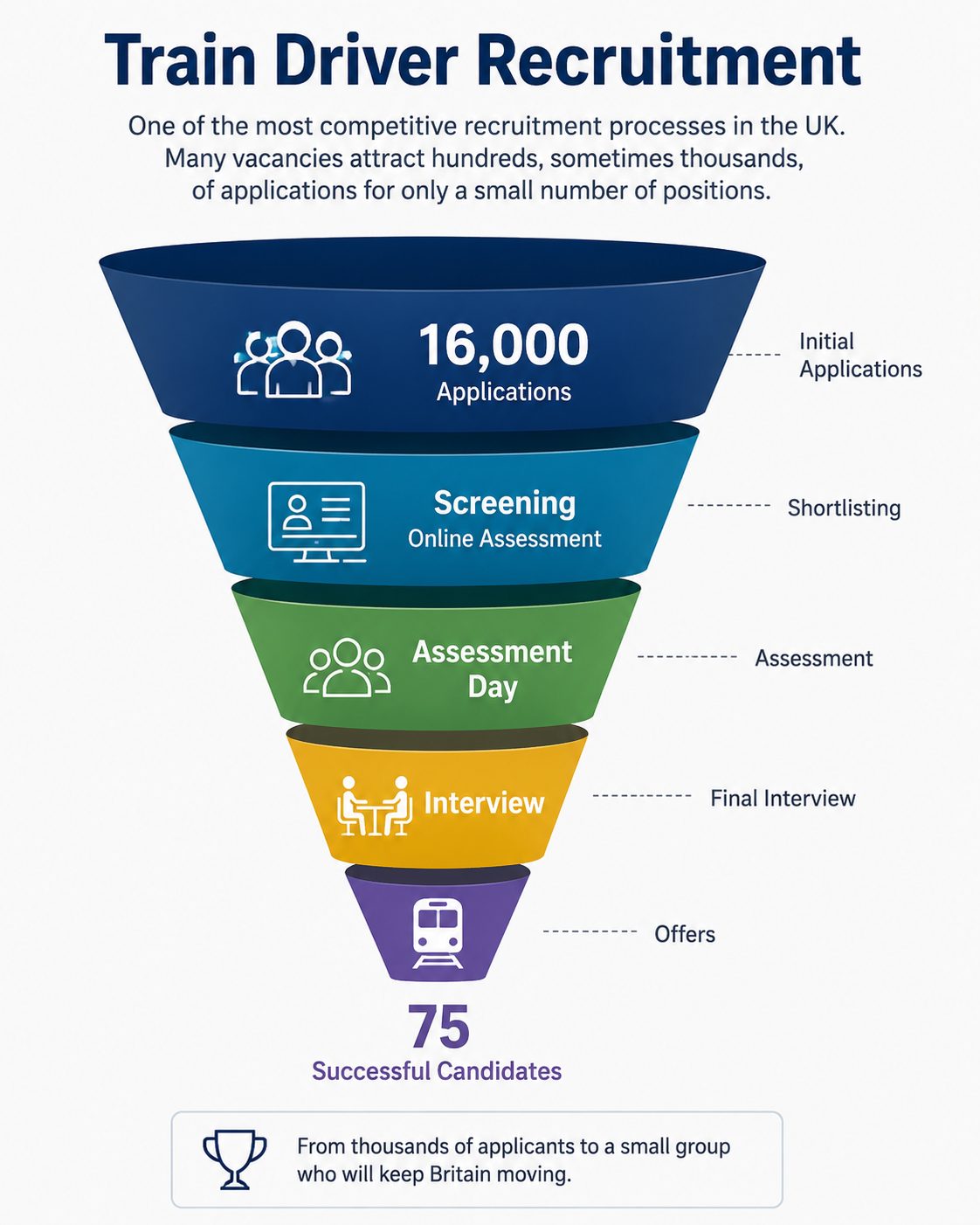




A psychometric assessment is not simply another box to tick in a trainee train driver application. It is part of how employers assess whether a candidate can work accurately, consistently and safely in a role where attention, judgement and concentration matter. The right rail psychometric support tools help applicants prepare with purpose, without treating the process as something to be bypassed or memorised.
For many candidates, the difficulty is not a lack of ability. It is uncertainty. They may know that assessments form part of recruitment, but not understand what they are designed to measure, how to practise appropriately, or how to identify where their preparation needs attention. A structured approach turns that uncertainty into a clear preparation plan.
What rail psychometric support tools should do
Effective support tools do more than provide a collection of timed questions. They should help you understand the demands of safety-critical selection and develop the habits needed to perform reliably under assessment conditions.
Train driver recruitment can include different forms of aptitude and psychometric testing. The precise assessment journey varies by Train Operating Company (TOC), vacancy and campaign, so candidates should never assume that one practice format covers every possibility. However, assessments commonly examine areas relevant to safety-critical work, including concentration, following instructions, working accurately at pace, checking information, learning rules and responding consistently.
A good tool therefore has two jobs. First, it gives you realistic practice in core cognitive skills. Second, it helps you review your approach so that practice becomes development rather than repeated guesswork.
This distinction matters. Completing hundreds of questions without considering errors, timing or concentration patterns may feel productive, but it can reinforce an unhelpful approach. Focused practice should show you where accuracy drops, whether you rush when time pressure increases, and whether you properly understand the instruction before beginning.
The support categories that matter most
Timed practice for attention and accuracy
Many candidates are comfortable with a task when there is no clock running. The challenge changes when they need to maintain attention while processing information accurately within a defined period. Timed practice allows you to experience this pressure in a controlled setting.
The objective is not to chase speed at the expense of quality. In train driving and other railway operational roles, a fast response that is wrong is not a strong response. Start by ensuring that you understand the task and can complete it accurately. Then introduce time limits gradually and monitor whether your accuracy remains stable.
Practice should also include tasks that require sustained focus rather than only short bursts of activity. Concentration can fluctuate, particularly after work, during a busy household routine or when practising on a phone with notifications nearby. Use a quiet setting, remove distractions and treat each session as formal preparation.
Instruction-following and rule-based exercises
Safety-critical roles depend on disciplined working. Assessments may explore how well you absorb instructions, apply rules consistently and avoid making assumptions when information changes.
Useful rail psychometric support tools present clear instructions, then require you to apply them across a series of tasks. The key learning point is often not the final answer. It is whether you paused long enough to identify the relevant rule, checked exceptions and stayed consistent from one item to the next.
Candidates sometimes lose marks because they begin too quickly or rely on what they think a task is asking rather than what the instruction actually says. Build a short routine before each practice exercise: read the instruction fully, identify the rule, check an example if one is provided, then begin. That routine supports both assessment performance and the professional discipline expected in railway work.
Feedback that identifies patterns
Feedback is where practice becomes genuinely useful. A percentage score alone tells you very little. You need to know whether errors came from misunderstanding the instruction, losing concentration, rushing, poor time management or difficulty with a particular task type.
Keep a simple record after each session. Note the date, exercise type, score or completion level, time taken and the reason for any mistakes. Over several sessions, patterns become clearer. You may find that your first few answers are strong but your accuracy falls late in a timed task. Alternatively, you may be accurate but too slow because you repeatedly re-read information.
Neither pattern should cause panic. They give you a specific area to work on. Improvement is more likely when practice is targeted than when every session is treated as a pass-or-fail test.
Familiarisation with assessment conditions
Candidates should be familiar with the practical conditions of online testing as well as the questions themselves. This includes using an appropriate device, having reliable internet access, managing the time available and following instructions carefully on the day.
Where a practice platform includes timed modules, use them as intended. Do not pause mid-exercise to search for answers or ask somebody else to check your work. That does not prepare you for a live assessment and undermines the point of practice.
It is also worth planning the environment in advance. Choose a quiet room, charge your device, close unnecessary browser tabs and arrange childcare or household commitments where possible. These are simple actions, but they reduce avoidable pressure and allow you to focus on the task in front of you.
How to use practice without over-practising
More practice is not always better. If you repeat similar questions for hours while tired or frustrated, your concentration and confidence can decline. Short, regular sessions are usually more productive than occasional marathon sessions.
A sensible approach is to alternate between learning and testing. In one session, work slowly through an exercise and study the instructions, examples and feedback. In the next, complete a timed version without interruption. This allows you to develop understanding first, then test whether you can apply it under pressure.
Be honest about readiness. If a practice score is disappointing, avoid immediately repeating the same exercise in the hope that familiarity will produce a better result. Review what happened, take a short break, and return to the underlying skill. A candidate who can explain how they improved their process is developing a more reliable approach than one who simply remembers a question sequence.
Rest also forms part of preparation. Fatigue affects attention, patience and working memory. In the days before an assessment, protect your sleep where you can, eat normally and avoid cramming late into the evening. You are preparing to demonstrate consistent performance, not to force a last-minute result.
Psychometric preparation alongside the wider application
Psychometric practice should not sit separately from the rest of your train driver preparation. A strong application also requires a clear understanding of the role, a well-presented CV, evidence of safety awareness and reliable examples for structured interviews.
The same professional qualities appear throughout the process. When preparing an interview example, show how you followed a procedure, maintained concentration, communicated clearly or raised a concern appropriately. When reviewing your CV, make operational responsibility, rule-following, customer service and dependable attendance easy to identify where they are genuinely part of your experience.
Candidates moving from the Armed Forces, logistics, engineering, bus operations or other disciplined environments may already have relevant examples. The task is to translate them clearly, without exaggeration. Explain the situation, your responsibility, the action you took and the outcome, particularly where safety, accuracy or teamwork were involved.
Train Driver Foundation approaches preparation as a pathway: understand the role and eligibility requirements, prepare your application materials, practise assessment skills ethically, and develop evidence for the later stages of selection. Each element strengthens the others.
Choosing support that respects assessment integrity
Be cautious about any resource that claims to reveal confidential content, promises a guaranteed result or suggests that safety-critical assessments can be beaten through tricks. Those claims do not reflect the purpose of recruitment testing or the standards expected of future railway professionals.
Choose support that focuses on transferable skills, clear explanations, realistic timing and constructive feedback. It should encourage you to work independently, recognise your development areas and arrive prepared to show your own capability.
The recruitment process is demanding because the role is demanding. That is not a reason to be discouraged. With measured practice, honest self-review and a professional routine, psychometric preparation can become a practical part of showing that you are ready for the responsibility ahead.