
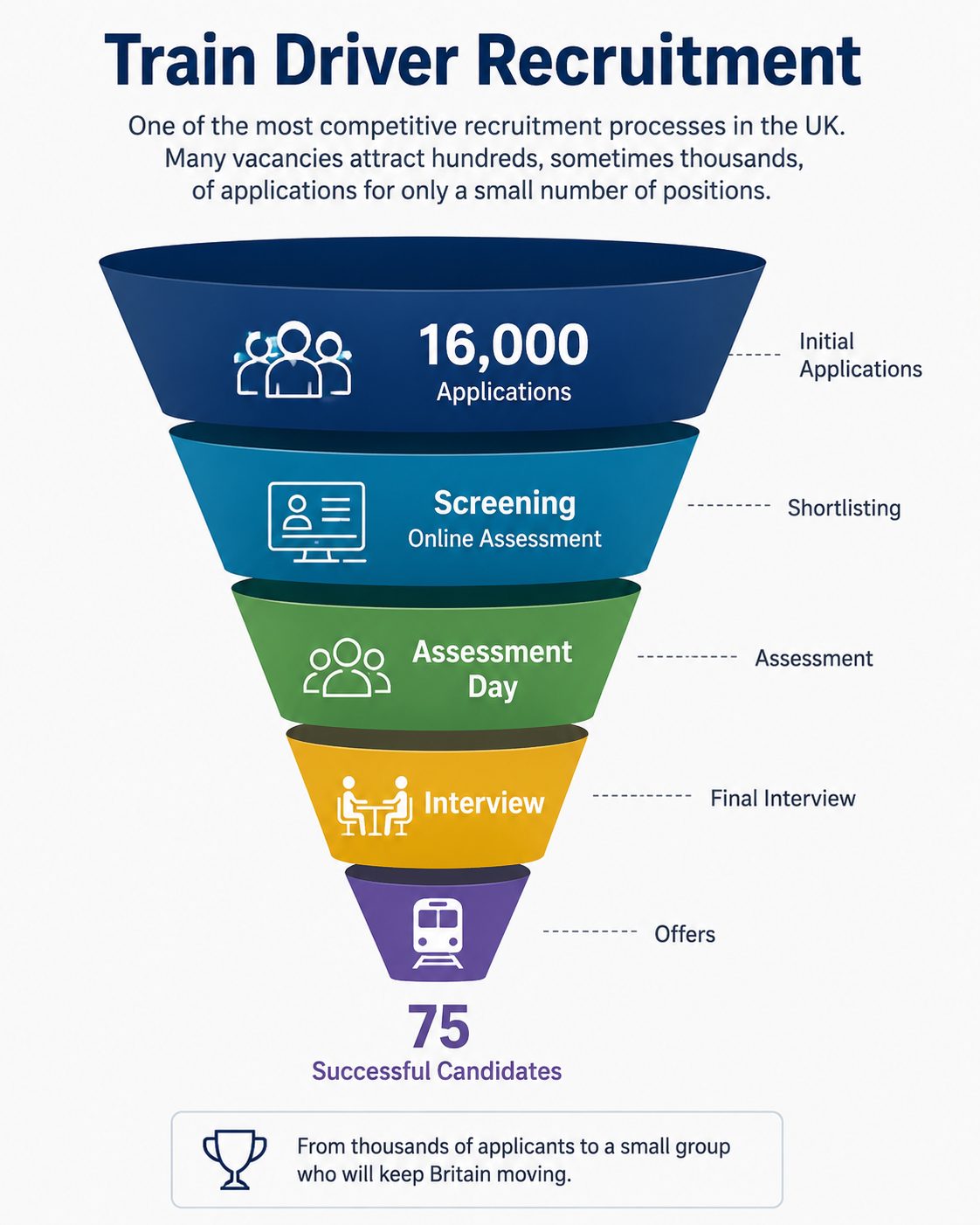



A trainee train driver vacancy can attract a substantial number of applicants, often from experienced operational, military, transport and customer-facing backgrounds. That is why rail recruitment is not simply a matter of submitting a strong CV. It is a structured assessment of whether you can develop into a dependable professional in a safety-critical role.
For aspiring train drivers, the most productive approach is to treat recruitment as a preparation pathway. Understand the standards behind the process, identify the evidence in your own experience, and build the knowledge and habits that support a credible application. The aim is not to find shortcuts. It is to show that you understand the responsibility attached to the role and are ready to meet the required standard.
What rail recruitment is designed to assess
Train Operating Companies recruit for more than enthusiasm for the railway. A train driver works independently for long periods, follows rules precisely, manages concentration, responds calmly to changing conditions and communicates clearly when required. Recruitment processes are designed to assess the personal qualities and potential that underpin those demands.
The exact process varies between TOCs and vacancies, but candidates should expect a combination of eligibility screening, application review, online assessments, psychometric testing, structured interviews and, in some cases, assessment centre activity. Each stage provides different evidence. An application may establish that you meet the practical criteria; assessments can explore attention, reasoning and safe decision making; interviews examine how you have behaved in situations that matter to a safety-critical employer.
This explains why a capable person can still be unsuccessful if they prepare only for one part of the process. A polished CV cannot compensate for weak interview examples. Equally, test practice on its own does not demonstrate operational maturity or an understanding of professional responsibility.
Start with suitability, not the vacancy list
When vacancies open, it is tempting to apply immediately and work out the details later. A more disciplined approach begins by checking whether the career genuinely fits your circumstances, working style and long-term expectations.
Train driving can involve early starts, late finishes, weekend work, public holidays and rostered shift patterns. The role requires sustained alertness, disciplined adherence to procedures and the ability to work alone without losing focus. It can be highly rewarding for people who value responsibility, routine, technical learning and public service, but it is not suited to everyone.
Consider your travel arrangements carefully as well. TOCs may set requirements around living within a reasonable travelling distance of a depot, particularly where very early or late shifts are involved. Do not assume that a good application will overcome a practical issue with availability. Check each vacancy carefully and be honest about whether the location and roster demands are sustainable.
You should also review the transferable evidence you already hold. Candidates from the Armed Forces, logistics, aviation, emergency services, manufacturing, driving roles and customer operations may have strong examples of following procedures, managing risk, maintaining standards and communicating under pressure. First-time rail applicants can demonstrate the same qualities through other responsible work, voluntary roles or education. The relevance comes from the behaviour you describe, not the job title you previously held.
Building an application that reflects operational standards
A train driver application should be clear, accurate and tailored. Generic claims such as “hard-working”, “reliable” or “a good team player” carry limited weight unless they are supported by evidence. Recruiters need to see how you have acted when accuracy, safety, time pressure or accountability mattered.
Your CV should make the most relevant responsibilities easy to find. Use concise descriptions that show what you did, the standard you worked to and the outcome. For example, instead of saying you “worked well under pressure”, explain how you prioritised tasks during disruption, followed reporting arrangements and maintained service or safety standards.
Accuracy matters throughout. Dates, qualifications, employment history and answers to screening questions should be complete and consistent. In safety-critical recruitment, careless errors can create doubts about attention to detail and professional standards. Take time to review the application before submission, particularly where questions ask about attendance, shift work, driving history or previous assessment outcomes.
It also helps to avoid overstating railway knowledge. If you are new to the industry, you are not expected to present yourself as an experienced rail professional. A better approach is to show informed motivation: you understand the realities of the role, have researched the employer and have begun developing relevant operational awareness.
Research the employer with purpose
Research should help you answer practical interview questions rather than produce a long list of facts. Understand the TOC’s routes, depot location, customer environment and the broad nature of its operation. Think about how those factors may affect the role.
For instance, a busy commuter operation may place particular emphasis on punctuality, disruption management and high passenger volumes. Other services may involve longer-distance working, different route characteristics or a different operational rhythm. The point is not to make assumptions about internal procedures. It is to demonstrate that you have considered the working environment and can explain why it suits you.
Preparing for psychometric tests professionally
Psychometric assessments are a significant part of many train driver selection processes. They are not designed to be “beaten”, and candidates should not seek methods that compromise assessment integrity. Their purpose is to provide standardised evidence about aptitudes and behaviours relevant to safety-critical work.
Preparation remains worthwhile because it helps you understand common assessment formats, manage time and approach instructions with confidence. Familiarity can reduce avoidable anxiety, but it cannot replace the underlying capability being assessed.
Practise under realistic conditions. Find a quiet space, remove distractions, use a reliable device and follow instructions exactly. If practice material includes timed elements, work within the stated limit rather than repeatedly pausing or restarting. Afterwards, review where errors occurred. Were you rushing? Did you misread a rule? Did concentration fall towards the end? This reflection is more useful than simply repeating questions without changing your approach.
Candidates should also protect their performance on the day. Get adequate rest, allow time for technical checks and avoid trying to complete assessments around competing responsibilities. If an adjustment is needed due to a health condition or disability, raise this through the employer’s stated process at the appropriate stage. Requesting support is part of engaging professionally with recruitment, not a sign of weakness.
Structured interviews: prepare evidence, not speeches
Structured interviews commonly assess behaviours such as safety awareness, conscientiousness, communication, customer focus, resilience and response to pressure. Questions often ask for a specific example from your experience. The interviewer is looking for a clear account of what happened, what you did and why your actions were appropriate.
Prepare a bank of real examples before the interview. Strong examples may involve identifying a hazard, challenging unsafe practice appropriately, dealing with an error, following a process despite time pressure, resolving a difficult customer situation or maintaining concentration during repetitive work. The best examples are not always dramatic. A routine situation can be powerful when it demonstrates sound judgement and consistent standards.
Use a simple structure: set out the situation, explain your responsibility, describe your actions and state the result and learning. Keep the focus on your contribution. Saying “we did” throughout can make it difficult for an assessor to understand your personal decision making.
Be ready to discuss setbacks honestly. In a safety-critical setting, employers do not expect candidates to claim they have never made a mistake. They are more interested in whether you recognised the issue, followed the correct reporting or escalation process, learned from it and changed your approach where necessary.
Develop operational awareness before you apply
Recruitment preparation is stronger when it is supported by relevant learning. Introductory rail and operational courses can help candidates understand the language, responsibilities and risk-based thinking associated with railway work. They do not replace the employer’s training programme, but they can show that you have approached the career seriously and begun developing your professional knowledge.
Useful learning areas include personal track safety, traction and rolling stock awareness, operational thinking, risk-based decision making and human performance. The value lies in how you apply the learning. A candidate who can explain why rules, communication and situational awareness matter is likely to present more credibly than someone who has simply collected course certificates.
For service leavers and career changers, CPD can also provide a useful bridge between previous experience and civilian rail expectations. Map what you learn against examples from your own background. This makes your application more coherent and gives you stronger material for structured interviews.
A disciplined preparation plan for rail recruitment
The process can feel lengthy, especially when vacancies are irregular and recruitment timelines vary. A simple preparation plan helps you make progress before an opportunity appears. Keep your CV current, record relevant work examples while they are fresh, practise assessments periodically and continue building operational understanding.
Avoid applying indiscriminately. Each application should meet the vacancy requirements and be supported by genuine availability, appropriate research and a clear reason for choosing that employer and location. Quality preparation is more valuable than a high volume of poorly targeted applications.
If you need specialist support, use it to improve your understanding and presentation rather than to create an artificial version of yourself. A CV review, interview preparation or assessment practice programme should help you identify evidence, address weaker areas and approach the process with greater structure. The responsibility for demonstrating the required standard remains yours.
Rail recruitment rewards candidates who are patient, accurate and prepared to develop. Start building those habits now, because they are not only useful during selection - they are closely connected to the professional mindset the railway expects.