
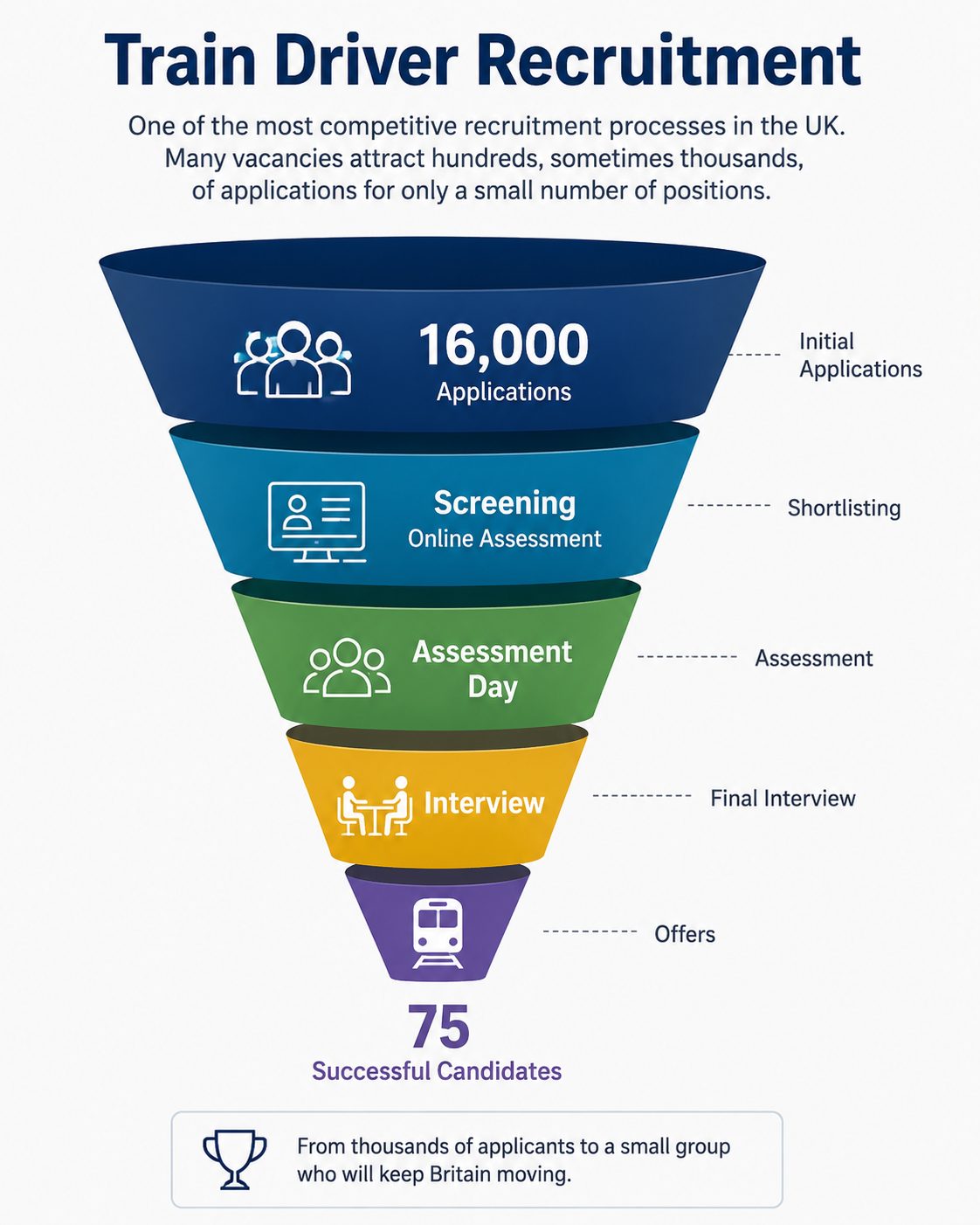




A trainee train driver vacancy can attract thousands of applicants, yet most rejections happen long before interview. That is why a rail recruitment preparation guide matters. Good candidates are often filtered out not because they lack potential, but because they underestimate how structured, evidence-based and safety-critical the process really is.
If you are serious about moving into a train driver role or another rail position with high operational responsibility, preparation needs to start well before you submit an application. Recruitment is not simply about enthusiasm for the railway. It is about demonstrating judgement, rule adherence, concentration, communication, self-management and the capacity to work safely under pressure.
What rail recruiters are really assessing
Train Operating Companies do not recruit on interest alone. They recruit against behaviours and abilities that can be evidenced, tested and compared. That means every stage of the process is designed to answer a practical question.
Your application and CV help employers decide whether you understand the role and whether your background suggests suitability for safety-critical work. Psychometric assessments look at abilities linked to concentration, attention, rule-following and processing information accurately. Structured interviews examine how you have behaved in demanding situations and whether your examples reflect the standards expected in rail.
This is where many applicants lose direction. They prepare each stage in isolation. In reality, the strongest candidates build one consistent case for suitability across the full process. If your CV suggests care, responsibility and operational discipline, but your interview examples are vague or poorly structured, the overall picture weakens.
Start with eligibility and role fit
Before investing time in practice, confirm that the role genuinely fits your current profile. A sound rail recruitment preparation guide starts with realism. Not every strong applicant is ready immediately, and recognising gaps early is part of professional preparation.
Look closely at the person specification in any vacancy. Some employers place significant weight on recent experience in safety-critical, rules-based or customer-facing roles. Others may expect evidence of lone working, shift tolerance, incident reporting, fatigue management or dealing calmly with disruption. You should also think carefully about lifestyle compatibility. Driver roles often involve early starts, weekends, public holidays and strict route to work requirements.
Career changers can still be strong candidates, but they need to translate prior experience properly. Military service leavers, transport staff, emergency services personnel, logistics professionals and operations workers often have relevant evidence. The key is not the job title. It is whether your experience shows disciplined decision-making, adherence to procedure and consistent personal responsibility.
Build a CV that matches rail standards
A rail CV should not read like a general employment history. It should present relevant evidence clearly and professionally. Recruitment teams do not need inflated language. They need to see behaviours and responsibilities that relate to the vacancy.
Focus on examples that show punctuality, compliance, risk awareness, incident handling, communication under pressure, working to standards and maintaining concentration in repetitive or demanding environments. If you have managed safety checks, followed operating procedures, dealt with difficult passengers or customers, worked shifts, handled handovers or documented events accurately, those details matter.
Keep wording precise. “Worked well in a busy environment” is weak because it is generic. “Completed pre-start safety checks, followed regulated procedures and maintained accurate records during time-critical operations” is stronger because it shows operational relevance.
It also helps to remove material that distracts from suitability. An overlong CV filled with unrelated achievements can dilute your case. The aim is not to tell your whole story. It is to show why your background aligns with a safety-critical rail role.
Prepare for psychometric testing properly
Rail recruitment preparation guide for assessment stages
Psychometric testing causes anxiety because candidates often do not know what is being assessed or how preparation should work. Good preparation is not about trying to memorise answers or outsmart the process. It is about familiarising yourself with test formats, building mental stamina and improving your ability to work accurately within rules and time limits.
These assessments are designed to measure consistent performance. If you rush, guess carelessly or become flustered by repetition, your performance can dip. That is why realistic practice matters. It helps you understand pacing, concentration demands and the discipline required to remain accurate over time.
There is also a trade-off here. Too little practice leaves candidates unsettled and unfamiliar with the format. Too much poor-quality practice can encourage bad habits, especially if you focus only on speed. In rail recruitment, accuracy and controlled attention are often more valuable than trying to finish everything quickly.
A sensible preparation approach includes timed practice, quiet test conditions, limited distractions and honest review of errors. If your concentration drops after fifteen minutes, that is useful information. You can then work on attention control rather than simply repeating the same mistakes.
Strengthen your structured interview evidence
Structured interviews are usually where preparation becomes visible. Interviewers are not looking for polished speeches. They are looking for evidence. Your examples should show what the situation was, what you did, why you did it and what the outcome was.
The strongest examples usually involve real responsibility. That might include enforcing a rule despite resistance, responding calmly to an incident, spotting a risk before it escalated, correcting an error, maintaining standards during fatigue or pressure, or communicating clearly when safety and service were both affected.
Weak examples tend to be either too broad or too passive. Saying “we worked together to solve the problem” does not help much if your own actions are unclear. Saying “I always take safety seriously” is not evidence unless you can show it in practice.
Prepare a bank of examples in advance, but do not script them word for word. Interview performance should sound natural and controlled, not rehearsed to the point of rigidity. It is better to know your evidence thoroughly than to memorise fixed phrases.
What interviewers usually want to hear clearly
Across many rail interviews, certain themes come up repeatedly. They want to understand how you respond to rules, pressure, routine, accountability, customer interaction and unexpected events. They also want to hear that you understand the job beyond the attraction of salary or status.
That means your motivation matters. Wanting a stable long-term career is reasonable, but it should sit alongside a genuine understanding of the discipline the role requires. Train driving appeals to many people, but not everyone fully grasps the demands of concentration, fatigue management, route learning and personal responsibility attached to it.
Show operational maturity, not just enthusiasm
One of the clearest distinctions between average and strong candidates is operational maturity. This does not mean you need prior railway experience. It means you present yourself as someone who understands serious responsibility.
Operational maturity shows in small things. You answer questions directly. You avoid exaggeration. You recognise the value of procedure. You can discuss mistakes honestly and explain what changed afterwards. You do not frame rules as obstacles. You frame them as safeguards.
For some applicants, especially those entering rail for the first time, this area needs deliberate work. CPD-style learning can help because it develops the mindset behind the role, not just the recruitment stage. Topics such as risk-based decision making, operational thinking and rail safety awareness are useful because they strengthen how you interpret the job itself.
Avoid common mistakes that weaken strong applications
A surprising number of capable candidates damage their own chances by preparing in the wrong order. They spend weeks looking for vacancy alerts but very little time developing interview evidence or understanding assessment standards. Others apply too broadly without adjusting their CV or personal statement to the role.
Another common mistake is assuming that customer service alone is enough. Customer-facing experience can be valuable, but for train driver recruitment it usually needs to be supported by evidence of discipline, procedure, composure and personal responsibility. A friendly manner helps, but friendliness without structure is not enough for a safety-critical role.
Candidates also sometimes treat recruitment as a one-off event. In practice, it is often a preparation cycle. You may need to improve your CV, sharpen your examples, strengthen your concentration and build a better understanding of operational expectations over time. That is not failure. It is part of approaching the process seriously.
How to use this rail recruitment preparation guide well
The most effective way to use a rail recruitment preparation guide is to turn it into a sequence. Start with eligibility and role fit. Then tighten your CV and application language. After that, prepare systematically for psychometric testing and structured interviews. Alongside those stages, build your rail understanding so your motivation and answers are grounded in reality.
If you try to do everything at once, preparation becomes fragmented. If you work stage by stage, you create a clearer and more credible application. That is often the difference between looking interested in the railway and looking ready for the standards of railway recruitment.
For candidates who want specialist support, Train Driver Foundation focuses specifically on these recruitment demands rather than broad employability advice, which can be useful when you need preparation tied closely to train driver standards.
The process is competitive for a reason. Employers are selecting for consistency, responsibility and safe decision-making. Treat your preparation in the same way, and you give yourself something far more valuable than a quick confidence boost - a stronger case for being taken seriously.