
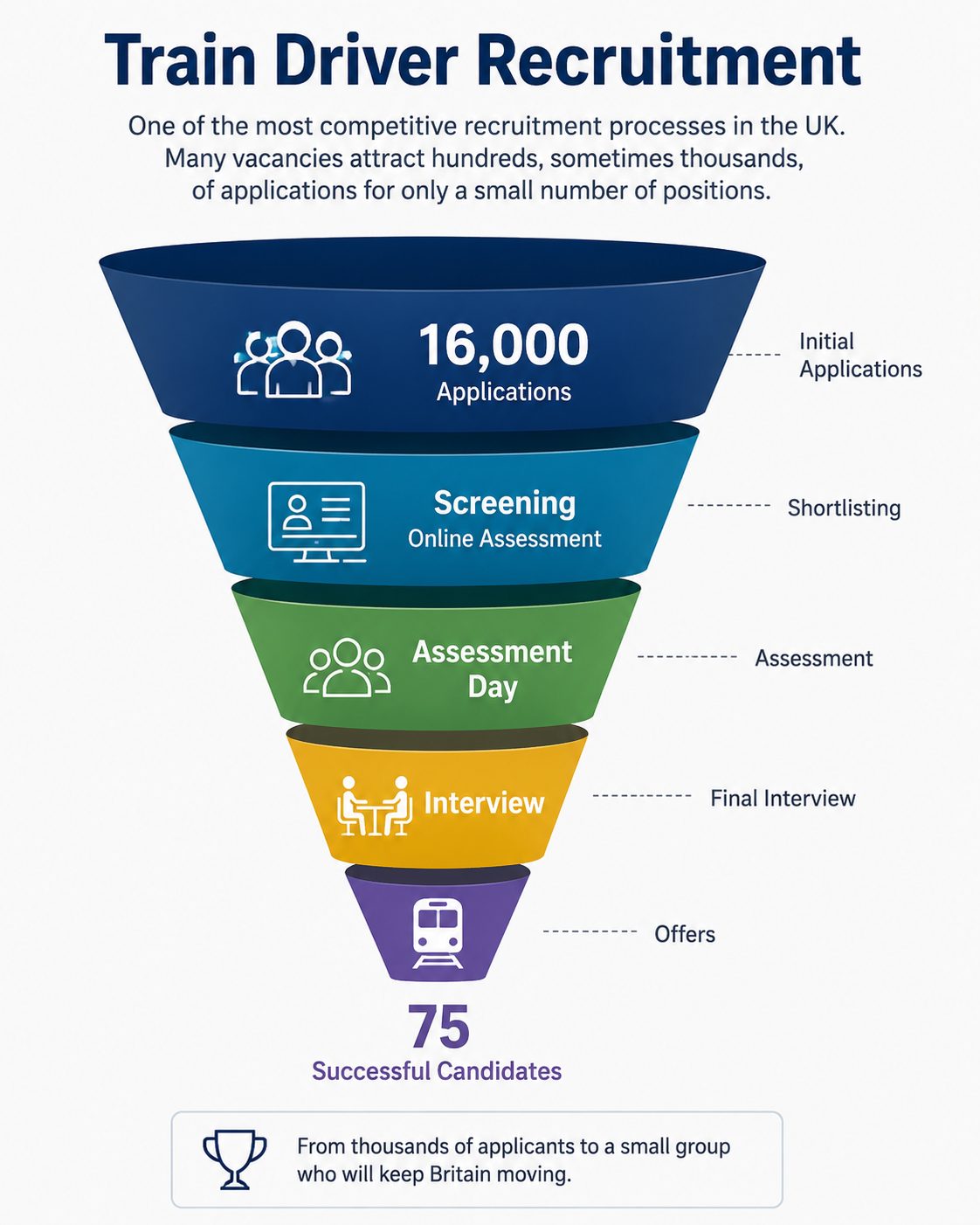



A vacancy may attract thousands of applications, but rail skills in demand are not simply a list of qualifications to add to a CV. For trainee train driver and other safety-critical roles, employers need evidence that you can work methodically, make sound decisions and remain dependable when the routine changes. The strongest applicants understand that railway recruitment is designed to assess how they are likely to perform over the long term, not just how well they can describe the job.
Rail offers a respected, structured career path, but it also carries serious operational responsibility. That is why Train Operating Companies (TOCs) assess candidates carefully through application screening, psychometric tests, structured interviews and medical standards. Knowing which skills matter, and how to show them credibly, gives you a far more useful starting point than generic interview advice.
Why rail employers look beyond experience
Many capable candidates come into rail from other sectors. You may have worked in the Armed Forces, logistics, engineering, customer operations, manufacturing, emergency services or a public-facing role. Direct railway experience can help, but it is not the only route into a trainee position.
What matters is whether your existing experience demonstrates behaviours that transfer to a safety-critical environment. A delivery driver who completed checks consistently, a supervisor who escalated a fault correctly, or a service leaver who maintained standards under pressure may all have relevant evidence. The setting is different; the underlying discipline is not.
A common mistake is to focus a CV on enthusiasm for trains or broad personal qualities such as being hardworking. Motivation matters, but it does not prove operational readiness. Employers need specific examples that show what you did, why the process mattered, how you managed risk and what result followed.
The rail skills in demand for safety-critical roles
Safety awareness and risk-based decision making
Safety is not an isolated skill used only when something goes wrong. It is a daily way of working. In rail, this means following rules, completing checks properly, recognising when conditions are not normal and taking the appropriate action rather than making assumptions.
Good candidates can explain occasions when they identified a hazard, paused a task, used the right reporting route or challenged an unsafe practice professionally. Your example does not need to involve dramatic danger. In fact, a calm example of preventing a small issue from becoming a larger one can be more convincing because it reflects normal operational discipline.
Risk-based decision making also means understanding your limits. There are situations where the correct decision is to stop, seek clarification or escalate. Candidates who present themselves as people who always act alone can unintentionally raise concerns. Railway work depends on clear boundaries, communication and compliance.
Sustained concentration and situational awareness
Train driving requires attention over long periods, including on familiar routes and during quiet periods when distractions can creep in. Other rail roles also demand close observation, accurate checking and awareness of changing circumstances.
Employers will look for evidence that you can maintain focus without becoming complacent. You might draw on work involving monitoring equipment, driving professionally, completing repetitive quality checks, supervising a busy environment or working to time-sensitive procedures. The key is to describe how you maintained accuracy, not merely that you were busy.
Situational awareness is closely connected. It involves noticing relevant information, understanding what it means and responding appropriately. For example, recognising a change in the operating environment, a customer issue that needs escalation or an inconsistency in a document shows that you are actively engaged with the task.
Following procedures with care and consistency
Procedures exist in rail because consistency protects passengers, colleagues and the operation. A candidate who sees rules as optional when under pressure is unlikely to suit a safety-critical role.
This does not mean employers want robotic answers. They want people who understand the purpose of a process and can apply it accurately. Strong interview examples often show that you followed a defined method, checked your work, recorded information clearly and raised an issue when the process could not be completed as expected.
Be precise in your language. Rather than saying, “I always follow rules”, explain the procedure, your responsibility within it and how you made sure it was completed. That level of detail helps a recruiter assess your judgement and reliability.
Clear communication and professional reporting
Railway communication must be accurate, concise and timely. Whether you are speaking with a controller, colleague, manager or customer, unclear information can create delay, confusion or risk.
For applicants, this skill is often tested through the quality of written applications and structured interview answers as much as through a direct communication question. Use a logical sequence: explain the situation, state your responsibility, describe the action you took and give the outcome. Avoid embellishment, jargon from unrelated industries or vague statements that leave the interviewer guessing.
Professional reporting also includes knowing when to communicate. Raising a concern early, recording a defect correctly or handing over important information demonstrates maturity. It shows that you understand the difference between managing a task and protecting the wider operation.
Emotional control and resilience
A railway career can involve disruption, shift work, customer pressure, unexpected events and periods of working independently. Resilience is not about pretending stress has no effect. It is the ability to remain composed, use the correct process and recover your focus when demands increase.
A useful example might involve dealing with conflict, changing priorities or a difficult operational decision while maintaining standards. The strongest answers show self-awareness: what did you do to stay effective, who did you inform and what did you learn? Blaming others or presenting an emotionally charged account rarely supports a safety-critical application.
Shift work also deserves honest consideration. Candidates should assess whether they can reliably manage early starts, nights, weekends and public holidays. Dependability is a core requirement, not an administrative detail. A well-prepared applicant has considered the practical impact on travel, sleep, family commitments and personal routine before applying.
Learning agility and operational maturity
Trainee train driver roles involve substantial learning. You will need to absorb rules, route knowledge, traction knowledge and operational principles over time, then apply them reliably. Employers therefore value candidates who take learning seriously and can accept feedback without becoming defensive.
Operational maturity is shown through habits: preparing for a task, using feedback to improve, avoiding unnecessary shortcuts and understanding how individual actions affect colleagues and passengers. It is less about age or seniority than judgement.
CPD can support this area when it is relevant and genuinely completed. Introductory learning in operational thinking, personal track safety, traction and rolling stock, or risk-based decision making can help you build vocabulary and context. It will not replace recruitment standards or work experience, but it can strengthen your understanding and give your preparation more structure.
Turning your experience into credible evidence
Before applying, review your work history through an operational lens. Identify examples where you maintained concentration, followed a process, managed a changing situation, communicated accurately, received feedback or took responsibility for safety. Then write each example in a clear structure: context, required standard, your actions and the outcome.
Choose examples you can discuss naturally and in detail. A polished but thin answer is less useful than an ordinary workplace example with clear evidence of judgement. If an interviewer asks follow-up questions, you should be able to explain what you noticed, what options you considered and why you chose your action.
Your CV should make this evidence easy to find. Lead with responsibilities that demonstrate safety, reliability and process control. Quantities and results can be helpful where they are accurate, but do not force numbers into every statement. In safety-critical recruitment, quality of judgement matters as much as speed or output.
Preparing without treating assessment as a shortcut
Psychometric tests and structured interviews are part of a wider assessment of suitability. Practice can familiarise you with question formats, improve your time management and reduce avoidable anxiety. It should not be approached as a way to manufacture a personality or bypass the process.
A better approach is to prepare systematically. Check eligibility and vacancy requirements carefully, tailor your CV to the role, practise explaining real examples and develop a realistic understanding of operational expectations. If you identify a gap, address it through relevant learning, stronger evidence gathering or further experience rather than hoping a generic application will carry you through.
For many applicants, independent preparation provides the structure they need. Train Driver Foundation focuses on role-specific guidance, CV support, assessment practice and CPD learning designed around the standards candidates encounter when pursuing train driver careers.
The most valuable rail skills are built through consistent habits: arriving prepared, checking carefully, communicating clearly and doing the right thing when the easiest option is not the safest one. Start developing evidence of those habits now, and each application will reflect a more credible, professionally ready candidate.