



Leaving the Armed Forces often means finding a civilian career that still values discipline, responsibility and clear standards. Railway careers for veterans can offer exactly that, particularly for people who are comfortable following rules, working shifts, making sound decisions and taking ownership of safety. However, rail recruitment is competitive and safety-critical. Military experience can provide a strong foundation, but it must be presented clearly and matched to the requirements of the specific role.
For service leavers considering train driving or another operational railway position, the most productive approach is to understand where your experience fits, identify any gaps early and prepare for recruitment in the way Train Operating Companies and rail employers expect.
Why the railway can suit military service leavers
The railway needs people who can maintain concentration, communicate accurately and act professionally when conditions are demanding. Those qualities are familiar to many veterans. A career in rail also offers defined operating standards, formal training, ongoing competence assessment and progression routes that can appeal to people used to structured professional development.
Your service background may have developed practical strengths that employers value: procedural discipline, situational awareness, calm decision making, teamwork and an appreciation of the consequences of poor communication. Experience of working independently, managing fatigue, operating equipment or responding to changing priorities may also be relevant.
That said, an Armed Forces background is not an automatic route into rail. Employers recruit against their own role profiles and selection standards. A former engineer, driver, logistics specialist or combat role professional may all have useful experience, but each applicant still needs to demonstrate the behaviours required for the vacancy. The strongest applications explain relevance rather than assuming it will be obvious.
Railway careers for veterans: roles to consider
Train driving attracts significant interest from service leavers because it combines independent working with a high level of responsibility. Trainee train driver roles typically involve intensive initial training, shift work and a long-term commitment to safe, consistent performance. The role is not simply about operating a train. It requires sustained vigilance, rule compliance, effective communication and the maturity to manage routine work without becoming complacent.
Eligibility requirements vary between Train Operating Companies, locations and vacancies. Residence-distance rules, previous applications, medical standards and availability for training can all affect whether a person is able to apply. Read every advert carefully rather than relying on general advice from another operator or a previous campaign.
Other railway careers may be equally suitable depending on your skills and preferences. Conductors and guards work directly with customers while retaining important operational responsibilities. Depot, shunting and fleet roles can suit candidates with mechanical awareness and a methodical approach to safe systems of work. Control, incident response and operations roles may appeal to those with experience of co-ordination, communications and prioritisation under pressure.
Infrastructure and maintenance careers offer another route, although the work can involve outdoor conditions, nights and safety-critical site requirements. Freight operators also employ operational staff across driving, ground operations and planning functions. The right choice depends on whether you prefer customer-facing work, technical tasks, independent concentration or a more team-based operational environment.
Do not focus only on the job title
A stable career is built around the day-to-day reality of a role, not its headline. Consider the commute, roster pattern, weekend and bank holiday working, training location and the likelihood of moving between duties. A job may be attractive on paper but less suitable if the shifts conflict with family commitments or if the depot is difficult to reach reliably at unsocial hours.
For train driving in particular, candidates should be realistic about the concentration demands and the solitary nature of much of the work. Some service leavers enjoy the autonomy. Others find they miss the constant team interaction of military life. Neither response is wrong, but recognising it early helps you target roles well.
Understanding the recruitment standard
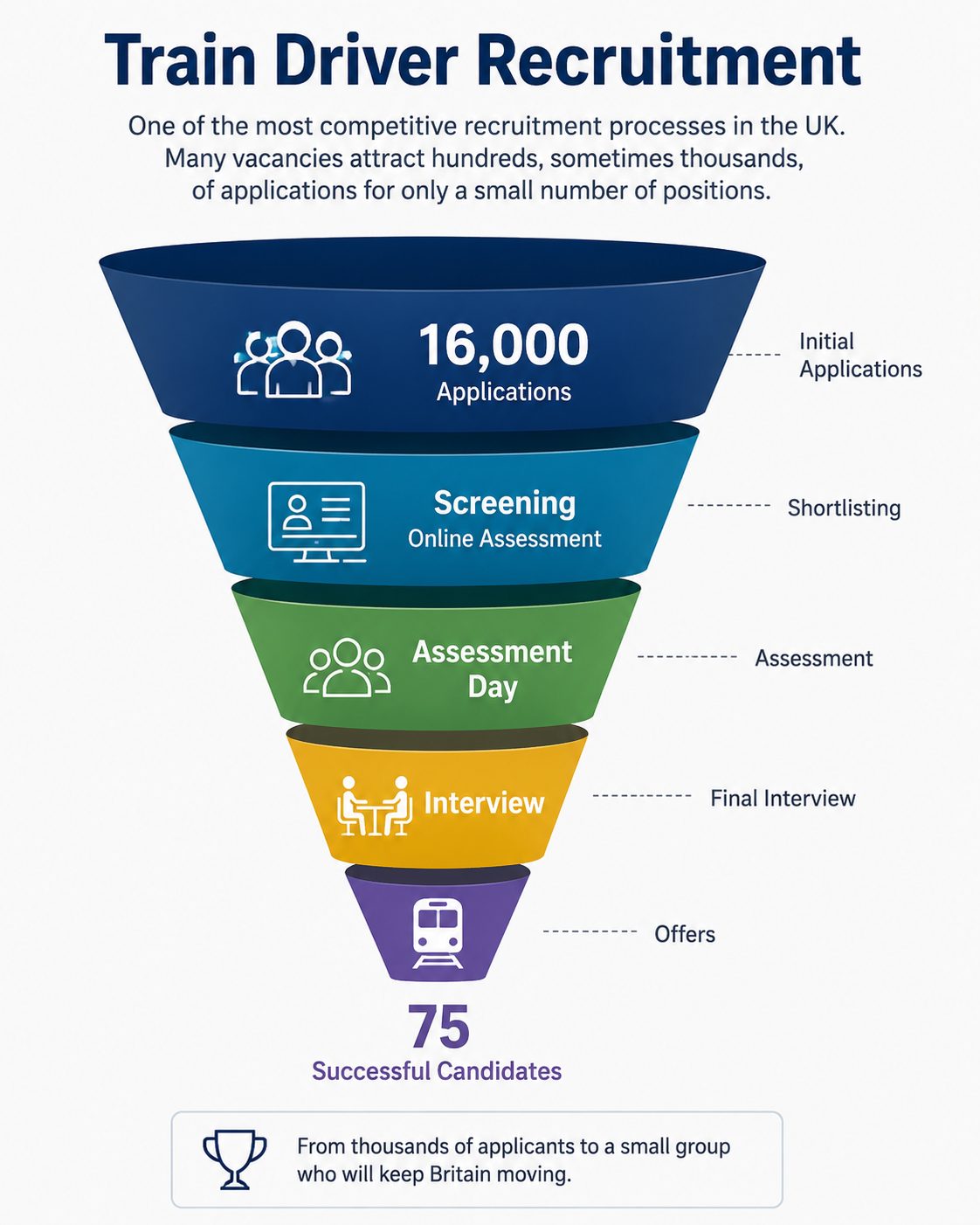
Rail employers use structured recruitment because operational roles carry genuine safety responsibilities. The process can include an online application, initial screening, online assessments, psychometric testing, structured interviews, medical assessment and, where relevant, a drugs and alcohol test. The sequence differs by employer and vacancy.
Psychometric assessments are designed to assess qualities that matter in safety-critical work, such as concentration, reactions, rule application and the ability to process information accurately. They are not tests to bypass through tricks. Preparation should focus on understanding the format, practising under realistic conditions and learning how to work accurately within time limits.
Structured interviews need the same disciplined approach. Recruiters will usually assess evidence of specific behaviours, including safety awareness, communication, following procedures, working alone, managing pressure and dealing with change. A broad statement such as ‘I was responsible for safety in the military’ is rarely enough. You need a relevant example that shows what you did, why you did it and what the outcome was.
Medical fitness also matters. Railway employers need assurance that candidates can safely carry out the role, including the demands of shift work and any role-specific standards. If you have an existing health condition or take prescribed medication, do not make assumptions based on online discussion. Follow the employer’s process and provide information honestly when requested.
Turn military experience into clear evidence
Military terminology can make a CV sound impressive to people with the same background, while leaving a civilian recruiter unclear about what you actually did. Translate acronyms, ranks and unit-specific language into plain English. Focus on responsibilities, decisions and measurable outcomes.
For example, instead of describing a particular military qualification, explain that you worked within a controlled safety system, completed checks before operating equipment, reported defects accurately and stopped work when conditions fell outside the required standard. That language helps a recruiter see the connection to rail.
Use a clear situation, task, action and result structure when preparing examples. Choose experiences where your own contribution is evident. Good evidence might involve challenging an unsafe assumption, maintaining standards during a long shift, passing on critical information during a handover or responding calmly when plans changed.
Avoid overstating your experience. Rail employers respect confidence, but they also look for self-awareness and willingness to learn. You may have extensive operational experience, yet railway rules, language and working practices will be new. Showing that you understand this is a strength, not a weakness.
Prepare before the vacancy opens
Recruitment campaigns can move quickly, and an application form is not the best place to start thinking about your evidence. Build your preparation before a suitable role appears. Review your CV, identify examples for common competency areas and practise explaining your experience without military shorthand.
Research the employer and the actual depot or location where possible. Understand the operational nature of the role, but do not rely on rumours about recruitment campaigns, pass marks or internal procedures. Vacancy information and the job description should remain your primary reference point.
It is also sensible to prepare for online assessments in a measured way. Familiarise yourself with common assessment formats, practise concentration and numerical or verbal tasks where relevant, and create a quiet environment for the real assessment. Following instructions precisely is part of the test. Rushing because a question feels simple can damage accuracy.
Formal learning can help service leavers develop railway vocabulary and demonstrate purposeful career development. Introductory training in operational thinking, risk-based decision making, personal track safety or traction and rolling stock can be useful when chosen for a clear reason. Where available and appropriate, Standard Learning Credit aligned learning may support this stage of transition. Training should strengthen your understanding, not replace the need to meet an employer’s own selection process.
Managing the transition into civilian rail
The transition is often more than a change of uniform. Civilian recruitment may feel less direct than a military posting process, and feedback is not always available after an unsuccessful application. This can be frustrating, particularly when you know you have strong operational experience. Treat each application as a separate opportunity to improve rather than a judgement on your wider career.
You may also need to adjust how you communicate. Rail recruitment rewards concise, relevant evidence over formal military phrasing. Ask yourself whether someone with no knowledge of your previous trade would understand the example and its relevance within thirty seconds.
A rejection does not necessarily mean you are unsuitable for railway work. It may reflect a high-volume campaign, a location-specific requirement, an assessment outcome or a stronger match elsewhere. Review what you can improve, maintain assessment integrity and apply again only where you meet the stated criteria.
A well-planned move into rail starts with honest self-assessment. Match your service experience to the role, prepare for the standard expected and give yourself time to develop evidence that a railway recruiter can clearly understand. Professionalism, patience and consistent preparation will serve you well long before the first day of training.