
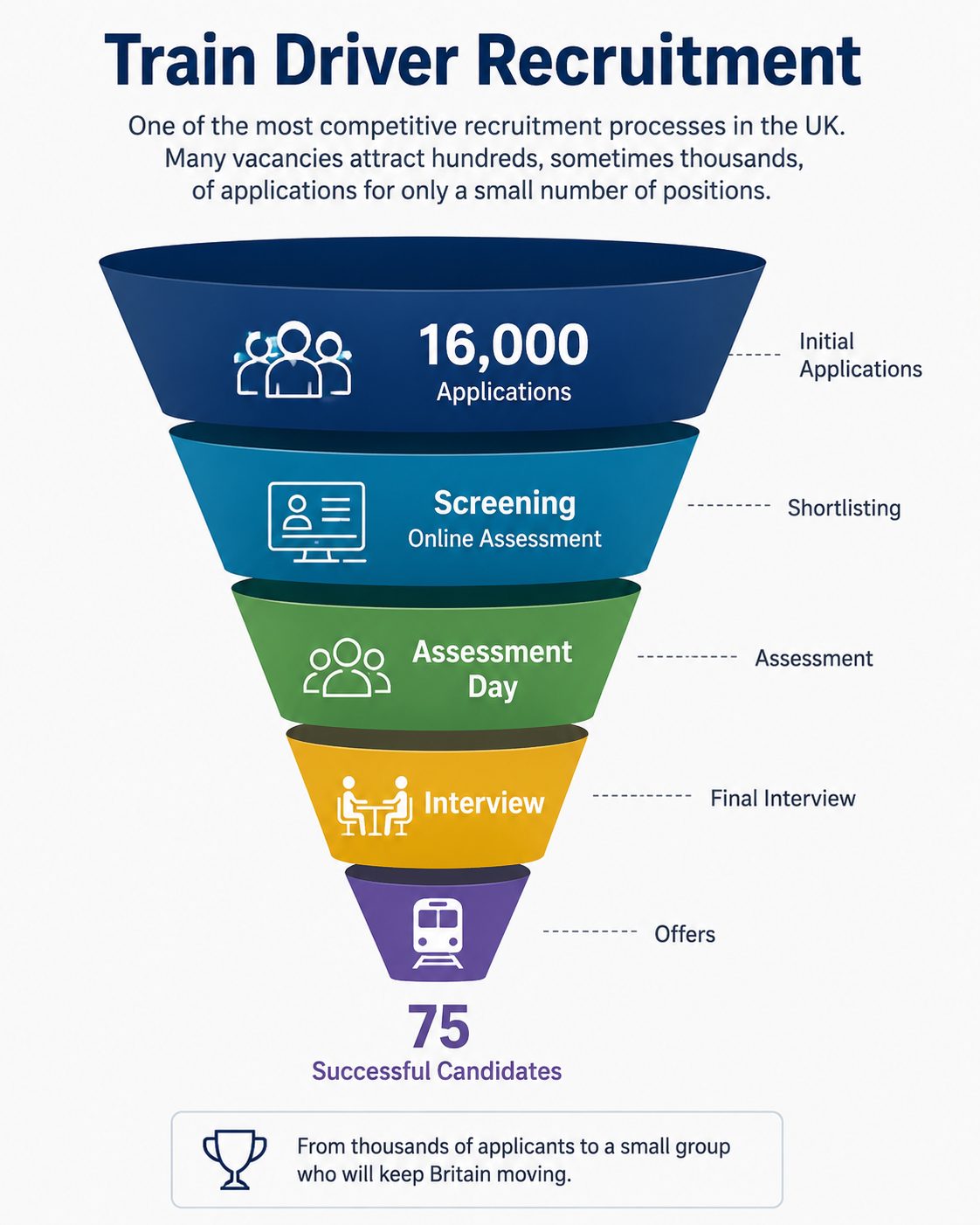




A trainee train driver CV may be read alongside a large volume of applications from capable people with strong work histories. Railway CV standards are therefore less about attractive design or clever wording and more about presenting credible evidence of the behaviours a safety-critical employer needs to see: reliability, concentration, procedural discipline, communication and sound judgement.
For most Train Operating Company (TOC) applications, your CV is not a substitute for the application form. It is supporting evidence. It should make your experience easy to understand and give the recruiter confidence that you can meet the professional demands of a role where safety, rules and consistency matter every day.
What railway CV standards look for
There is no single CV template used by every TOC, and each vacancy may ask for different information. However, strong railway CV standards are consistent in one respect: claims must be supported by relevant examples.
Saying that you are “safety-conscious” has limited value on its own. Explaining that you completed pre-use checks, followed a permit-to-work process, escalated defects promptly or stopped work when conditions were unsafe gives that claim weight. The same principle applies to punctuality, customer service, teamwork and working under pressure.
Recruiters are looking for evidence that your existing behaviour is compatible with safety-critical work. You do not need previous railway employment to demonstrate this. Candidates from logistics, aviation, manufacturing, emergency services, the Armed Forces, utilities, retail management and many other sectors can have highly relevant experience when it is described properly.
Start with relevance, not a generic personal statement
Your opening profile should be short, factual and tailored to the vacancy. Avoid broad statements such as “seeking a challenging new opportunity” or “a hard-working individual with excellent skills”. These phrases do not distinguish you from other applicants.
Instead, establish your professional background, the operational strengths you bring and the direction you are taking. A candidate moving from a depot, warehouse or transport role, for example, might state that they have experience of working to defined procedures, meeting time-critical requirements and maintaining high standards of attendance and safety.
Do not claim that you understand every aspect of train driving if you have not done the role. A more credible approach is to show that you understand its core demands: independent working, sustained concentration, rule compliance, clear communication and responsibility for safety. This demonstrates maturity without overstating your experience.
Put safety-critical evidence into your employment history
The employment history section should do more than list job titles and dates. Under each relevant role, show what you were responsible for and how you carried out that responsibility. Use concise, outcome-focused language.
A useful way to write each role is to cover the working environment, the responsibility and the behaviour you demonstrated. For example, rather than writing “responsible for deliveries”, a stronger description might explain that you planned work within fixed schedules, completed mandatory vehicle checks, reported defects and maintained accurate records while dealing professionally with customers.
Look for evidence in four areas:
- Following documented procedures, instructions, rules or checklists.
- Identifying hazards, reporting concerns and acting within your authority.
- Maintaining concentration and accuracy during repetitive, time-sensitive or lone work.
- Communicating clearly with colleagues, supervisors, customers or control functions.
The right examples depend on your background. A military service leaver may draw on disciplined routine, briefings, equipment accountability and risk assessment. A care worker may demonstrate calm decision-making, detailed record keeping and escalation. A bus driver may show road safety awareness, customer communication and consistent adherence to scheduled duties. The task is to translate real experience into evidence a railway recruiter can assess.
Show reliability with facts
Reliability is central to train driver recruitment. Early starts, shifts, weekend duties and personal responsibility for reporting fit for work require a dependable approach. Your CV should make this visible where possible.
Include stable employment dates, relevant shift patterns and any responsibilities that depended on your attendance or handover quality. If you have been trusted to open or close a site, work alone, cover safety-related checks or mentor colleagues, these details can help. They show that others relied on you to turn up prepared and perform consistently.
Be honest about employment gaps. A brief, neutral explanation is usually better than leaving a recruiter to guess. Caring responsibilities, study, relocation or planned career development can be stated plainly. Do not turn the CV into a detailed personal account, but do ensure the timeline is clear.
Accuracy matters as much as presentation
A CV for a railway role should be clean, structured and easy to scan. Use clear headings, consistent dates and straightforward fonts. Two pages is often sufficient for an applicant with an established work history, although quality matters more than a fixed page count.
Proofread it carefully. Spelling errors, conflicting dates and vague job descriptions can raise concerns about attention to detail. In a role where records, instructions and communication must be handled accurately, presentation is part of the evidence.
Avoid decorative graphics, skill bars and heavily designed templates that make content harder to read. Applicant systems and recruiters both benefit from simple formatting. Use bullet points within employment entries where they clarify distinct responsibilities, but do not create a long list of generic duties.
Address career changes directly
Many successful railway applicants are career changers. Your previous sector does not need to look like rail for it to be relevant, but your CV should explain the connection.
If you are moving from an office-based role, identify where you managed confidential information, followed compliance processes, made careful decisions or remained focused over long periods. If you are coming from retail or hospitality, do not limit yourself to customer service. Consider cash accuracy, incident reporting, opening procedures, supervision, conflict management and working to demanding schedules.
A short profile can explain your motivation for a move into rail, but keep the focus on professional fit. Employers are unlikely to be persuaded by salary or lifestyle motivations alone. They need to see that you understand the responsibility attached to a safety-critical career and are prepared for its operational realities.
Education, licences and training
List qualifications clearly, particularly English and maths qualifications where requested in the vacancy. Include driving licences, relevant industry cards, first aid training, operational certifications and CPD that support your application. State the awarding body and completion date when useful.
Only include training you can discuss confidently. A course title without any indication of what you learned will not carry much weight. Where appropriate, add a brief line explaining how the learning strengthened your understanding of safety, operational risk, rolling stock awareness or professional decision-making.
Train Driver Foundation’s role-specific CPD learning can help candidates build a more informed foundation, but it does not replace the selection process or the requirements set by a TOC. Training should support genuine understanding and give you better language for explaining your readiness, not become a collection of badges on the page.
Tailor the CV to the vacancy
Before submitting, read the vacancy wording closely. If it refers to shift work, safety, customer-facing duties, independent working, communication or residence requirements, check that your CV addresses the relevant points truthfully.
Tailoring does not mean copying phrases from an advert without evidence. It means selecting the strongest examples from your work history and placing them where they will be seen. A good CV is selective. It gives a recruiter a clear, consistent picture rather than every task you have ever completed.
Keep a master CV with your full employment history, qualifications and examples, then produce a focused version for each application. This reduces rushed applications and helps you maintain accuracy when several recruitment campaigns are open at once.
Final checks before you apply
Read your CV as if you were a recruiter seeing it for the first time. Can you quickly identify your employment history, your safety-related responsibilities, your reliability and your reason for applying? Are dates complete? Are claims specific? Does every section support the role you want?
If the answer is no, revise before submitting. A carefully prepared CV will not guarantee progression, because trainee train driver recruitment is competitive and includes several assessment stages. It can, however, ensure that your experience is presented to the standard it deserves.
Your CV is the first operational document in your application journey. Treat it with the same care you would bring to a safety-critical responsibility: be accurate, be specific and make every statement capable of standing up to scrutiny.