



Leaving the Armed Forces often means stepping away from a role built on discipline, procedure and accountability. That is exactly why a service leavers train driver career can be a credible next move. The railway values people who can follow strict standards, stay composed under pressure and make safe decisions when routine changes.
Train driving is not a fallback career and it is not a quick entry route. It is a safety-critical profession with a demanding recruitment process, high expectations around concentration and strong emphasis on operational judgement. For many service leavers, that will feel familiar rather than intimidating. The challenge is not whether your background is valuable. The challenge is translating it properly for a civilian rail employer.
Why a service leavers train driver career makes sense
Many former military personnel are drawn to train driving for the same reasons they valued service life - structure, responsibility, standards and purpose. You are working within a regulated environment where procedures matter, complacency is dangerous and consistency is part of the job. That alignment is real, but it should not be overstated. Railway employers do not recruit simply because someone has served. They recruit because a candidate can demonstrate the right behaviours for the specific demands of the role.
That distinction matters. A service record can strengthen an application, but it does not replace evidence. Train Operating Companies want to see concentration, rule adherence, emotional control, risk awareness, communication and the ability to work independently for long periods. Service leavers often have these qualities, but they still need to present them in rail-relevant terms.
The strongest candidates usually avoid broad statements such as being good under pressure or used to responsibility. Instead, they explain how they maintained standards, followed technical procedures, responded to changing conditions and stayed focused during repetitive but important tasks. That kind of evidence is far more useful in train driver recruitment.
The parts of military experience that transfer well
A good service leavers train driver career plan starts with understanding what actually transfers. Not every military role is the same, and not every experience maps neatly into rail. Still, several areas tend to carry real value.
Operational discipline is one of them. Train drivers work in a rules-based environment where consistency is essential. If your background includes following formal procedures, using checklists, reporting accurately and maintaining standards under supervision and independently, that is relevant.
Situational awareness is another. Drivers must monitor signals, speed, route conditions and operational changes while remaining calm and focused. Service leavers from technical, transport, engineering, logistics and operational roles may already be used to processing information carefully in live environments.
Fatigue management and personal responsibility also matter. Railway work can involve early starts, late finishes, shift patterns and periods of lone working. Candidates who have managed demanding routines and stayed reliable within safety-critical systems may already understand the level of self-management involved.
What does not transfer automatically is railway knowledge. You may have worked in highly regulated settings, but train driving has its own standards, language and recruitment benchmarks. That is where preparation becomes important.
What train operators will assess
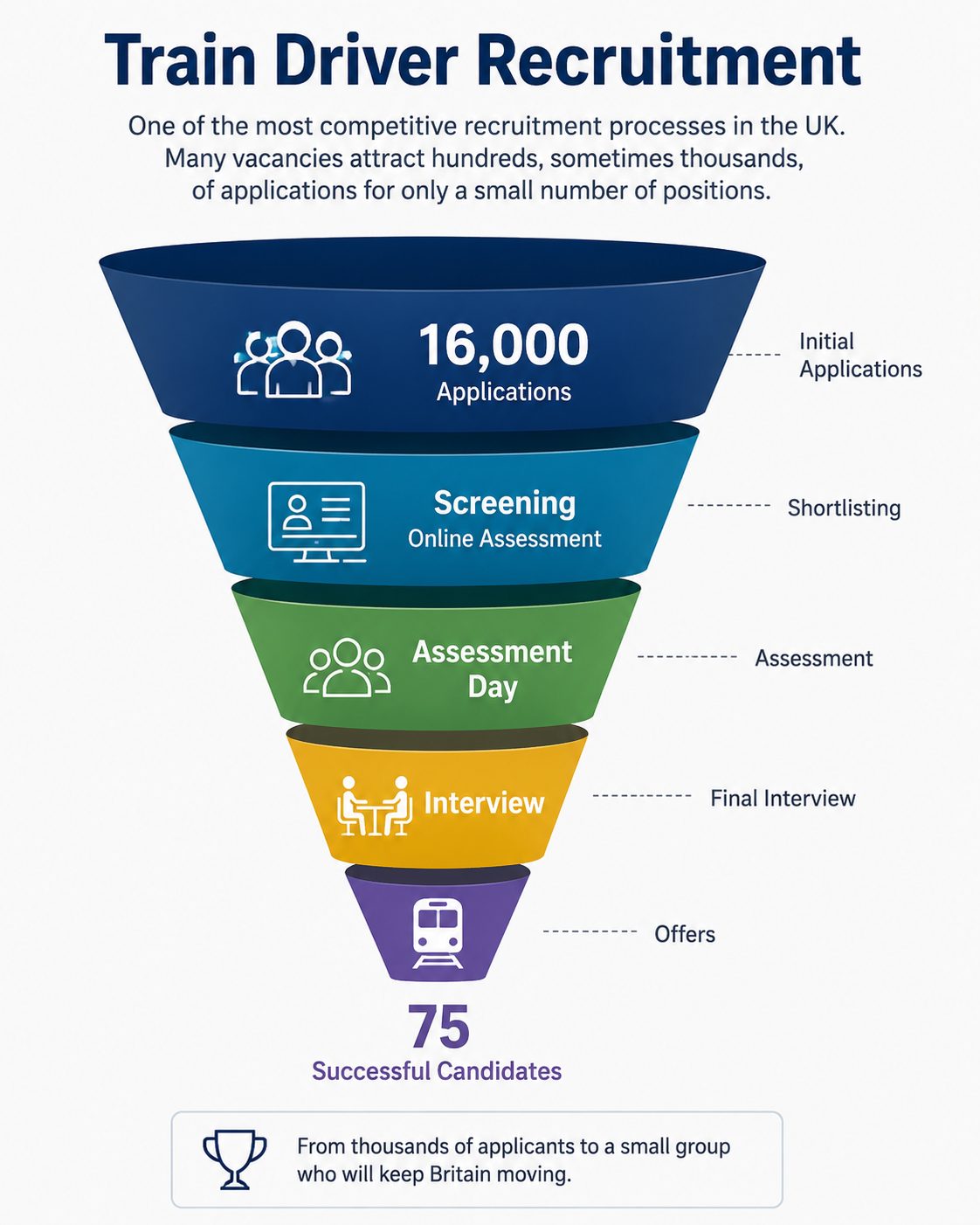
Most first-time applicants underestimate how structured train driver recruitment is. Employers are not only reviewing a CV and deciding whether someone seems capable. They are assessing suitability through several stages designed to test consistency, safety awareness and behavioural fit.
The early stage often includes application screening. This is where many service leavers either do well or fall away. A strong background can still be weakened by a CV that is too military in language, too vague in examples or too focused on rank rather than responsibilities. Civilian employers need clarity. They want to understand what you did, how you did it and why it shows readiness for a safety-critical role.
If shortlisted, candidates may face online assessments, psychometric testing and structured interviews. These stages are there to measure concentration, attention, decision making and the behaviours required for safe train operation. There is no shortcut through them. Good preparation helps because it familiarises you with the format, the pressure and the level of response expected, but it does not remove the need for genuine suitability.
Structured interviews are especially important for service leavers. This is often the point where a good candidate either converts military experience effectively or loses ground by assuming the value is obvious. Interviewers need specific examples of following procedure, maintaining focus, challenging unsafe situations, communicating clearly and staying composed when plans change. They also need confidence that you understand train driving as it is, not as you imagine it.
Common mistakes service leavers make
One of the most frequent errors is assuming that discipline alone is enough. It is helpful, but train driving also demands patience, concentration and a very measured style of judgement. Some strong military candidates speak convincingly about leadership and action, but less convincingly about routine, repetition and calm vigilance. In rail, those quieter strengths matter a great deal.
Another mistake is using too much service-specific terminology. Acronyms, unit references and internal language can confuse recruiters if they are not translated properly. Your aim is not to impress with military detail. It is to make your evidence easy to understand and clearly relevant.
Some applicants also focus too heavily on the attraction of the role rather than the realities of it. Stability and long-term career prospects are valid reasons to apply, but employers want to know that you understand the operational side - shift work, route learning, strict rules, lone working and continuous standards. Realism is usually more persuasive than enthusiasm on its own.
How to prepare properly for the transition
The best preparation is structured rather than reactive. Start by reviewing the role in practical terms. Understand what trainee train driver positions involve, what employers tend to ask for and where your own experience aligns or leaves a gap.
Your CV should be translated into civilian language with a clear focus on safety, procedure, concentration, responsibility and communication. It should not read like a service record. It should read like evidence of suitability for a regulated operational role.
You should also prepare for assessments and structured interviews well before vacancies open. Train driver recruitment is competitive, and waiting until an application goes live often leaves too little time to build quality answers or become familiar with assessment formats. Preparation is particularly valuable for service leavers because it helps bridge the gap between a strong background and a targeted application.
This is where specialist support can be useful. A provider focused specifically on train driver recruitment can help you interpret employer expectations, refine your examples and build a preparation plan around real selection standards. That is far more useful than generic career advice aimed at broad civilian employment.
Building rail relevance before you apply
You do not need prior train driving experience to apply for trainee roles, but you do benefit from showing genuine commitment to the sector. That means learning the expectations of safety-critical work in rail and developing your understanding of operational behaviours.
CPD-style learning can help here, especially for service leavers who want a more structured transition. Subjects such as operational thinking, risk-based decision making and rail safety awareness can strengthen your confidence and give you a clearer framework for interviews. The benefit is not about collecting certificates for their own sake. It is about showing that you take the profession seriously and are preparing in a way that reflects the job.
It also helps you test your own fit. Train driving suits people who are comfortable with rules, repetition and accountability. It may be less suitable for those who need constant variety, frequent social interaction or a highly flexible schedule. Service leavers sometimes assume the operational nature of the railway means it will automatically suit them. Often it does, but not always in the way they first expect.
Is this the right next step?
A service leavers train driver career is a strong option for people who want a safety-critical role with structure, high standards and long-term professional identity. It can be particularly suitable for those from transport, logistics, engineering, operations or other disciplined military environments. But suitability depends on more than background.
The key question is whether you can demonstrate the behaviours train operators need and whether you are ready to prepare properly for a competitive process. That means understanding the role clearly, translating your experience accurately and approaching recruitment with professionalism rather than assumption.
For many service leavers, that is a very achievable shift. Your background may already contain much of the discipline and operational maturity the railway values. The next step is turning that into evidence that speaks the language of train driver recruitment and shows you are ready for the standards the role demands.
If you approach the transition with clarity, patience and proper preparation, rail can offer more than a job after service - it can offer a career that still rewards responsibility, precision and calm judgement every day.