



A trainee train driver CV is not a place for broad claims such as “hard-working” or “a good team player”. Recruiters need clear evidence that you can work reliably in a safety-critical environment, follow procedures, remain focused and communicate professionally. This successful train driver CV example shows how to present that evidence before you reach the online assessments and structured interview stages.
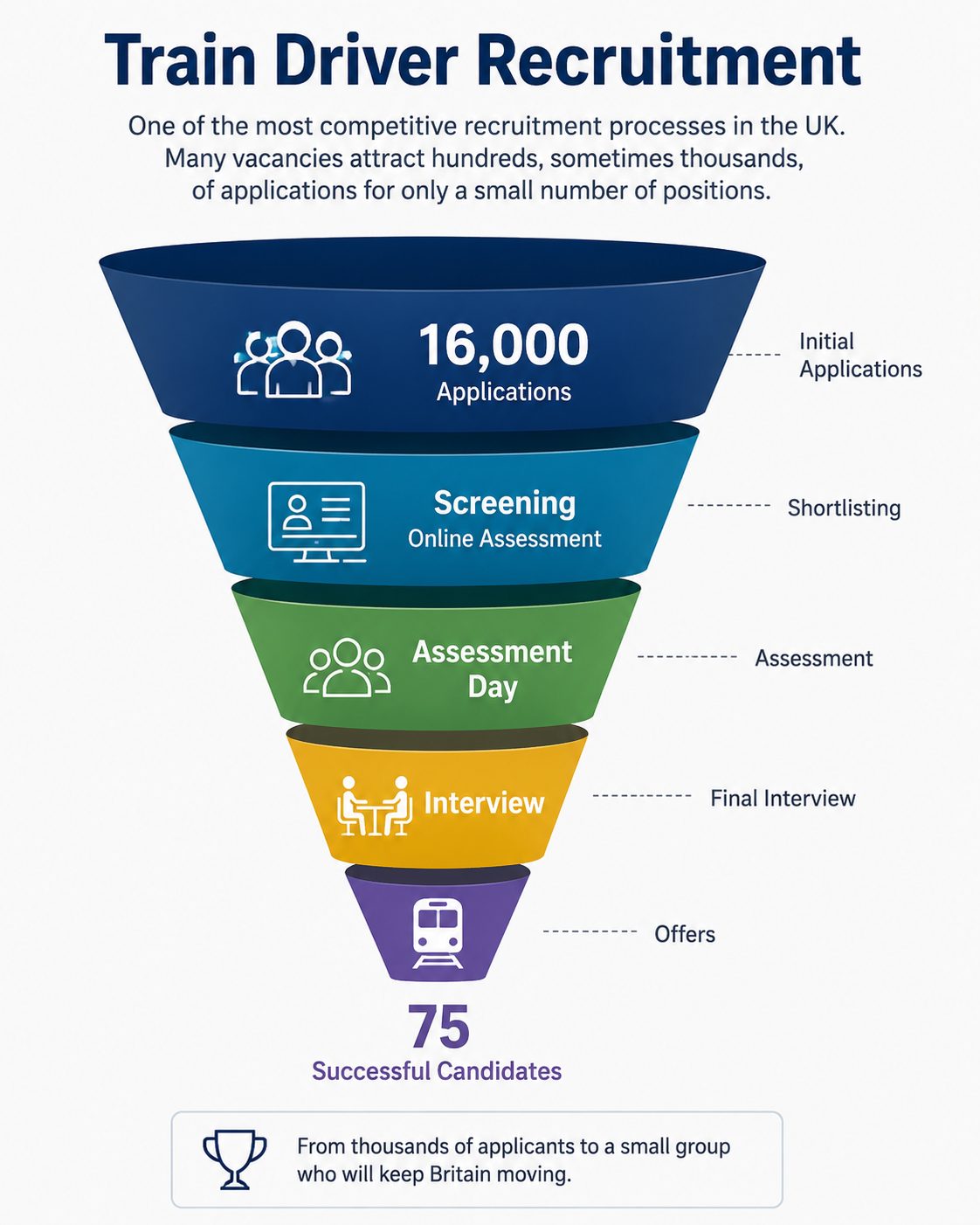
The strongest applications do not try to sound like an experienced driver when the applicant is not one. They make a credible connection between previous work, the demands of the role and the standards expected by a Train Operating Company (TOC). That difference matters in a competitive recruitment process.
What a successful train driver CV example needs to show
A CV for a trainee driver vacancy should make it easy for a recruiter to identify the behaviours required for safe, dependable operational work. Your job title matters less than the quality of the examples you provide. A warehouse supervisor, bus driver, Armed Forces service leaver, control room operator or retail manager may all have relevant experience if they can explain it precisely.
Focus on evidence of working to rules and procedures, maintaining concentration during routine or repetitive tasks, managing time and punctuality, reporting issues correctly, making considered decisions and communicating with colleagues or customers under pressure. You should also show personal responsibility. In rail, safety is not a line added at the end of a CV. It should be visible in how you describe your work.
Avoid copying wording from a person specification without supporting it. “Excellent safety awareness” is weak on its own. “Completed pre-use checks, isolated faulty equipment and reported defects before work continued” gives the reader something they can assess.
Train driver CV example
The following is a model structure, not a script to reproduce word for word. Replace every detail with your own genuine experience and use the terminology that accurately reflects your current or previous role.
Professional profile
Reliable and safety-focused operational professional with eight years’ experience working to procedures, meeting time-critical commitments and maintaining high standards during shift-based work. Experienced in completing checks, identifying and escalating defects, recording information accurately and communicating clearly with colleagues, supervisors and members of the public. Seeking a trainee train driver opportunity where disciplined working, sustained concentration and a strong commitment to safety can support a long-term railway career.
This opening works because it is specific without overstating rail experience. It identifies relevant behaviours and gives the reader a clear reason for the application. If you are changing career, do not apologise for that change. Make the transfer of skills obvious.
Key skills
Keep this section concise and support each skill elsewhere in the CV. Suitable examples include safety-critical working, procedure compliance, shift work and fatigue awareness, accurate record keeping, incident and defect reporting, customer communication, situational awareness, independent working and teamwork.
Do not include skills you cannot evidence at interview. A structured interview is likely to explore the situations behind your claims, so consistency between your CV and your examples is essential.
Employment history
Operations Supervisor | Logistics Company | May 2019 to Present
- Supervise daily loading activity within a busy distribution operation, allocating work while maintaining site safety rules and planned departure times.
- Complete documented vehicle and equipment checks at the start of each shift, remove defective equipment from use and report faults through the required process.
- Maintain accurate handover records for incoming supervisors, including outstanding issues, delays and safety concerns.
- Respond calmly when plans change, such as late arrivals or equipment failures, prioritising safe working before productivity.
- Support new colleagues with local procedures and challenge unsafe practice professionally when required.
Customer Service Adviser | Transport and Travel Business | January 2016 to April 2019
- Provided clear, accurate information to customers during service disruption while remaining professional in a high-pressure public-facing environment.
- Handled cash and sensitive customer information in line with company procedures and audit requirements.
- Recorded incidents and customer concerns factually, escalating matters that required supervisor involvement.
- Maintained dependable attendance across early, late and weekend shifts.
The first role provides the strongest operational evidence, while the second adds communication, composure and reliability. This is a useful pattern for many applicants: prioritise the most relevant experience, but do not discard earlier roles that demonstrate essential behaviour.
Qualifications and development
Qualifications: GCSEs or equivalent, including English and maths, plus any relevant vocational or technical qualifications.
Professional development: Include genuine training that strengthens your application, such as health and safety, first aid, manual handling, leadership, transport operations, risk awareness or CPD courses. State the course name, provider and completion date. Do not imply that an introductory course gives you operational competence you have not yet gained.
For Armed Forces service leavers, include responsibilities that demonstrate disciplined routine, risk-based decision making, formal briefings, equipment checks and accountability. Translate acronyms and specialist terminology so that a civilian recruiter can understand the relevance quickly.
Additional information
Use this short final section for practical details relevant to the vacancy, such as a full driving licence, availability for shift work, willingness to travel to the depot, or the right to work in the UK where relevant. Check the vacancy carefully before making statements about location or availability. A TOC may have specific distance, residency or shift-pattern expectations.
How to make the example credible for your background
The right wording depends on the work you have actually done. If you have worked in a safety-critical environment, lead with the controls you followed, the checks you completed and the action you took when something was not right. If your experience is primarily customer-facing, show how you maintained accuracy, followed escalation processes and communicated during difficult situations.
Candidates from driving, logistics, aviation, manufacturing, emergency services and the military often have clear operational examples. However, applicants from retail, hospitality or office-based roles can still produce a strong CV. Look for evidence of dependable attendance, handling responsibility without close supervision, following regulated processes, managing competing priorities and remaining calm when people rely on you.
The trade-off is detail. A CV cannot contain every responsibility from a long career, but it must contain enough context to make each claim believable. Use short bullet points with a situation, your action and the operational outcome. Where possible, include scale or frequency, such as the number of colleagues supported, shifts covered or records completed. Never invent figures simply to make a point sound stronger.
Common train driver CV mistakes
Generic personal statements are the most common issue. A paragraph full of ambition but no evidence does little to show readiness for a safety-critical role. Equally, a CV that concentrates only on customer service can miss the operational qualities a recruiter is looking for.
Another mistake is treating safety as a buzzword. Explain what safe behaviour looked like in your role: completing checks, using protective equipment, stopping work, reporting hazards, following a communication protocol or documenting a handover. The exact example will vary, but the principle is the same.
Be careful with layout too. Keep the document clean, readable and usually no longer than two pages. Use consistent dates, clear job titles and plain language. Avoid photographs, decorative graphics and dense blocks of text. Applicant tracking systems and busy recruiters both benefit from straightforward formatting.
Finally, tailor the CV for each vacancy. Read the advert and identify the behaviours it emphasises, then select your most relevant evidence. Tailoring does not mean rewriting your history. It means choosing the examples that best demonstrate your fit for that particular trainee driver opportunity.
Before you submit your application
Read your CV alongside the vacancy and ask whether every major claim can be explained with a real example. Check that your dates, qualifications and employment history are accurate, and prepare to discuss any gaps openly if asked. A well-written CV can help you progress, but it is only the first piece of a wider selection process involving eligibility checks, assessments and structured interviews.
Train Driver Foundation encourages candidates to treat CV preparation as operational preparation: be accurate, be evidence-led and be ready to stand behind every line. A credible application does not need to be dramatic. It needs to show that you understand the responsibility of the role and are prepared to meet its standards.