

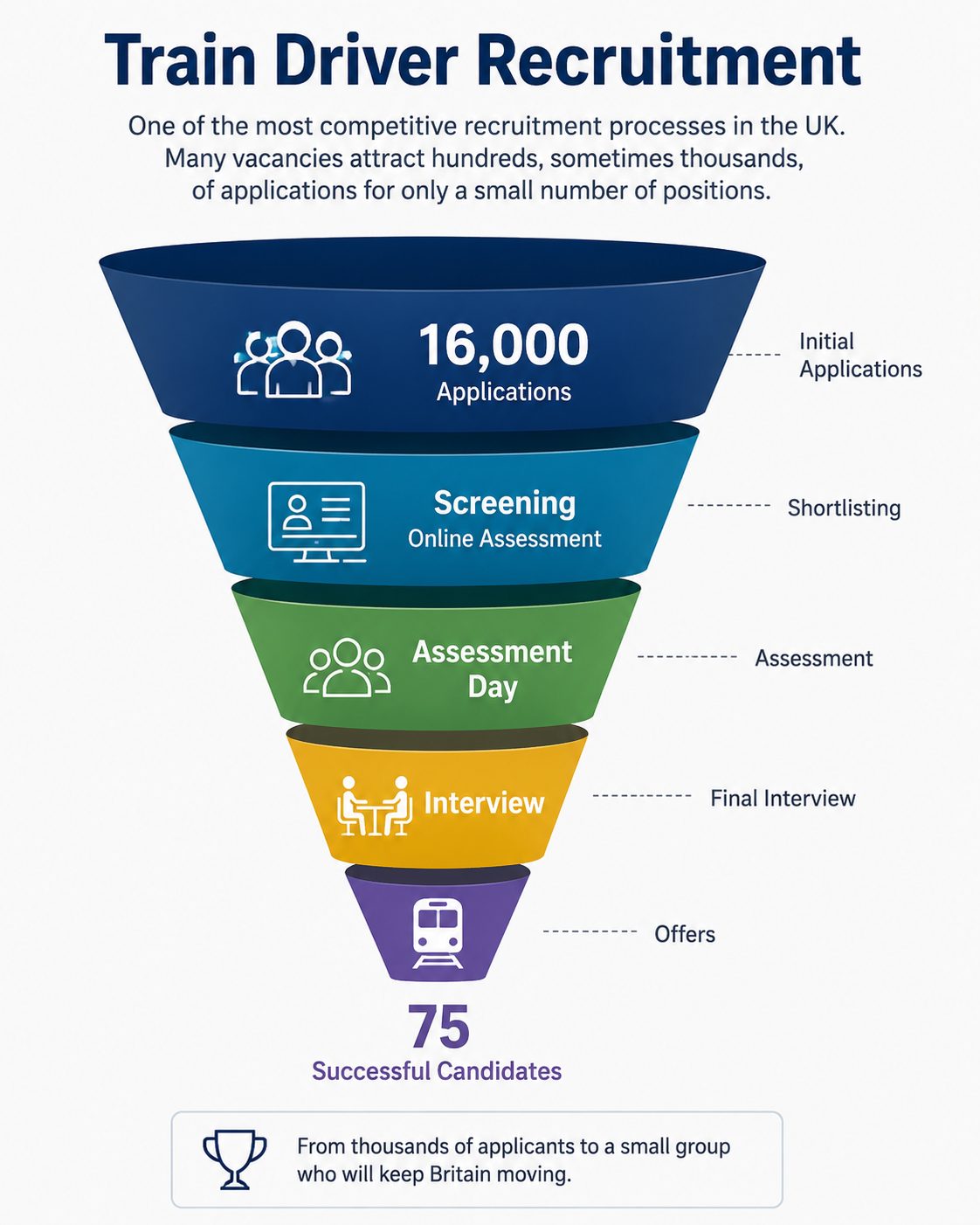




A trainee driver application can be rejected long before an interview because the evidence does not show the standard a safety-critical employer needs. The top mistakes in rail applications are rarely about a lack of interest in the railway. More often, they come from treating a specialist recruitment process like a general job application.
Train Operating Companies need candidates who can work methodically, follow rules, manage attention over long periods and make sound decisions when conditions change. Your application is the first opportunity to demonstrate those qualities. It needs to be accurate, relevant and supported by examples from your real working life.
Mistake 1: Applying before checking the essential criteria
Many candidates see a trainee driver vacancy and apply immediately. Enthusiasm is understandable, but eligibility requirements are not optional preferences. A TOC may set requirements around location, shift availability, right to work, qualifications, safety-critical medical standards, previous applications or the distance you live from the depot.
Read every part of the vacancy carefully, including the wording around the depot location and working pattern. Early starts, late finishes, weekends and public holidays are part of railway operations. Saying you can work flexibly is not enough if your travel arrangements, caring commitments or other responsibilities make that impractical.
Be equally honest about application history. Where an employer asks about previous applications, assessment attempts or employment information, provide a clear and truthful answer. Accuracy and integrity matter at every stage of a safety-critical recruitment process.
Mistake 2: Sending a generic CV
A CV written for broad customer service, logistics or management roles may describe valuable experience but still fail to make the rail relevance clear. Recruiters should not have to infer that your role involved following procedures, working independently, managing risk or maintaining concentration.
Tailor the CV to the vacancy without changing the truth. Start with a concise profile that reflects the role you are applying for. Then use your employment history to show evidence of the behaviours that matter: rule compliance, timekeeping, communication, customer responsibility, situational awareness, incident reporting and working calmly under pressure.
Generic statements such as “hard-working”, “a team player” or “excellent under pressure” do little on their own. Replace them with specific evidence. For example, a bus driver might explain how they completed vehicle checks, followed route and safety requirements, responded to disruption and communicated professionally with passengers. A service leaver might describe disciplined adherence to instructions, accurate handovers and accountable decision making. The experience does not need to come from rail. The evidence needs to show operational maturity.
Do not overload the document
A long CV can be as unhelpful as a thin one. Prioritise recent and relevant evidence, use clear job titles and dates, and check that your responsibilities are easy to understand for someone outside your previous industry. Spelling errors, inconsistent dates and unexplained employment gaps can raise avoidable questions.
Mistake 3: Writing application answers that lack evidence
Online application forms often ask questions designed to test your understanding of the role and your suitability for it. A common mistake is responding with motivation alone: “I have always wanted to drive trains” or “I want a stable career”. Those points may be genuine, but they do not demonstrate competence.
Use a structured approach for every competency-based response. Briefly set the situation, explain the task or responsibility, describe the action you personally took, and state the result. Focus on what you did, why you did it and how you maintained safety, accuracy or service.
The strongest examples usually include a meaningful level of challenge. Describe a time you had to follow a procedure despite time pressure, deal with an unexpected problem, raise a concern, remain focused during repetitive work or communicate a clear handover. Avoid examples where the main achievement was simply working hard. Railway roles require controlled, dependable performance.
It also helps to answer the exact question asked. If the question is about working alone, do not submit a teamwork example and hope the assessor will connect it. Keep a bank of genuine examples and adapt each one carefully rather than copying the same answer into every box.
Mistake 4: Underestimating psychometric assessments
Psychometric tests are not a hurdle to rush through after completing the application form. They assess abilities and behaviours that are relevant to safety-critical work, which may include concentration, reaction, information processing, rule-based judgement and personal effectiveness.
Candidates sometimes make two opposite errors. The first is avoiding preparation completely because they believe aptitude cannot be practised. The second is looking for tactics to manipulate the assessment. Neither approach supports a credible application. Preparation should help you understand common formats, manage time, become familiar with instructions and practise working accurately under controlled pressure.
Set aside focused sessions rather than attempting hours of practice when tired or distracted. Review where you lose marks or time. Is it a misunderstanding of instructions, a tendency to rush, difficulty sustaining attention, or anxiety when the clock is running? Identify the issue and work on it methodically.
On the assessment day, follow the instructions precisely. Make sure your device, internet connection and environment meet the stated requirements where testing is remote. Do not assume that speed matters more than accuracy. The balance required depends on the assessment, and the instructions should guide your approach.
Mistake 5: Treating the structured interview as an informal chat
A structured interview is designed to compare candidates fairly against defined criteria. It may feel conversational, but each question has a purpose. Vague answers, rambling stories and opinions without examples make it difficult for an interviewer to assess you positively.
Prepare for questions about safety, responsibility, working alone, communication, rule adherence, concentration, customer impact and managing pressure. Think beyond the obvious examples. A time you challenged an unsafe practice respectfully, reported a mistake, or paused to clarify an instruction can reveal more about your judgement than a story about achieving a sales target.
Your motivation also needs to be realistic. Train driving is a respected career, but it involves shift work, continual learning, strict procedures and personal accountability. Show that you understand the operational commitment as well as the attraction of the role. Employers are looking for candidates who have considered what the work demands on an ordinary difficult day, not only what appeals about it.
Know the difference between confidence and overstatement
You do not need railway experience to present yourself well, and you should not pretend to have knowledge you do not possess. If you are changing careers, explain the transferable strengths you bring and the steps you have taken to understand the role. Confidence comes from well-prepared evidence, not exaggerated claims.
Mistake 6: Ignoring the safety-critical mindset
Some applicants focus heavily on customer service or technical interest while giving too little attention to safety. Both can matter, but safety-critical work begins with consistent compliance, alertness and professional judgement.
This does not mean repeating the word “safety” in every answer. It means showing how you behave. Do you use checklists properly? Do you escalate concerns rather than make assumptions? Can you maintain standards when no manager is present? Do you recognise when fatigue, distraction or incomplete information could affect performance? These are the practical signs of a safety-focused mindset.
Use examples that demonstrate personal responsibility. If an issue occurred, explain what you did to contain it, who you informed and what you learned. Do not blame colleagues, employers or customers. A balanced answer acknowledges the situation while showing accountability.
Mistake 7: Failing to prepare for the full recruitment journey
Rail recruitment can involve several stages across a period of time. Candidates sometimes prepare intensely for the initial form, then lose momentum before an assessment, interview or medical appointment. Others leave document checks, travel planning and interview preparation until the last moment.
Create a simple preparation plan as soon as you apply. Keep copies of your submitted application answers, record key dates, review the vacancy again before each stage and organise the documents you may need. If you are invited to attend in person, plan the journey with enough margin for disruption. Punctuality is part of the professional impression you create.
It is also sensible to reflect after every stage. If an application does not progress, avoid assuming the process is random or that you are unsuitable for rail. Check whether your evidence was specific enough, whether you met every criterion and whether your preparation matched the stage. Improvement is usually more useful than sending a higher volume of generic applications.
A strong rail application is built before the vacancy appears. Keep developing examples from your current role, learn the realities of safety-critical work and practise explaining your experience with precision. When the right opportunity opens, you will be ready to show not just that you want a railway career, but that you can approach it with the discipline it requires.