



Most applicants do not fail because they lack interest in the role. They fail because their application gives a Train Operating Company too little confidence in how they think, work and follow standards. That is why train driver application mistakes matter so much. In a safety-critical recruitment process, small errors can suggest bigger concerns.
The strongest applications are not the most dramatic or the most polished in a generic sense. They are the ones that show clear evidence of suitability for a disciplined, rule-bound, customer-facing operational role. If you are applying for trainee train driver vacancies, it helps to understand what recruiters are actually looking for and where candidates commonly weaken their own case.
Why train driver application mistakes carry more weight
A train driver application is not judged in the same way as an application for a general office job. TOCs are hiring for a role where concentration, procedural compliance, communication, personal responsibility and consistency all matter. The application stage is an early filter for those qualities.
That means a rushed form, vague CV or poorly chosen example does more than look untidy. It can raise questions about your attention to detail, your understanding of safety-critical work or your ability to present relevant evidence under instruction. In a competitive field, that can be enough to move your application out of contention.
It also helps to remember that not every TOC asks for exactly the same evidence in exactly the same format. Some place more emphasis on employment history, others on competency-based questions, and others on screening for baseline suitability before later assessments. The principle stays the same - relevance and accuracy matter more than volume.
1. Treating the application like a standard CV exercise
One of the most common train driver application mistakes is using a generic CV and cover style approach without adapting it to the role. Applicants often focus on broad strengths such as being hardworking, reliable and motivated. Those qualities are useful, but they are far too general on their own.
TOCs need evidence that maps to the demands of train driving. That may include working to rules, staying calm under pressure, maintaining concentration during repetitive tasks, making safe decisions, managing fatigue, communicating clearly and acting professionally with limited supervision.
If your CV reads like it was sent to ten different industries in the same week, it will not carry much weight. A better approach is to align your wording and examples with operational discipline and safety-critical behaviours. A warehouse supervisor, bus driver, police officer, signaller, engineer or Armed Forces leaver may all have highly relevant experience, but only if that relevance is explained properly.
2. Listing duties instead of proving behaviours
Many candidates describe what their job involved but not how they performed it. There is a big difference between saying, "Responsible for opening and closing the site" and showing the behaviour behind it, such as following strict procedures, checking for irregularities, logging issues accurately and securing the environment without shortcuts.
Recruiters are not just collecting job titles. They are looking for patterns of behaviour that suggest suitability for driver training and frontline railway operations. A strong example usually shows context, responsibility, action and outcome. It demonstrates what standards you worked to, how you handled pressure and what your decisions achieved.
This matters especially when answering application questions. If you are asked for an example of working safely or following rules, avoid broad claims. Give one well-structured example with enough operational detail to show judgement, accountability and consistency.
3. Ignoring gaps, inconsistencies or weak presentation
Applications lose credibility when dates do not line up, employment history is incomplete or qualifications are unclear. These issues are not always disqualifying, but unexplained inconsistency can create doubt. In a competitive process, doubt is costly.
Formatting also matters more than some applicants expect. A cluttered CV, spelling mistakes, inconsistent capitalisation or careless grammar can suggest poor attention to detail. That does not mean your application needs inflated corporate language. In fact, plain, precise wording is usually stronger. What matters is that the information is easy to follow and professionally presented.
If you have employment gaps, a career change or a non-linear background, address it clearly and calmly. Many successful candidates come from varied industries. The issue is rarely the gap itself. The issue is leaving the recruiter to guess.
4. Using poor examples for safety and responsibility
Candidates often know safety matters, but they do not always choose the right examples to prove it. Saying that you "take safety seriously" is not enough. Nor is offering an example that is really about speed, multitasking or working around obstacles without clear procedural discipline.
Good safety examples show that you understand standards, not just caution. They show you followed process, challenged risk, stopped work when necessary, escalated concerns appropriately or maintained concentration despite routine and pressure. They also show personal accountability.
This is especially important for applicants coming from non-rail backgrounds. You do not need previous railway experience to present strong safety evidence. Many sectors involve compliance, risk awareness and consequence management. The key is translating that experience into language that reflects operational maturity rather than informal common sense.
5. Underestimating the importance of instructions
A train driver application form often tells you exactly what to provide. Minimum word counts, maximum word counts, document requirements, eligibility questions and role-specific criteria are there for a reason. Ignoring them is one of the most avoidable mistakes.
If a form asks for a specific competency example and you provide a personal statement instead, you have not shown initiative. You have shown that you did not follow the brief. In a role built on rules, signalling, procedures and formal communication, that matters.
The same applies to basic screening questions. Right to work status, driving licence details, location, shift flexibility and previous application history should all be answered carefully and honestly. Trying to second-guess what the recruiter wants to hear usually backfires. Accuracy is the stronger choice.
6. Writing for sympathy instead of suitability
Some applicants lean too heavily on how much they want the role, how long they have dreamed of it or how badly they need a career change. Commitment matters, but recruitment decisions are not based on enthusiasm alone.
TOCs are assessing suitability for a demanding training pathway and a safety-critical operational job. If your application becomes overly personal without showing evidence, it can weaken your position. The recruiter does not need persuasion that the job is attractive. They need evidence that you are ready for the standard required.
A better tone is professional and grounded. Show motivation, but link it to realistic understanding. For example, it is stronger to explain that you are drawn to structured working, operational responsibility and disciplined standards than to rely on childhood ambition or broad statements about loving trains.
7. Applying too early without proper preparation
There is a balance here. You do not want to delay forever waiting for the perfect moment, but submitting a weak application just because a vacancy appears can be a poor decision. Some candidates only realise afterwards that their CV was generic, their examples were weak and they had not thought carefully about the recruitment stages.
Preparation before applying can make a significant difference. That includes reviewing your CV against train driver criteria, building better competency examples, understanding how psychometric tests fit into the process and making sure your application reflects the standards of the role.
It also helps to recognise that recruitment campaigns can vary. One vacancy may be better suited to your location, work history or readiness than another. Applying selectively and well is often better than applying widely with the same material every time.
How to avoid train driver application mistakes
The most effective approach is to treat the application as part of the assessment, not as admin before the real process starts. Every section should support the same message: you understand the responsibility of the role and can evidence the behaviours it requires.
Start by reviewing your CV and application examples against the actual demands of trainee train driver work. Ask whether each point demonstrates concentration, rule adherence, communication, safety awareness, independent working or professional judgement. If it does not, it may not be helping.
Then check the quality of your evidence. Specific examples are stronger than statements. Clear timelines are stronger than vague histories. Plain English is stronger than padded language. And careful proofreading is not optional in a process that values accuracy.
For many applicants, outside review is useful because it highlights blind spots. What feels obvious to you may not be visible on the page. A specialist review can often identify where your experience is relevant but under-explained, or where your wording unintentionally weakens your case.
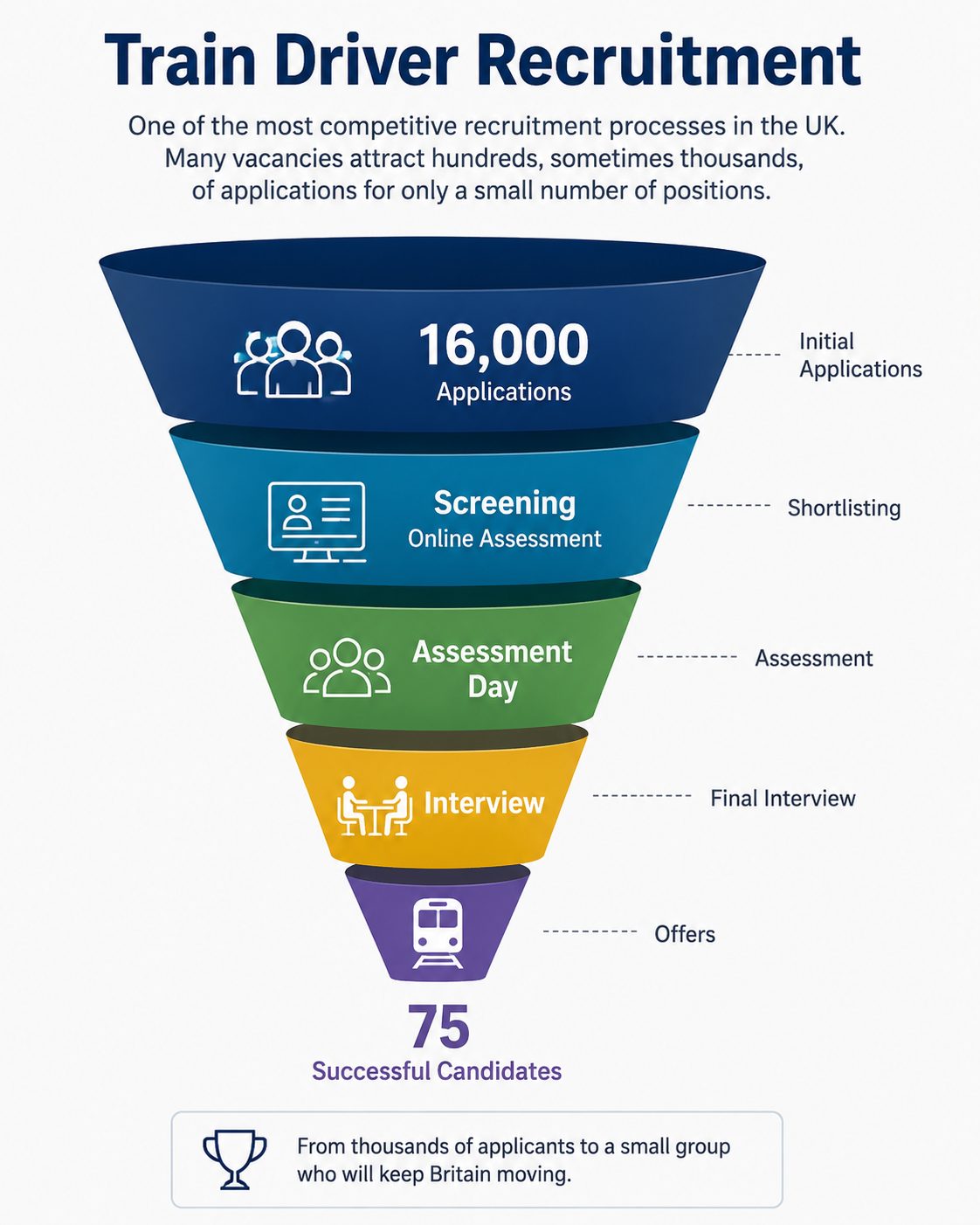
Train driver recruitment is competitive for a reason. The standard is high because the responsibility is high. That should not discourage you. It should sharpen your approach. A disciplined application does not guarantee progress, but it gives recruiters something far more useful than enthusiasm alone - evidence they can trust.
Take the time to make your application read like someone who already respects the standards of the railway.