

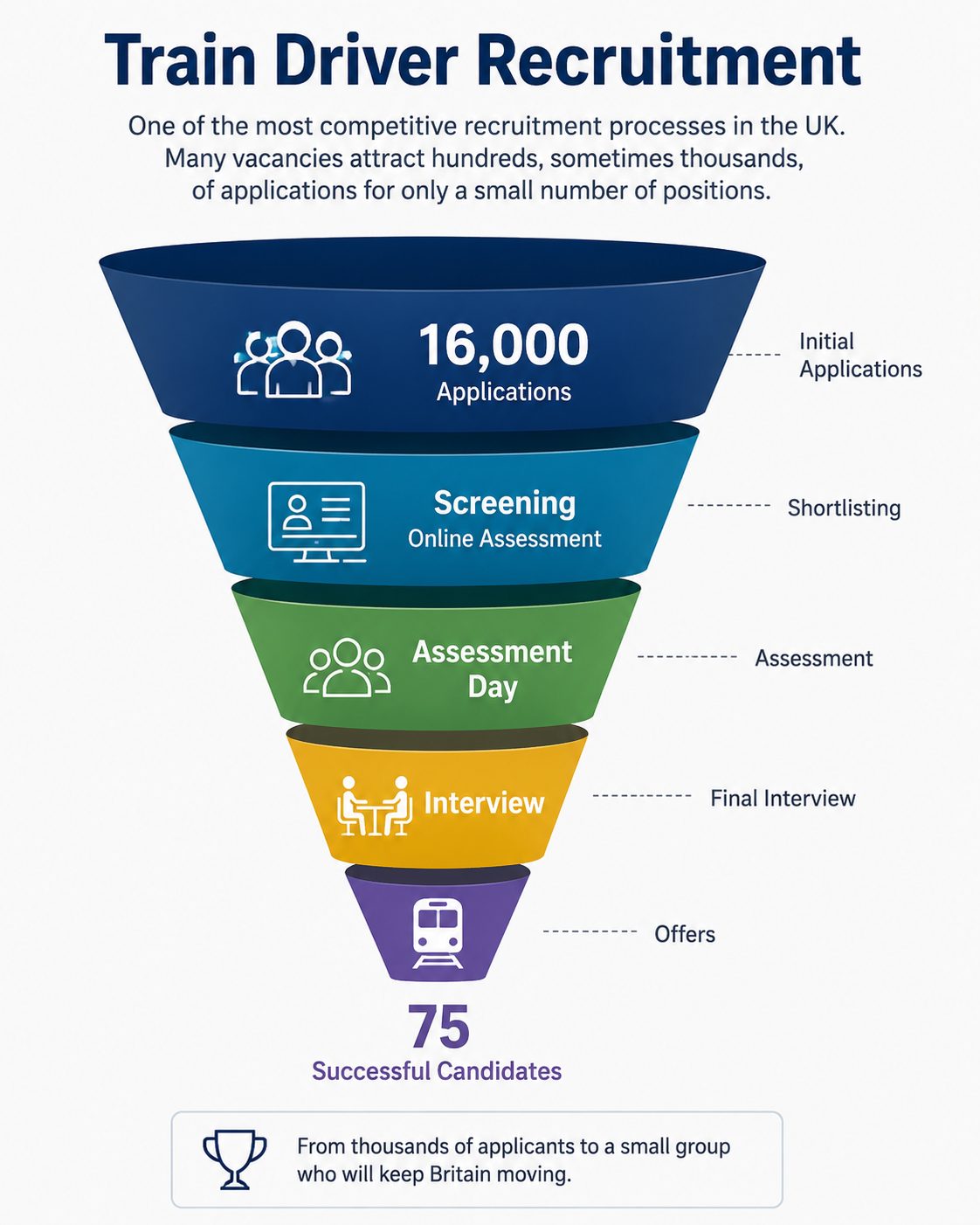




A train driver assessment centre is the point where interest in the role stops being theoretical and starts being measured against safety-critical standards. For many applicants, this is the stage that feels most difficult because it combines pressure, scrutiny and limited room for error. That said, it is not designed to catch people out. It is designed to identify candidates who can work safely, think clearly and remain consistent under structured assessment conditions.
If you are applying for a trainee train driver role, it helps to understand that the assessment centre is not one single test in the ordinary sense. It is usually a sequence of exercises that allow a Train Operating Company to examine how you process information, follow rules, maintain concentration and present yourself in a professional selection setting. The exact format varies, but the underlying purpose is broadly the same.
What a train driver assessment centre is really testing
The train driver role carries a high level of responsibility, so assessment centres are built around suitability for safety-critical work rather than personality alone. Recruiters are not simply looking for someone who wants the job badly enough. They are looking for evidence of the behaviours and cognitive strengths needed to perform reliably over time.
That usually means a focus on concentration, attention to detail, rule adherence, checking accuracy, verbal communication and decision making. In many cases, the process also tests how well you cope with repetitive material and whether you can maintain standards when tasks become mentally tiring. This matters because train driving is not a role where confidence can replace discipline. Good candidates show controlled performance, not rushed performance.
Some applicants expect the day to feel like a broad interview event, but the balance often sits more heavily on formal assessments than general conversation. Even where there is a structured interview included, it tends to sit within a tightly defined process. The emphasis is on consistency and evidence, not charm.
What to expect at a train driver assessment centre
A train driver assessment centre can include several stages delivered in one day or across more than one session. Some TOCs separate the process into different appointments, while others group elements together. That variation matters because your preparation should match the employer's format rather than a generic idea of assessment day.
In practical terms, you may encounter psychometric tests, concentration-based exercises, written or computer-based tasks, and a structured interview. You might also complete paperwork and identity checks, particularly if this is an advanced stage in the recruitment process. The atmosphere is usually formal, quiet and closely managed.
Psychometric assessment remains one of the main pressure points for candidates. These exercises are not there to reward guesswork or speed for its own sake. In fact, over-accelerating can damage performance. The better approach is accurate, disciplined and repeatable working. You need to show that you can follow instructions exactly and sustain your attention from start to finish.
If a structured interview is part of the process, expect competency-based questions linked to behaviours relevant to train driving. That may include safety awareness, rule compliance, communication, responsibility, handling routine, remaining calm under pressure and working within procedures. Strong answers are usually specific and grounded in real examples rather than general claims about being hard-working or reliable.
Why good candidates still struggle
Many capable applicants fall short at assessment centre stage not because they are unsuitable, but because they underestimate the precision of the process. A strong CV or a good first interview does not automatically transfer into strong test performance. The recruitment standard is narrower than that. It asks whether you can meet a particular operational profile.
Another common issue is treating preparation too casually. Some people assume that if they are naturally calm, careful or intelligent, they will manage on the day. Sometimes they do. Often they discover that working under timed conditions, with formal instructions and high stakes, feels very different from ordinary work tasks.
There is also the problem of fragmented preparation. Candidates may spend time reading forum discussions, watching general careers advice or using unrelated practice material. That can create activity without real alignment. Preparation is most effective when it reflects the actual demands of trainee train driver recruitment rather than generic interview coaching.
How to prepare properly
Preparation for a train driver assessment centre should be structured. Start with the recruitment pack or instructions provided by the employer and read them carefully more than once. Candidates sometimes miss key information because they skim the material and focus only on dates and times. Small details matter in safety-critical recruitment.
Next, separate your preparation into three areas: test readiness, interview readiness and professional readiness. Test readiness means understanding the style of psychometric and concentration-based assessment you are likely to face, then practising in a way that builds accuracy and familiarity. Interview readiness means preparing evidence-based examples from your own work or life experience that demonstrate discipline, communication, safety awareness and responsibility. Professional readiness means sleep, punctuality, document checks, travel planning and presentation.
The practical side should not be underestimated. Arriving flustered, under-rested or uncertain about what you need to bring places you at an immediate disadvantage. Assessment centres reward steady performance. That starts before the first exercise begins.
The difference between practice and over-preparation
There is a useful line between proper preparation and counterproductive preparation. Good preparation builds familiarity with task formats, improves instruction-following and reduces avoidable nerves. Poor preparation can lead candidates to chase shortcuts, obsess over rumours or rehearse unnatural interview answers that sound polished but empty.
For psychometric work, quality matters more than volume. Repeating large numbers of unrelated exercises will not necessarily improve your performance. Focused practice that mirrors the expected demands is usually more valuable. The aim is not to outsmart the process. It is to become more controlled within it.
For interviews, avoid memorising speeches. Structured interviews reward relevance and clarity. A concise example that shows responsibility, safe judgement and accountability is stronger than a long answer padded with vague enthusiasm. Interviewers are generally more interested in what you actually did, why you did it and what standard you worked to.
What assessors notice on the day
Candidates often assume that only test scores matter. They matter a great deal, but the wider impression you create still counts, especially where interviews or group handling are involved. Assessors will notice whether you listen properly, follow instructions the first time, remain composed and conduct yourself professionally throughout the session.
That does not mean performing a version of confidence. In fact, forced confidence can work against you if it turns into rushing, interrupting or carelessness. Train driver recruitment tends to favour controlled professionalism. Measured behaviour is often better than trying to appear impressive.
They may also notice how you deal with a difficult section. Not every exercise will feel comfortable. The key is to recover well and keep applying yourself. One moment of uncertainty does not always define the entire day. Losing focus after a setback can be more damaging than the setback itself.
If you are changing career, use that to your advantage
Many applicants come from the armed forces, logistics, transport, engineering, emergency services or other operational environments. Others are moving from completely different sectors but bring valuable habits such as punctuality, rule compliance, customer responsibility or independent working. A train driver assessment centre does not require previous rail employment. It requires evidence that you can adapt to the standards of the role.
The important step is translating your background properly. Do not assume assessors will make the connection for you. If your previous work involved safety checks, procedural discipline, lone working, fatigue management, high-consequence decisions or communication under pressure, be ready to explain that clearly and directly.
This is where specialist preparation can be helpful. Services such as those offered by Train Driver Foundation are useful when they help candidates understand the actual recruitment standard and map their experience against it in a realistic way.
A final approach that usually works best
Treat the assessment centre as a professional standard to meet, not a mystery to fear. Read carefully, prepare methodically, practise with purpose and present yourself as someone who understands the seriousness of the role. You do not need to appear perfect. You do need to show that you can work accurately, responsibly and consistently when it matters.