



A missed signal, a rule breach or a lapse in concentration can carry serious consequences, which is why any train driver career guide worth reading needs to start with the reality of the role. Train driving is respected, stable and well paid, but it is also safety-critical, tightly assessed and highly competitive. If you are considering this path, the right question is not simply how to get hired. It is whether you understand what the job demands and how to prepare to meet that standard.
What the role really involves
Many applicants are drawn to train driving for good reasons. The role offers long-term career security, defined responsibilities and a clear operational purpose. For career changers, service leavers and candidates from transport or safety-focused industries, that structure can be especially appealing.
The day-to-day reality, however, is more demanding than many first-time applicants expect. Drivers work to rules, maintain concentration for extended periods, manage routine and unexpected situations, and operate within a strict safety culture. Shifts can start very early, finish late, include weekends and bank holidays, and affect sleep patterns and family routines.
That does not mean the role is only suitable for people with rail experience. It does mean employers look for evidence that you can work calmly, consistently and responsibly in a disciplined environment.
Train driver career guide - who is the role right for?
A strong candidate is not always the person with the most impressive CV on paper. In train driver recruitment, employers are usually looking for a combination of behaviours, mindset and reliability rather than broad corporate experience.
You are likely to be well suited to the role if you can follow procedures without cutting corners, remain focused during repetitive tasks, make sound decisions under pressure and accept personal accountability. Strong communication matters too, even though much of the role is carried out alone. Drivers must be able to report clearly, understand instructions and operate professionally with signallers, control teams and platform staff.
Some applicants worry that they have the wrong background because they have never worked in rail. In practice, transferable experience can come from many places. Emergency services, armed forces, warehousing, aviation, logistics, bus and coach operations, engineering, manufacturing and other safety-critical settings can all provide relevant evidence. The key is not where you worked. It is how well you can demonstrate rule compliance, concentration, safety awareness and operational maturity.
Basic eligibility before you apply
Before investing time in applications, check the practical entry requirements used by many Train Operating Companies. These vary, so always read the vacancy details carefully, but common requirements include minimum age criteria, the right to work in the UK, acceptable proximity to the depot, and the ability to pass medical and drugs and alcohol screening.
You will also need to meet standards for vision, hearing and general fitness relevant to a safety-critical role. Some vacancies ask for a certain level of education, while others focus more heavily on behavioural evidence and work history. A driving licence is not always essential for the train driving role itself, but depot location and shift patterns can make independent travel highly relevant.
This is one of the first points where applicants lose momentum. They apply widely without checking whether they can realistically meet the vacancy terms. A more effective approach is to assess fit early and target roles where you meet the stated requirements cleanly.
Understanding the recruitment process
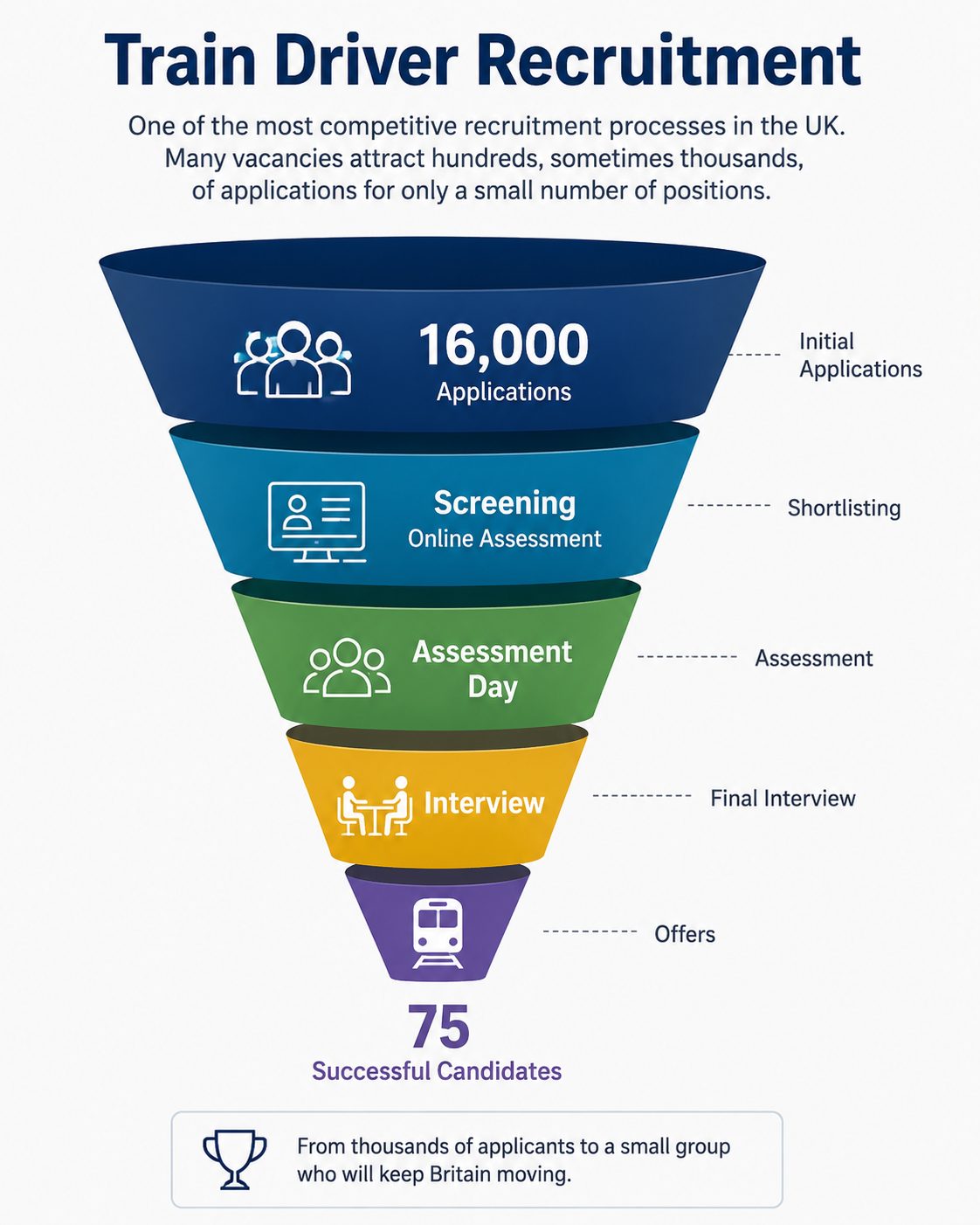
A practical train driver career guide should treat recruitment as a staged process, not a single application. Most candidates who succeed do so because they prepare for each stage with care rather than relying on general employability advice.
Stage 1 - Application and CV screening
The first hurdle is often the application form or CV review. This is where many capable candidates undersell themselves. Generic phrases such as “hard-working team player” carry very little weight unless they are backed by specific examples.
Your application should show clear evidence of safety awareness, rule adherence, responsibility, concentration, punctuality and experience working in structured environments. If you have managed incidents, worked shifts, followed formal procedures or carried personal safety accountability, that should be presented clearly.
Stage 2 - Online assessments and psychometric tests
Psychometric testing is a major filter in train driver recruitment. These assessments are designed to measure underlying suitability for a safety-critical role, including concentration, attention control, rule following and behavioural consistency.
This is not an area for shortcuts. The best preparation is familiarisation with assessment style, disciplined practice and understanding what the test is measuring. Candidates who perform well usually arrive prepared, calm and able to work accurately under timed conditions. Candidates who assume common sense will carry them through often come unstuck.
Stage 3 - Structured interview
The interview is usually far more evidence-based than applicants expect. You may be asked to provide examples that show safety focus, decision making, rule compliance, dealing with pressure, communication and working alone. Interviewers are often testing consistency as much as confidence.
A weak answer tends to be vague, exaggerated or focused on what the team did rather than what you personally did. A stronger answer is specific, structured and grounded in real behaviour. You should be able to explain the situation, your role, the actions you took and why they mattered operationally.
Stage 4 - Manager interview and final checks
Later-stage interviews often focus on motivation, lifestyle fit and understanding of the role. This is where unrealistic expectations become obvious. If an applicant appears attracted mainly by salary, status or perceived ease of the job, that raises concerns.
Employers want to see that you understand shift work, fatigue management, route responsibility and the seriousness of operating in a safety-critical environment. Final checks may include references, medical assessments and further suitability screening.
Why strong candidates still get rejected
Rejection does not always mean you are unsuitable. Sometimes the field is simply very strong. Train driver vacancies can attract high application volumes, especially in desirable locations.
That said, there are recurring reasons capable people fall short. Some apply before understanding the role properly. Some use a generic CV that does not translate their experience into railway-relevant evidence. Others underestimate psychometric testing or arrive at interview with polished but shallow answers.
There is also a mindset issue. Candidates who treat recruitment as a quick change of job often struggle. Those who approach it as entry into a tightly regulated profession usually prepare more thoroughly and present themselves more credibly.
How to prepare in a way that actually helps
Preparation should be structured and role-specific. Start by reviewing your work history through the lens of train driver competencies. Where have you worked safely under pressure? Where have you followed procedures precisely? Where have you taken responsibility for risk, punctuality, communication or lone working?
Next, build realistic knowledge of the role. You do not need confidential operational detail, but you do need a grounded understanding of what the job involves, how TOC recruitment works and why standards are high. That understanding improves both your application quality and your interview performance.
Assessment preparation should then be approached methodically. Practice helps most when it improves accuracy, focus and familiarity with pressure rather than encouraging rushed performance. Structured interview preparation matters as well. Good examples rarely appear on the spot. They usually need careful thought, shaping and rehearsal.
This is where specialist support can make a difference. A provider such as Train Driver Foundation focuses specifically on the standards and preparation demands of train driver recruitment, which is more useful than broad careers coaching when the process is this role-specific.
It depends - choosing the right time to apply
One of the most common questions is when to apply. There is no perfect answer. If you already meet the core requirements and can present strong evidence, applying sooner can make sense. If your CV is weak, your examples are unprepared and you know little about the process, waiting to prepare properly may be the better decision.
Location matters too. Some depots attract far more competition than others, and relocation is not practical for everyone. Existing shift patterns, caring responsibilities and transport access can all affect whether a vacancy is genuinely viable. A disciplined application strategy is usually better than submitting large numbers of poorly targeted applications.
Building long-term credibility
Even before you secure a trainee role, you can strengthen your profile by taking your development seriously. CPD, operational learning and role-relevant study all help demonstrate commitment when they are credible and grounded in the realities of rail work.
What matters most is relevance. Courses or preparation activities should improve your understanding of safety-critical working, decision making, operational discipline and recruitment readiness. They should not be treated as a badge collection exercise. Employers are more interested in whether your preparation has made you a stronger, more informed candidate.
Train driving appeals to people who value standards, routine, responsibility and professional pride. If that describes you, the path is worth taking seriously. Approach it with patience, prepare for each stage properly, and let your evidence speak for your suitability rather than trying to outguess the process.