



A weak application is rarely weak because the candidate lacks potential. More often, it fails because the evidence is buried, too general, or written in a style that does not match a safety-critical role. That is exactly why a train driver CV review matters. It is not about polishing language for the sake of appearance. It is about making sure your CV presents the right evidence, in the right order, with the right level of operational credibility.
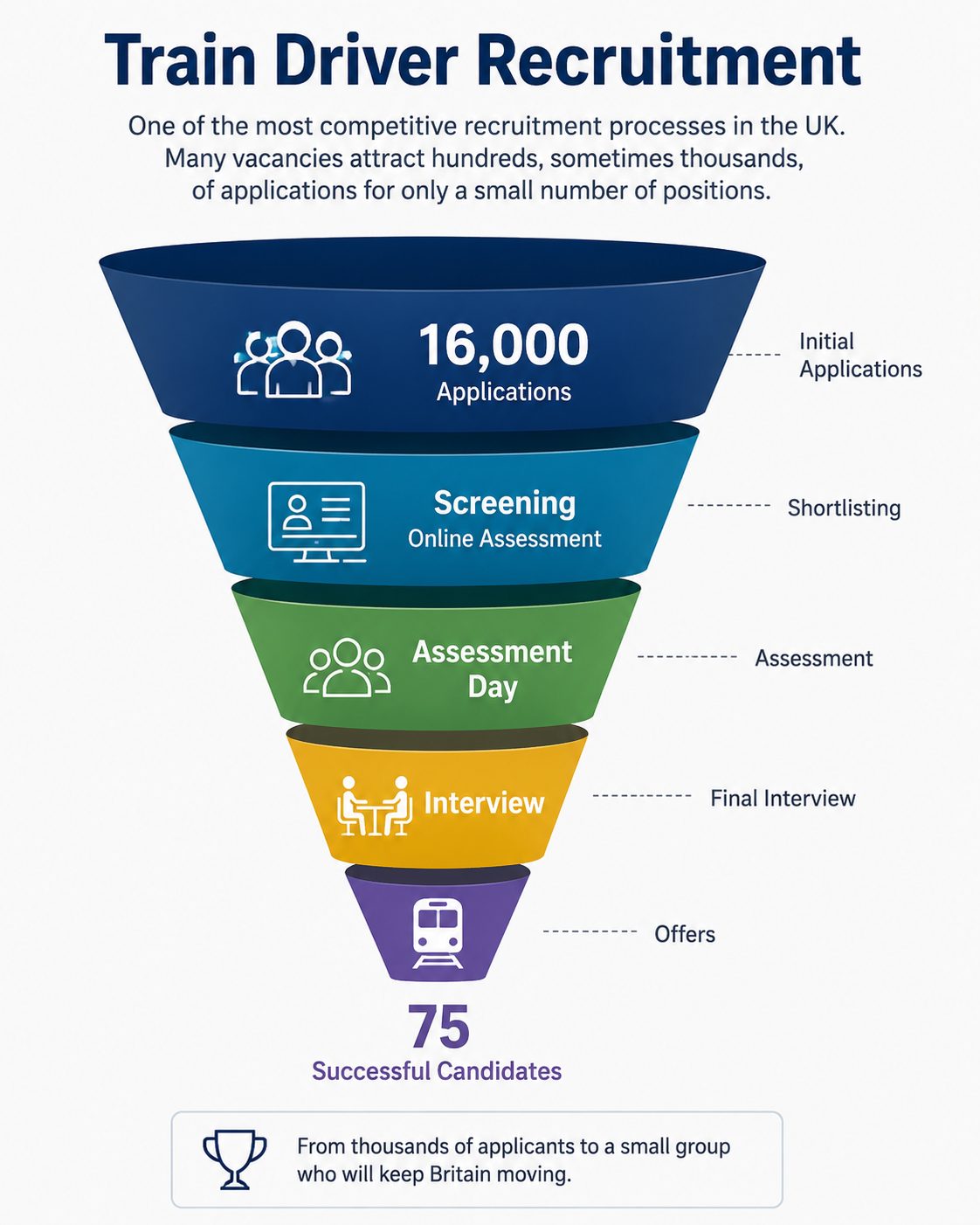
Trainee train driver recruitment is competitive, and many applicants are capable people coming from transport, logistics, the Armed Forces, emergency services, engineering, customer operations, or completely different sectors. What separates a stronger CV is not usually a more impressive job title. It is clearer proof of concentration, rule adherence, responsibility, communication, situational judgement, and the ability to work consistently to standard.
What a train driver CV review should actually assess
A proper train driver CV review should look beyond formatting. Presentation matters, but this is not a design exercise. In most cases, your CV needs to answer a simpler question: does this person look credible for a safety-critical recruitment process?
That means reviewing whether your work history shows dependable behaviour, whether your personal profile is relevant rather than generic, and whether your examples reflect the qualities TOCs tend to value. If your CV says you are hardworking, calm under pressure and a good communicator, that tells a recruiter very little. If it shows that you followed strict procedures, reported incidents accurately, maintained attention during repetitive tasks, managed fatigue-sensitive shifts, and made sound decisions when conditions changed, it becomes much more convincing.
A good review also checks balance. Some applicants over-focus on customer service and underplay safety, while others lean so heavily into technical detail that they forget the people side of the role. Train driving sits in both worlds. You need operational discipline, but also the ability to communicate professionally, follow instruction, and work within a wider railway environment.
Why generic CV advice often falls short
A great deal of CV advice online is written for broad office recruitment. It favours personal branding, achievements framed in sales terms, and language designed to sound energetic. That may help in some sectors. It is far less useful when applying for a trainee train driver role.
In rail recruitment, exaggerated wording can work against you. A CV full of claims such as dynamic leader, results-driven professional or proven multitasker often sounds vague. Recruiters for safety-critical roles usually respond better to clear, grounded evidence. They want to see consistency, accountability, procedure, accuracy and maturity.
That does not mean your CV should be dull. It means it should be relevant. If you have worked nights, handled lone working, operated machinery, completed checks to a strict standard, dealt with public-facing pressure, or worked in a role where mistakes carried real consequences, those points deserve careful emphasis. A general CV service may not recognise their value in a train driver context. A role-specific review should.
The sections that most often need work
The personal profile is one of the most common problem areas. Many applicants open with a paragraph that could apply to any job in any industry. If a recruiter removed your name from the top, would the profile still read like someone applying for train driving, or would it read like a standard CV copied across multiple sectors?
A stronger profile is shorter, more precise, and linked to operational suitability. It should give a realistic picture of your background and the qualities that transfer into a trainee driver pathway. That could include experience in safety-led environments, shift discipline, compliance, public responsibility, fault reporting or working calmly under pressure.
Employment history is another area where candidates often miss opportunities. The issue is not always lack of experience. It is poor translation of that experience. A bus driver, warehouse operative, signaller, technician, police officer, Armed Forces service leaver or station colleague may all have valuable examples, but if their CV only lists routine tasks, the relevance is lost.
Instead of merely stating duties, your CV should show standards. Did you carry out checks before starting work? Work to time-critical schedules? Escalate defects? Follow formal procedures? Manage distractions? Record information accurately? Adapt to changing operational conditions? These details carry more weight than broad statements about being motivated.
How to show suitability without overstating it
One of the harder parts of writing a train driver CV is striking the right level of confidence. You need to show that you understand the seriousness of the role and that you have qualities aligned to it. At the same time, you should not write as if you are already a qualified driver or imply experience you do not have.
This is where a train driver CV review adds value. It helps remove overreach while strengthening genuine evidence. For example, saying you have excellent safety knowledge may sound inflated if your background does not support it. Saying you have worked in environments where compliance, vigilance and procedure were essential is more credible and easier to defend at interview.
The same applies to operational language. Used well, it shows awareness. Used badly, it can feel forced. You do not need to sound like a railway manual. You need to sound like a serious candidate who understands that train driving requires discipline, concentration, learning capacity and reliable professional conduct.
What reviewers should look for in your evidence
The strongest CVs usually contain evidence in four broad areas. First, they show responsibility - not just being busy, but being trusted with tasks that mattered. Second, they show consistency - turning up, following rules, maintaining standards over time. Third, they show judgement - knowing when to act, when to report and when to escalate. Fourth, they show trainability - the ability to learn, retain and apply structured information.
That evidence can come from many backgrounds. A retail manager may have handled incidents, led compliance routines and worked under pressure. A military applicant may bring procedural discipline and high-consequence decision making. A delivery driver may demonstrate route focus, lone working and concentration. The exact source matters less than how clearly it is explained.
A useful reviewer will also test whether your CV matches your likely interview narrative. If your document claims strong attention to detail, but contains inconsistent dates, loose wording or avoidable errors, it sends the wrong message. If it presents you as highly safety-conscious but gives no actual examples, the claim feels unsupported. Consistency across your application matters.
Common mistakes in a train driver CV review
One mistake is writing too much. Candidates sometimes add every duty from every role, hoping volume will create credibility. Usually it has the opposite effect. The key is not more content. It is better content.
Another mistake is focusing too heavily on interest in trains. Motivation has its place, but enthusiasm alone is not enough. Recruiters need evidence that you can meet the behavioural and operational standards of the role. A CV that talks extensively about passion for the railway but says little about discipline, concentration or responsibility is unlikely to stand out for the right reasons.
There is also the problem of generic achievement language. Statements such as exceeded targets or improved sales may be useful in other sectors, but they need reframing here. If you improved a process, reduced errors, strengthened compliance, handled incidents effectively or maintained standards in a demanding environment, those points are more relevant.
Finally, many applicants underestimate the value of plain English. Overwritten CVs often hide strong experience behind jargon. Clear writing suggests clear thinking, and that matters in safety-critical recruitment.
When a CV review is most useful
The best time to get your CV reviewed is before vacancies open, not after you have already sent several unsuccessful applications. If you are serious about entering train driver recruitment, your CV should be treated as part of your preparation, alongside your understanding of the role, structured interview readiness and awareness of assessment standards.
It is particularly useful if you are changing career, returning to the job market, leaving the Armed Forces, or applying for the first time to rail. In those cases, your experience may be highly relevant, but not yet presented in language that a train driver recruiter will immediately recognise.
It can also help after repeated rejections, although with one caution. A stronger CV may improve your chances of shortlisting, but it is only one part of the process. If your application is good enough to progress, later stages will still test concentration, judgement, communication and suitability. Preparation needs to be broad, not limited to the document itself.
A serious application should read like a professional case for suitability, not a guess at what might work. That is where specialist support can make a practical difference. If your background has value, your CV should prove it clearly. Give it the same level of care you would bring to any safety-critical responsibility, and let your application show the standard you intend to bring to the role.