





If you are serious about becoming a trainee driver, the first question is not how quickly you can apply. It is whether you meet the train driver eligibility requirements UK employers expect for a safety-critical role. Getting that clear early saves time, sharpens your preparation and helps you focus on vacancies that genuinely fit your profile.
Train driving attracts career changers for good reason. It offers long-term stability, responsibility and a clear operational purpose. But recruitment standards are strict, and rightly so. Train Operating Companies, freight operators and other rail employers are not simply looking for applicants who want the job. They are looking for people who can demonstrate the judgement, discipline, concentration and reliability needed to work safely under pressure.
What train driver eligibility requirements in the UK usually include
The exact criteria vary by employer, depot and vacancy, but the core expectations are broadly consistent. Most roles require you to be old enough to hold the position legally and complete the training route. In practice, trainee roles are usually aimed at adults with the right to work in the UK, a good standard of general education and the ability to pass the medical and psychometric stages.
That does not mean every employer wants the same background. Some vacancies ask for customer-facing or operational experience. Others place greater weight on evidence of safety awareness, rule compliance and shift-working readiness. The point is that eligibility is wider than qualifications alone. Employers are assessing whether you are suitable for a regulated, safety-critical environment.
Age, right to work and basic entry standards
Most applicants first look at age. You generally need to be at least 20 to begin the process for many trainee driver roles, although some employers may structure campaigns differently. Even where the legal licensing stage sits slightly later, operators usually recruit with the full training pathway in mind. It is always worth reading each advert carefully rather than relying on forum assumptions.
You must also have the legal right to work in the UK. This is a basic requirement, but it can become a stumbling block if your documents are not current or your work status is unclear. Recruitment teams will expect straightforward evidence, and any delays here can affect your progress.
Educational requirements are often more modest than candidates expect, but that should not be mistaken for low standards. Many employers ask for GCSEs, or equivalent, particularly in English and maths. The reason is practical. Drivers need to interpret written instructions, record information accurately, communicate clearly and handle operational detail without ambiguity.
Medical standards and fitness to work safely
A major part of train driver eligibility requirements UK candidates must understand is medical fitness. This is not a general workplace health check. It is a railway medical for a safety-critical role, and the standards are there to protect passengers, colleagues and the wider network.
Vision and hearing are especially important. Employers will assess whether your eyesight meets the required standard, including colour vision where relevant, and whether your hearing is suitable for safe railway work. Some candidates assume glasses or contact lenses automatically rule them out. That is not necessarily the case. What matters is whether you meet the required standard with or without correction, depending on the policy applied.
Medical screening may also cover general health, medication, alcohol and drug testing, and conditions that could affect alertness, concentration or safe performance. This is an area where honesty matters. Trying to minimise a condition is a poor decision in any job application, and especially in rail. If you are unsure whether a health issue may affect eligibility, the sensible approach is to check the specific vacancy information and seek appropriate professional advice rather than guess.
Location, depot access and shift-work reality
One of the most overlooked eligibility issues is where you live in relation to the depot. Many trainee drivers are required to live within a set travelling time of their depot, or to confirm that they can relocate if appointed. This is not arbitrary. Early starts, late finishes, fatigue management and service reliability all matter.
Driving work often includes nights, weekends, bank holidays and highly irregular shift patterns. If your domestic arrangements make that unworkable, it is better to recognise it early than push through a process for a role that does not fit your life. Employers are looking for realistic commitment, not ideal answers on application day.
Reliable transport to and from the depot can also matter, especially when public transport is unavailable at unsocial hours. That does not always mean you must own a car, but you do need a credible and consistent plan for getting to work safely and on time.
Previous experience - useful, but not always essential
A common misconception is that you must already work on the railway to qualify. You do not. Many successful candidates come from the Armed Forces, transport, logistics, emergency services, engineering, manufacturing and other disciplined sectors. What matters is whether you can show behaviours that transfer well into train driving.
Relevant experience usually includes working to rules, maintaining concentration over long periods, making sound decisions, communicating clearly, managing routine without losing focus and responding calmly when circumstances change. Customer service can also help, particularly in roles where professionalism, accountability and public interaction are important.
This is where many applicants undersell themselves. A job title alone rarely proves suitability. The stronger approach is to translate your experience into operational evidence. If you have worked shifts, managed safety checks, followed strict procedures or handled risk in a controlled environment, that is far more useful than simply stating you are hardworking.
Psychometric testing and behavioural suitability
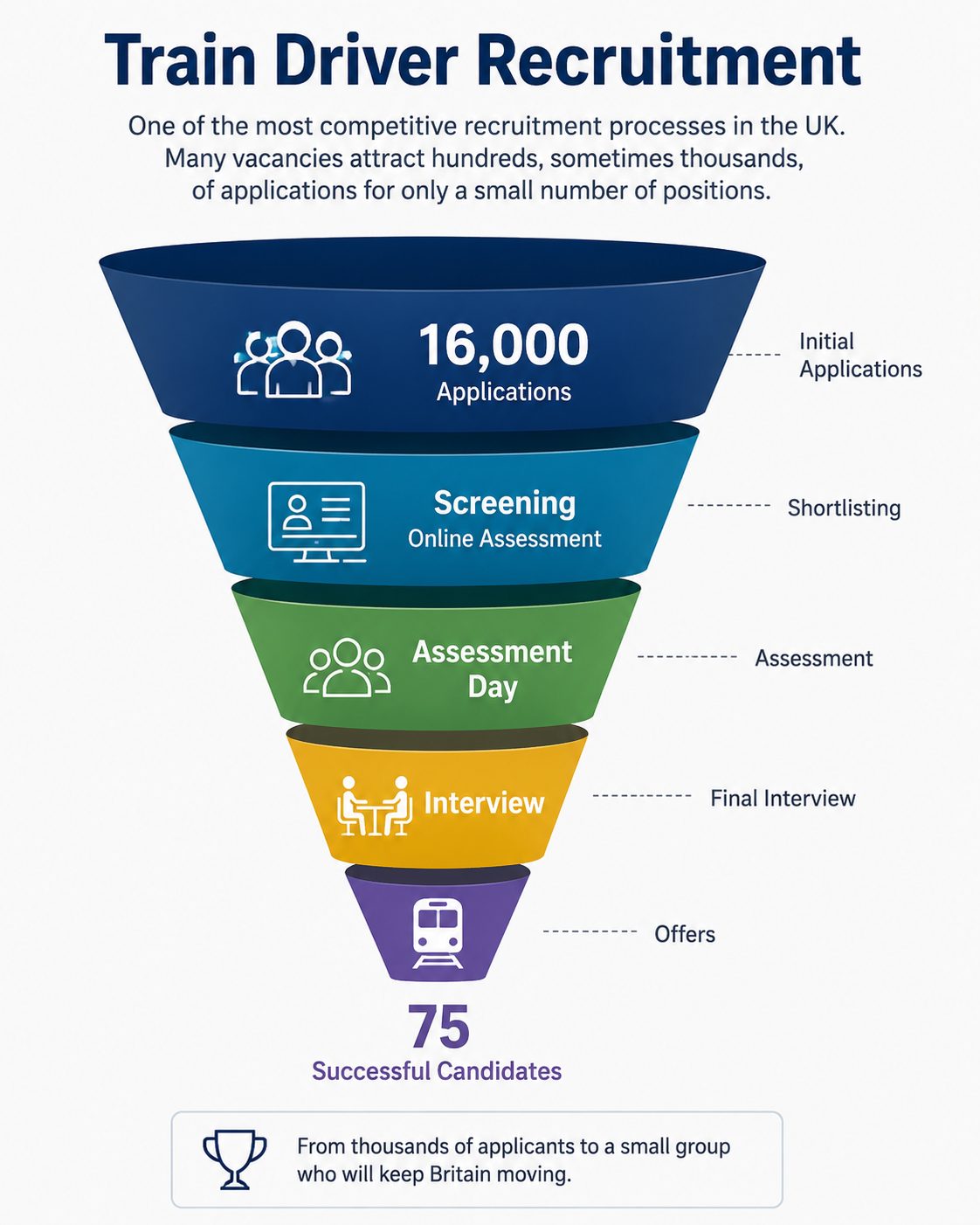
Meeting the basic entry criteria does not mean you are automatically a strong candidate. Train driver recruitment is competitive, and psychometric assessments are a central part of selection. These tests are designed to assess capabilities and behavioural tendencies linked to safe performance, such as concentration, vigilance, rule adherence and the ability to process information accurately.
Candidates sometimes treat this stage as a hurdle to rush through. That is usually a mistake. Good preparation is not about trying to outsmart the process. It is about understanding the demands of the role, becoming familiar with assessment formats and presenting your genuine capability under test conditions.
Structured interviews work in a similar way. Employers will be looking for evidence of operational maturity, personal responsibility, safety awareness and consistency. Enthusiasm helps, but it is not enough on its own. A candidate who understands the job, speaks in specific examples and shows realistic commitment is normally far stronger than one who simply says they have always loved trains.
Character, discipline and the standard expected
Because train driving is safety-critical, employers will also consider your overall reliability and professional conduct. That can include references, employment history, attendance patterns and, where relevant, background checks. Minor issues are not always career-ending, but unexplained inconsistencies or signs of poor judgement can weaken an application.
This is one of the reasons train driver recruitment can feel demanding. Employers are not only filling a vacancy. They are assessing whether you can be trusted with a role that depends on routine discipline every single day. Strong candidates tend to show self-control, patience, attention to detail and a measured approach to pressure.
It depends on the operator - and that matters
Although the broad framework is consistent, train driver eligibility requirements UK employers use are not identical. One operator may emphasise depot proximity more strongly. Another may screen more tightly for recent safety-critical experience. Freight roles and passenger roles can also differ in practical expectations.
That is why generic advice has limits. The better approach is to separate universal requirements from vacancy-specific ones. Universal requirements include legal working status, medical suitability, behavioural fit and the ability to pass assessments. Vacancy-specific requirements may include location, prior experience, educational thresholds or availability to start training within a set timeframe.
For applicants, this has one clear implication. Tailor your preparation. A broad interest in rail is useful, but role-specific readiness is what moves candidates forward.
How to check your eligibility before you apply
Before submitting applications, review your position honestly. Can you prove your right to work? Are your qualifications documented? Can you realistically manage depot access and shift patterns? Do you understand the medical standard and the assessment stages? Have you translated your previous experience into evidence that fits a safety-critical role?
If the answer is partly yes and partly not yet, that is not a dead end. It usually means your next step is preparation rather than immediate application volume. Strengthening your CV, improving your understanding of the role, practising for structured interviews and building familiarity with psychometric testing can make a significant difference to how credibly you present.
This is where specialist preparation can help, provided it stays grounded in railway standards and realistic employer expectations. The strongest candidates are rarely the loudest. They are the ones who arrive informed, organised and ready to meet the process properly.
Train driving is not an easy route into rail, and it should not be. But if you meet the core eligibility requirements and are prepared to approach the process with discipline, it becomes a path you can assess methodically rather than guess at. Start with facts, build your readiness step by step, and let your application reflect the standard the role demands.