



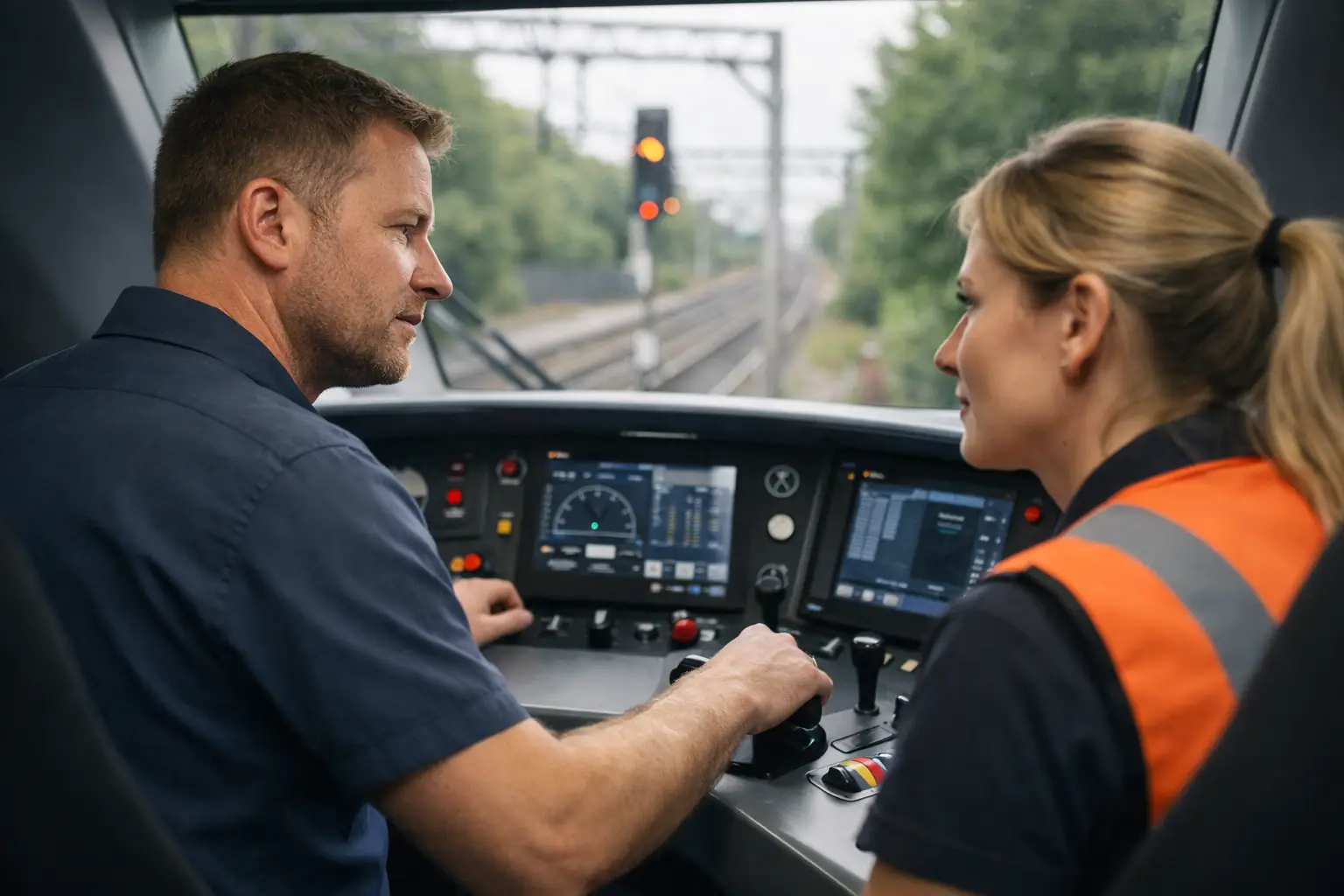
A train driver may spend much of a shift alone in the cab, but this is not an isolated or simple job. The train driver role explained properly is one of personal responsibility, disciplined decision making and consistent safety performance. Every journey depends on the driver applying rules, remaining alert and communicating effectively with the wider railway.
For aspiring trainee drivers, understanding the reality of the role matters before submitting an application. Train Operating Companies (TOCs) recruit carefully because driving is safety-critical. They are looking for people who can follow procedures without complacency, manage pressure calmly and maintain concentration over long periods.
What does a train driver actually do?
The visible part of the job is moving passengers or freight from one location to another. The professional responsibility behind that movement is much broader. A driver prepares the train, operates it in line with the timetable and railway rules, observes the route and signals, responds correctly to changing conditions, and brings the service to a safe finish.
Before departure, a driver will sign on, receive relevant operational information and carry out required checks. They must understand any changes that could affect the journey, such as restrictions, weather conditions, engineering work or altered stopping arrangements. This requires attention to detail from the beginning of the shift, not only when the train starts moving.
During the journey, drivers need to maintain awareness of signals, speed restrictions, platform stops, route features and the behaviour of the train. They work to established rules and instructions rather than relying on habit or assumption. A routine journey can still demand close concentration, particularly where there are disruptions, degraded conditions or unfamiliar circumstances.
At the end of a working turn, duties may include stabling a train, handing it over, reporting faults or completing the necessary records. The exact tasks vary by TOC, depot, route and whether the operation is passenger or freight focused. The core expectation does not vary: complete each duty safely, accurately and professionally.
Safety is the centre of the role
Train driving is a safety-critical career. That means a driver’s choices can affect passengers, colleagues, members of the public and the railway network. Safety is not a separate task to be completed at the start of a shift. It is the framework for every decision made throughout it.
A strong driver does not take shortcuts to recover time or make an awkward situation disappear. If something does not look right, they recognise it, apply the appropriate process and communicate it clearly. This may involve contacting a signaller or control, reporting a fault, or seeking clarification before proceeding. Sound judgement includes knowing when to stop and ask.
This is why TOCs place such weight on rule adherence, concentration, risk awareness and communication in recruitment. Candidates are not expected to arrive with every piece of railway knowledge. They are expected to show the behaviours that support safe training and dependable operational performance.
Concentration, routine and decision making
One common misunderstanding is that a driver simply repeats the same route until it becomes automatic. Familiarity is useful, but over-familiarity can create risk if it leads to reduced attention. Professional drivers stay actively engaged with the task, even on routes they know well.
The role calls for sustained concentration, often across long stretches of time and in conditions that can be monotonous. A driver must continue to notice what is happening, anticipate what is ahead and act at the correct moment. This is different from being generally busy. It is focused, controlled attention.
Decision making is equally important. Some decisions are straightforward because rules prescribe a clear action. Others require a driver to assess the available information, understand the limits of their authority and communicate with the right people. In both cases, the quality of the decision depends on composure, procedural discipline and situational awareness.
For applicants, examples from previous work can be highly relevant. Experience in transport, the Armed Forces, emergency services, manufacturing, aviation, logistics or other operational environments may demonstrate useful behaviours. So can roles where you worked independently, followed detailed processes, protected customers or colleagues, and reported concerns promptly. The setting matters less than the evidence of your approach.
Shift work and personal responsibility
Train driving is not a standard Monday-to-Friday, nine-to-five role. Rosters commonly include early starts, late finishes, weekends and public holidays. Some duties begin before normal public transport services are running, while others finish after the last passenger has left the station.
The pattern can suit people who value rostered time off and can manage their routine well. It can be more difficult for those who need fixed daily hours or struggle to protect sleep around changing shifts. Applicants should consider this honestly rather than viewing shift work as a minor detail.
Fatigue management is a serious professional responsibility. Drivers need to arrive fit for duty, rested and able to concentrate. This requires practical planning around sleep, commuting, family commitments and lifestyle. Reliability is not just about turning up on time. It is about being consistently ready to perform a safety-critical role to the required standard.
The job also involves working independently for substantial periods. That does not mean drivers are unsupported: they are part of an operational team with station staff, signallers, controllers, fleet teams and other colleagues. However, when in the cab, the driver must be comfortable taking ownership of their own actions and maintaining standards without close supervision.
The train driver role explained through recruitment standards
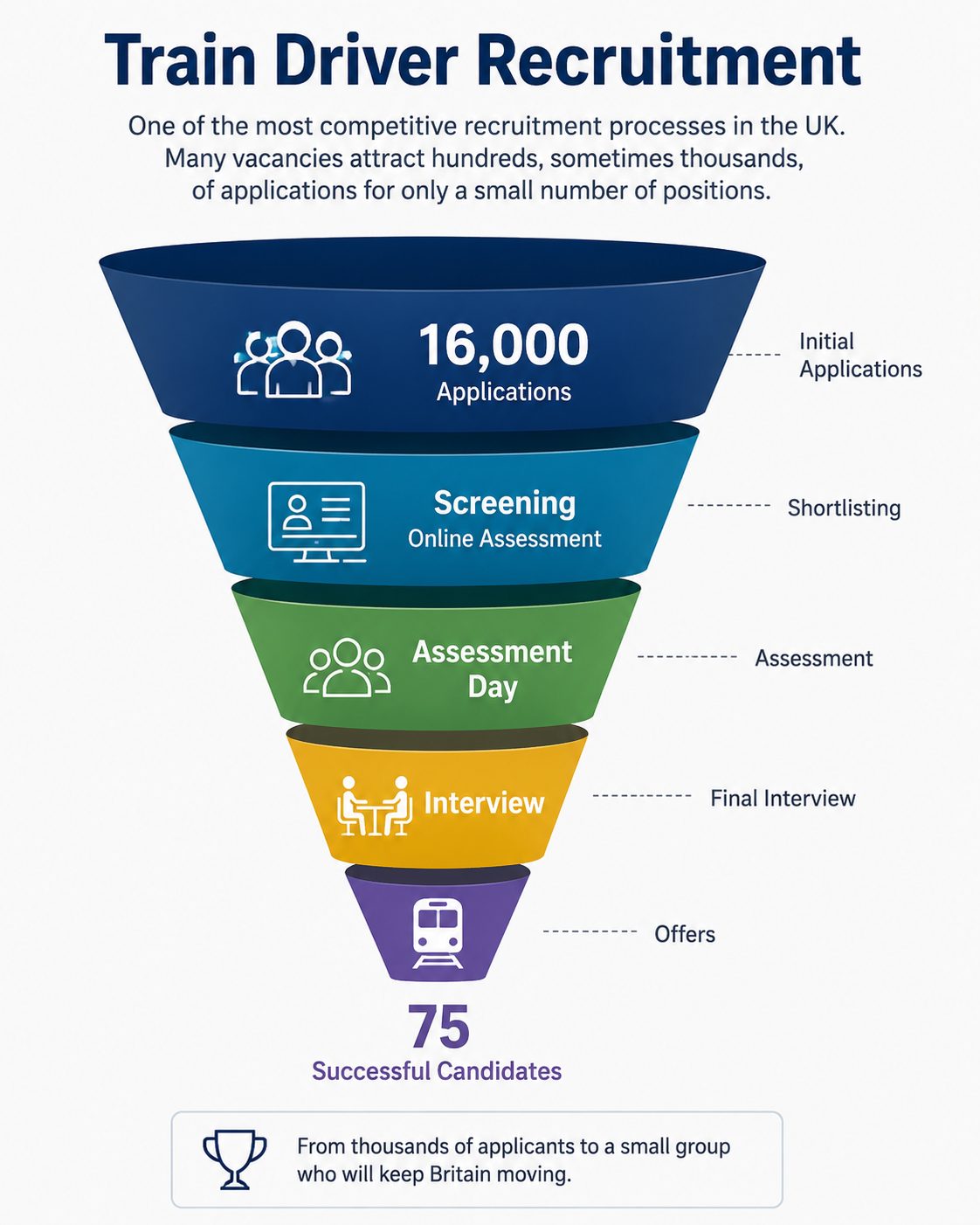
Trainee train driver recruitment is competitive because TOCs are selecting people for a role that demands trust, long-term training and proven operational suitability. The process often includes an application review, online assessments, psychometric tests, structured interviews, medical assessment and other role-specific stages.
Each stage is designed to examine different evidence. Application forms and CVs may assess employment history, motivation, reliability and transferable experience. Online and psychometric assessments can examine concentration, rule application, reaction to information and other cognitive or behavioural factors. Structured interviews explore whether your examples demonstrate the required safety and operational behaviours.
Preparation should never be about trying to second-guess or bypass an assessment. It should be about understanding what the role requires and presenting your genuine experience clearly. Candidates who prepare effectively can explain why they want the career, describe how they manage responsibility and give specific examples of disciplined decision making.
A useful starting point is to review your own work history against the role. Where have you followed a process when under pressure? When did you identify a risk and act on it? How have you maintained standards during repetitive work? When have you communicated a concern clearly, even when doing so was inconvenient? Specific, truthful examples are more persuasive than broad claims about being safety conscious.
Training after appointment
Being appointed as a trainee is the start of a demanding development pathway, not the end of the selection process. Training normally covers railway rules, route knowledge, traction and rolling stock, practical handling and the professional standards expected in the cab. It involves classroom learning, supported practical experience and formal assessment.
The learning load can be substantial. Trainees need to retain detailed information, apply it accurately and develop confidence without becoming complacent. Progress depends on consistent study habits, openness to feedback and the willingness to ask for clarification when something is not fully understood.
This is where early operational learning can be valuable. Introductory study in areas such as risk-based decision making, operational thinking, personal track safety, traction and rolling stock can help applicants build realistic awareness of railway work. It does not replace TOC training, but it can help a candidate approach recruitment and future learning with greater structure and maturity.
Is train driving the right career for you?
Train driving can offer a respected, long-term career for people who take pride in responsibility, routine and high standards. It is likely to suit applicants who can work independently, remain calm when plans change and value doing a task properly every time.
It may be less suitable if you need frequent social interaction throughout the day, dislike working to strict rules or find changing hours difficult to manage. There is no benefit in forcing your experience to fit an image of the job. A realistic view of the role leads to better applications and more informed career decisions.
If this career appeals to you, begin by treating readiness as a process. Build a clear understanding of the role, examine your evidence honestly and prepare for each recruitment stage with the same care a safety-critical profession demands. That professional mindset is valuable long before you sit in a driver’s cab.