




A train driver’s first day in the cab is not the start of the journey. It comes after a demanding train driver training pathway that tests suitability, builds technical knowledge and develops the disciplined decision-making required in a safety-critical role. For aspiring drivers, understanding the stages early makes it easier to prepare properly, set realistic expectations and present credible evidence at every point.
The route is not a single national course that leads directly to a job. In most cases, you apply for a trainee train driver vacancy with a Train Operating Company (TOC), complete its recruitment process, and undertake employer-led training once appointed. Each TOC has its own recruitment timetable, local requirements and training arrangements, but the underlying expectation is consistent: candidates must be capable of operating safely, reliably and independently.
The Train Driver Training Pathway at a Glance
The pathway usually has four connected stages: establishing eligibility and readiness, succeeding in recruitment, completing initial training, then maintaining competence after qualification. The order matters. A strong interest in rail is valuable, but it does not replace the evidence of concentration, rule-following, communication and personal responsibility that a TOC needs to see.
1. Establishing eligibility and operational readiness
Before applying, review each vacancy carefully. Requirements can differ by operator and location, particularly around age, residency, travel distance from the depot, shift availability and the right to work in the UK. Some roles have strict commuting expectations because early starts, late finishes and disruption can make long journeys impractical.
You should also consider the reality of the working pattern. Train driving commonly involves nights, weekends, public holidays and periods of lone working. Candidates who can explain how they will manage fatigue, reliable travel and personal commitments demonstrate a more mature understanding of the role than those who focus only on the attraction of the career.
Operational readiness is equally important. A driver must remain attentive during repetitive tasks, apply procedures consistently and respond calmly when conditions change. Experience from the Armed Forces, emergency services, logistics, manufacturing, aviation, transport or other regulated environments can be relevant where it shows safety awareness and accountability. Career changers without a direct operational background can still make a strong case, provided they identify specific examples rather than relying on general statements about being hardworking.
2. Applying and completing the recruitment process
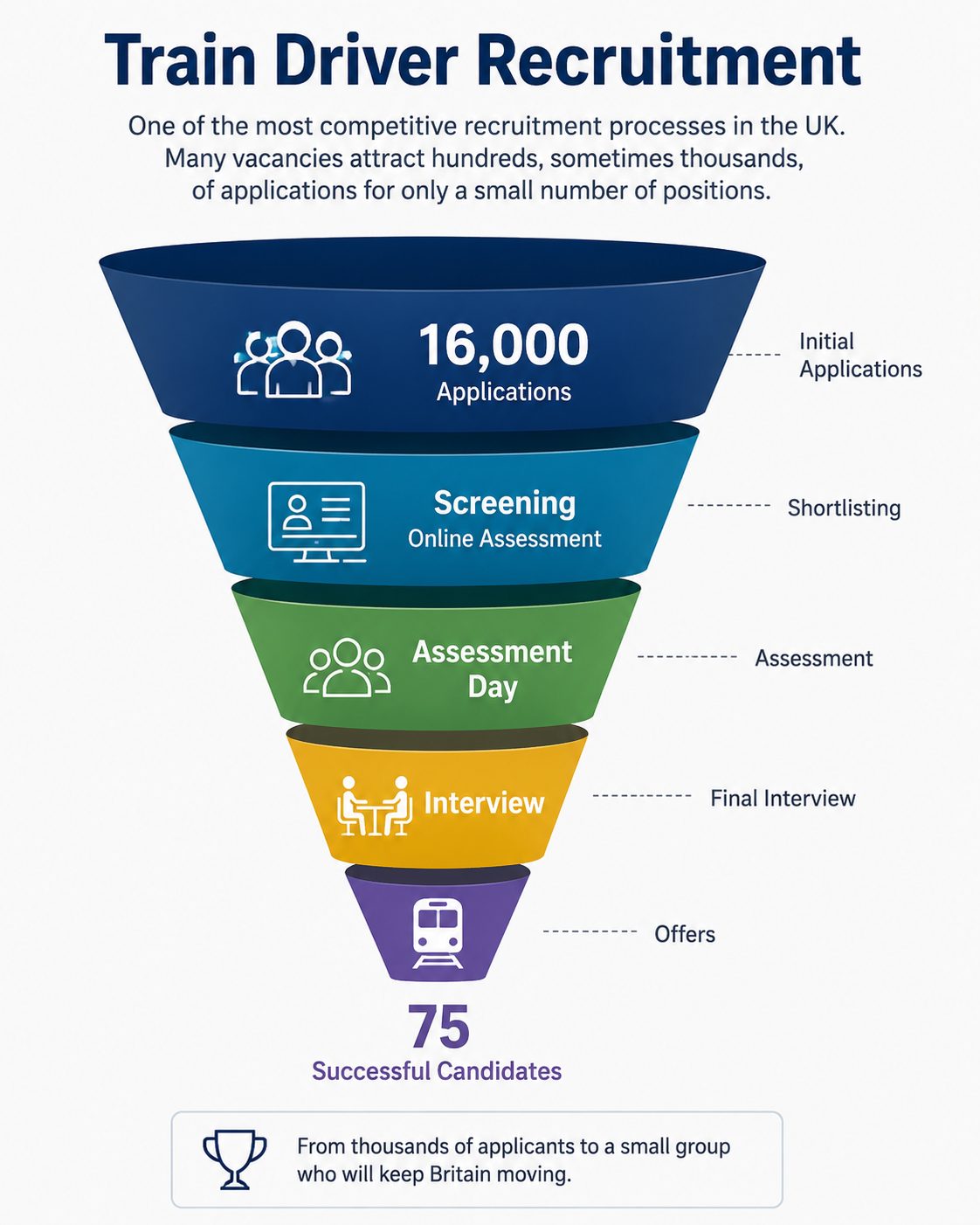
Trainee driver vacancies are highly competitive. The application is not simply an administrative formality: it is your first opportunity to show that you understand a safety-critical position and can communicate professionally.
A targeted CV should connect your employment history to the behaviours the role demands. Useful evidence may include following formal processes, maintaining standards under pressure, reporting hazards, working to time-sensitive instructions, making careful decisions and communicating clearly with colleagues or customers. Keep claims factual and specific. A recruiter needs to understand what you did, why it mattered and what the outcome was.
Candidates who progress may face several selection stages, depending on the TOC. These can include an application review, online assessments, psychometric tests, structured interviews, group-based exercises, a medical assessment and pre-employment checks. The process is designed to assess suitability, not to reward rehearsed answers or shortcuts.
Preparation should therefore be honest and structured. Practise working accurately within time limits, refresh your understanding of safety-critical behaviours and prepare examples using a clear situation, action and result format. For interviews, be ready to explain how you have handled responsibility, routine, pressure, conflict, rules and unexpected events. Do not invent railway experience. A well-explained example from your own work is more convincing than a vague answer built around what you think the interviewer wants to hear.
It is also sensible to expect setbacks. Recruitment campaigns can close quickly, assessments may be staged over several months, and a successful result at one point does not remove the need to meet the required standard at the next. Treat each application as a professional project: record deadlines, review feedback where it is provided, and improve the areas within your control.
What Initial Train Driver Training Involves
Once appointed, a trainee enters a formal training programme delivered by the employing operator. The precise sequence, duration and materials vary by TOC, route and traction, but the training is deliberately progressive. You are building knowledge and practical judgement that must hold up during normal running, disruption and degraded conditions.
Classroom and rules-based learning
Early training normally covers the operational principles required to work safely on the railway. This includes the responsibilities of a driver, communication standards, route-related knowledge, signalling principles, emergency awareness, traction and rolling stock fundamentals, and the importance of reporting and recording issues correctly.
This stage can be academically demanding because it requires accurate recall as well as understanding. Good study habits matter. Trainees need to organise notes, revise consistently, ask questions when uncertain and avoid allowing knowledge gaps to build. The aim is not merely to pass an assessment. It is to establish the dependable knowledge base needed for safe practical work.
Practical driving and route learning
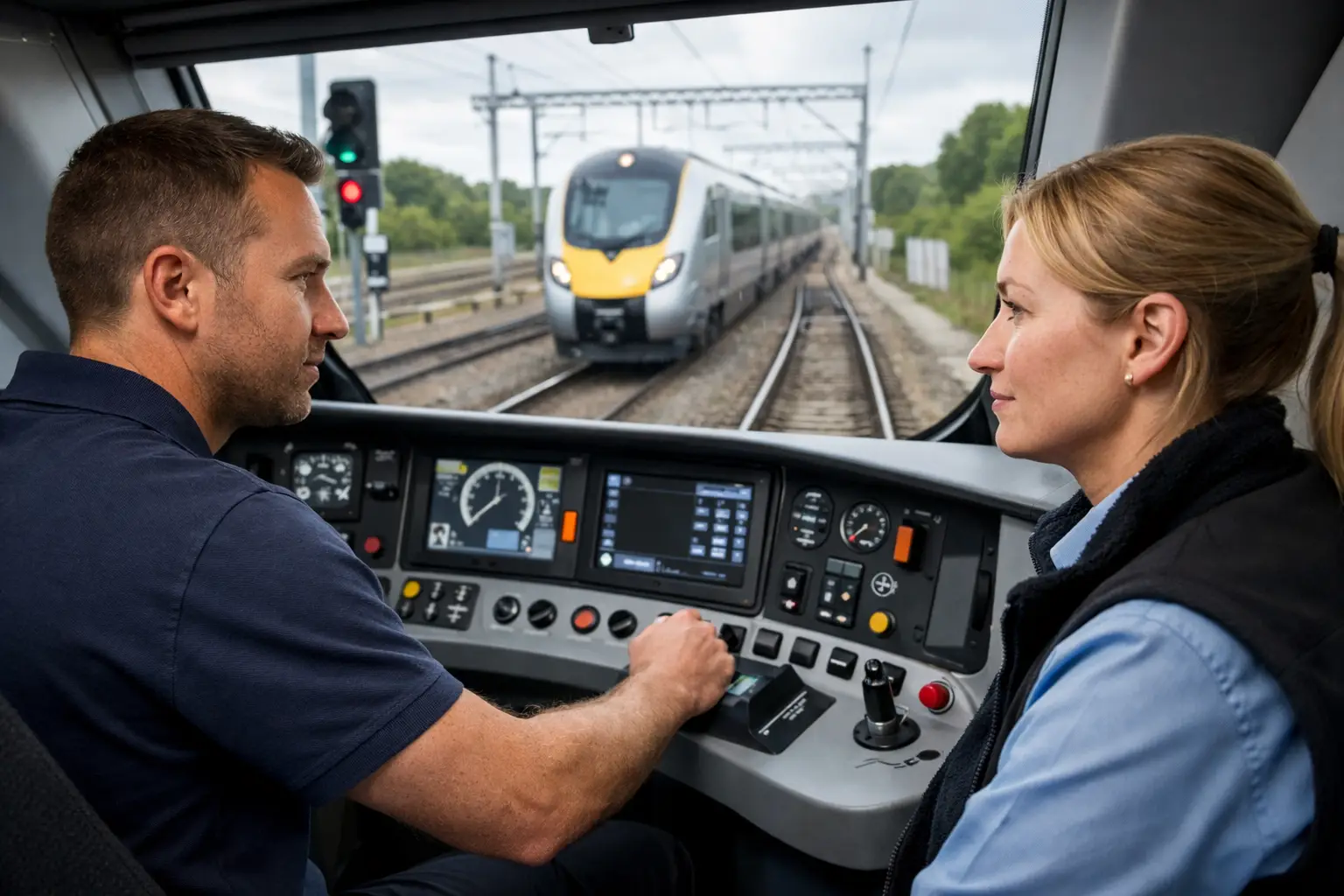
Cab training introduces the practical application of what has been learned. Under supervision, trainees develop skills in train preparation, handling, observation, braking, station duties, communication and responding appropriately to operational events. This is not a matter of becoming familiar with the controls alone. Smooth driving, timekeeping and customer service all sit beneath the overriding requirement to operate safely and in accordance with instructions.
Route learning adds another layer. Drivers must develop a detailed understanding of the routes they sign, including locations, landmarks, speed changes, stopping patterns and operational features relevant to their duties. This takes repeated exposure, active study and disciplined concentration. The amount of route and traction knowledge required is one reason training length varies significantly between roles.
Progress is checked throughout. If a trainee needs additional support in a particular area, the focus is on reaching the required standard, not rushing ahead. The safety-critical nature of the role means competence must be demonstrated consistently.
Assessment, qualification and competence management
Initial training ends only when the trainee has met the operator’s requirements across the relevant knowledge and practical assessments. Qualification is a significant milestone, but it is not a licence to stop learning. Drivers remain subject to ongoing competence management, refresher training, medical requirements and periodic assessments.
This continuing development reflects the reality of railway operations. Procedures can change, routes or traction may be added, and experience must be maintained through regular professional standards. The strongest drivers approach this as part of the role, not as an inconvenience after training.
How to Prepare Before You Apply
You cannot complete a TOC’s internal driver training in advance, but you can prepare for the standard it requires. Start by understanding the role beyond the cab. Read vacancy information carefully, research the operator’s service area and consider how its depot location and rostering demands fit your circumstances.
Build evidence from your present role. If you work with procedures, make a note of occasions when you identified a risk, escalated an issue, managed competing priorities or maintained accuracy during a repetitive task. If you supervise others, focus on how you set standards and communicate clearly. If you are leaving the military, translate service experience into civilian, outcome-focused language rather than relying on acronyms or assumed knowledge.
Role-specific learning can also strengthen your preparation when it develops genuine operational awareness. Courses in risk-based decision making, operational maturity, personal track safety or traction and rolling stock can help candidates understand the language and responsibilities of rail work. They should support, rather than replace, careful application preparation and honest assessment practice.
Train Driver Foundation’s preparation resources are designed around this reality: helping applicants understand the process, improve the quality of their evidence and approach recruitment with the professional standard the role demands.
A Career Path Built on Consistency
The train driver training pathway rewards people who can prepare patiently, learn methodically and take responsibility seriously. It may not move at the speed applicants hope for, and the route into a trainee role can require more than one application. That is normal in a competitive, safety-critical profession.
Focus on becoming the sort of candidate a TOC can trust with sustained responsibility: reliable in routine work, thoughtful under pressure, open to feedback and committed to doing things properly. That mindset will serve you in recruitment, throughout training and long after you qualify.