




If you are weighing up a move into rail, trainee train driver salary is usually one of the first practical questions. That makes sense. Train driving is a safety-critical career with demanding entry standards, and most applicants want to know whether the training period offers a realistic income while they work towards qualification.
The short answer is that trainee pay can be strong compared with many other entry routes, but there is no single national figure that applies everywhere. Salary levels vary by Train Operating Company, route, location, training structure and collective agreements. Some roles are advertised with a clearly stated trainee rate followed by a higher qualified rate. Others publish a broader pay framework, which means candidates need to read the detail carefully rather than assume all vacancies are equivalent.
How trainee train driver salary usually works
In most cases, a trainee train driver is employed on a salaried contract while completing classroom learning, rules training, traction knowledge, route learning and practical handling under supervision. This is not an unpaid training scheme and it is not casual work. You are being prepared for a highly responsible operational role, so the salary normally reflects the seriousness of the position even before you qualify.
That said, trainee earnings are usually lower than the full rate for a qualified driver. This is because you are still in training, not yet productive at full operational level, and still working towards competence sign-off. Once you complete training and move into a qualified driver post, pay generally increases, sometimes significantly.
For many applicants, the most useful way to think about it is not just the starting figure, but the full pay journey. A vacancy with a moderate trainee salary may still be attractive if the progression to mainline driver pay is clearly defined and the employer has a structured training pathway.
Typical salary ranges in the UK
Trainee train driver salary in the UK often falls somewhere in the broad range of around the mid-£20,000s to the mid-£30,000s, although some roles sit outside that depending on operator and location. London and South East roles may appear higher on paper, but that does not automatically mean they offer better overall value once commuting costs and local living costs are considered.
Qualified salaries commonly move well beyond trainee rates, often into the £50,000-plus range and, in some cases, higher still depending on the operator, depot, diagrams, Sunday arrangements and other contractual factors. That progression is one of the reasons train driving attracts career changers from logistics, the Armed Forces, bus and coach operations, engineering and other disciplined operational sectors.
Still, published figures should be treated carefully. Job adverts may state a salary during training, a salary on completion, or both. Some quote inclusive figures that may reflect allowances. Others separate base pay from enhancements. Unless you understand what is included, comparisons can be misleading.
What affects trainee train driver salary
The biggest factor is the employing TOC or rail operator. Pay structures are not identical across the industry, so one trainee post may start noticeably higher than another. Depot location also matters. A depot serving a busy commuter network in a high-cost area may offer a different package from a regional depot with a different operating pattern.
Training length can also shape how the salary feels in practice. If one company has a long route to competence but offers stable salaried training with clear milestones, that may suit applicants who want predictable progression. Another may move trainees to full rate quickly after qualification, but the pathway may still be demanding and competitive.
Contracted hours and working arrangements matter too. Some applicants focus only on the headline number and overlook the reality of rostered railway work. Early starts, late finishes, weekend turns and bank holiday working are part of the job in many depots. A slightly lower salary with a depot location or roster pattern that better fits your life can be the stronger long-term decision.
Salary is only one part of the decision
A common mistake is to judge a vacancy only by the starting wage. In train driver recruitment, that can be short-sighted. The right question is whether the full role matches your capabilities, circumstances and long-term career aims.
A good trainee opportunity should be considered in the round. Look at the training structure, pension, annual leave, travel facilities where offered, depot location, progression pathway and operational culture. A role with a competitive salary but poor practical fit for your travel distance or family commitments may become difficult to sustain, especially during training when concentration and consistency are vital.
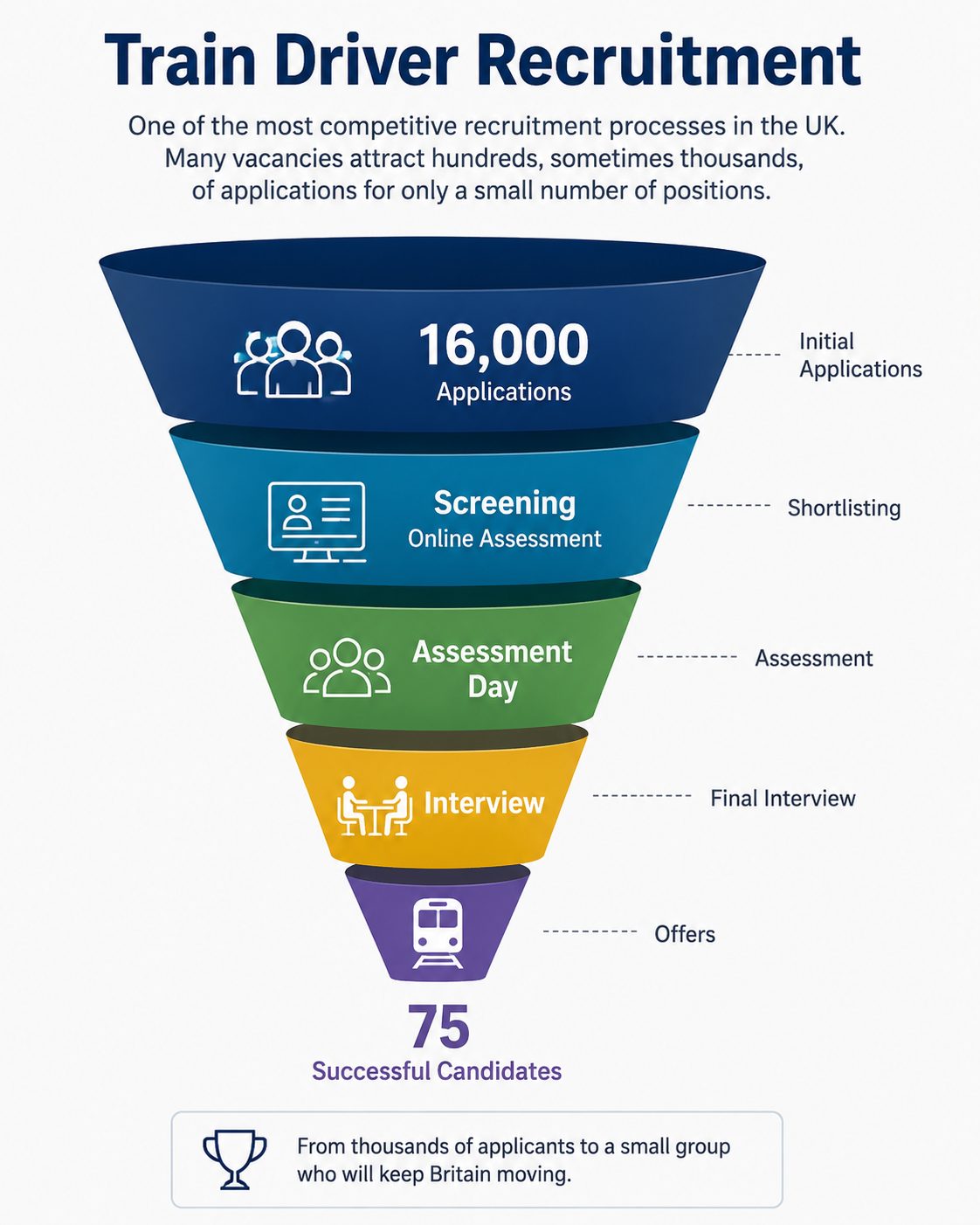
There is also the question of competition. Train driver vacancies often attract very high application volumes. Chasing only the highest-paying advert can lead applicants to ignore roles where they may be better aligned and better prepared. In practice, a realistic, well-targeted application strategy usually serves candidates better than focusing on headline pay alone.
Why trainee pay can still represent strong value
Even before qualification, many trainee roles compare favourably with salaries in customer service, retail management, warehousing, driving instruction, bus operations and some supervisory roles. For applicants moving from sectors with limited progression, trainee train driver salary can provide a more stable platform while they build towards a higher-paying qualified position.
More importantly, the salary sits within a career path that offers structure. This is not simply about earning more in year one. It is about entering a regulated profession where competence, discipline and operational standards are taken seriously. For the right candidate, that combination of pay, responsibility and long-term security is what makes the role attractive.
This is especially relevant for career changers and service leavers. Many already have the behavioural foundations employers value - concentration, rule adherence, situational awareness, calm decision making and personal accountability. Salary matters, but it tends to matter most when considered alongside career durability.
What applicants should look for in job adverts
When reviewing a vacancy, read beyond the headline figure. Check whether the advert states a trainee salary only, a qualified salary only, or a staged increase over the training period. Look for wording around depot assignment, contractual hours, roster expectations and whether the role includes Sundays within the working week or separately.
You should also pay attention to whether the role is trainee-specific or whether the operator is seeking qualified drivers only. Some applicants misread these adverts and build salary expectations around posts they are not yet eligible for.
Where salary wording is vague, that does not necessarily mean the opportunity is poor. It may simply mean the operator publishes pay details later in the process. Still, from an applicant point of view, clarity matters. A well-prepared candidate keeps records, compares adverts carefully and avoids assumptions.
Does higher trainee pay mean an easier route in?
No. Salary level is not a shortcut and it should not be treated as one. Higher-paying trainee roles are often linked to operators, depots or locations that attract especially large numbers of applicants. The recruitment process remains demanding because train driving is a safety-critical profession, not because of the salary alone.
Applicants still need to meet eligibility criteria, produce a credible application, perform well in structured interviews and show the behavioural profile needed for railway operations. Good pay does not reduce the standard. If anything, desirable vacancies often require sharper preparation because the competition is stronger.
This is where candidates benefit from treating the process professionally. Understanding the role, the assessment stages and the expectations around safety, concentration and operational maturity can help you approach vacancies more realistically. Train Driver Foundation supports applicants in that preparation-focused way - not by overselling outcomes, but by helping candidates understand what the role demands.
Should you wait for the highest-paying vacancy?
Sometimes yes, but often no. It depends on your current position, your readiness and how flexible you are on depot location. Waiting for the perfect salary figure can leave applicants inactive for long periods, especially in a market where vacancies open and close quickly.
If you meet the entry criteria and a suitable trainee role appears with a solid salary and workable location, that may be worth serious consideration. Experience shows that successful candidates tend to be consistent, organised and realistic. They do not rely on one idealised advert. They prepare thoroughly and apply where the role fits their profile.
A train driver career is built over years, not just from the first payslip. Starting on a credible trainee salary within a structured pathway can be more valuable than waiting indefinitely for a vacancy that looks marginally better on paper.
If you are assessing trainee train driver salary, focus on the full picture: what you earn while learning, how pay progresses after qualification, and whether the role genuinely fits your circumstances and strengths. The strongest career decisions in rail are usually the ones made with patience, clear thinking and proper preparation.