




When trainee train driver vacancies UK-wide start appearing, many applicants focus on the advert and miss the bigger issue - whether they are actually ready for the standard behind it. That matters because train driver recruitment is not simply about sending a CV quickly. It is a safety-critical selection process, and the strongest applicants usually treat it that way from the start.
If you are changing career, leaving the Armed Forces, moving from transport or operations, or applying to rail for the first time, the market can seem difficult to read. Vacancies do open, but they are often limited, highly competitive and shaped by local operational needs. A better approach is to understand how these roles are recruited, what employers are screening for, and how to prepare before the next campaign lands.
Where trainee train driver vacancies UK employers advertise
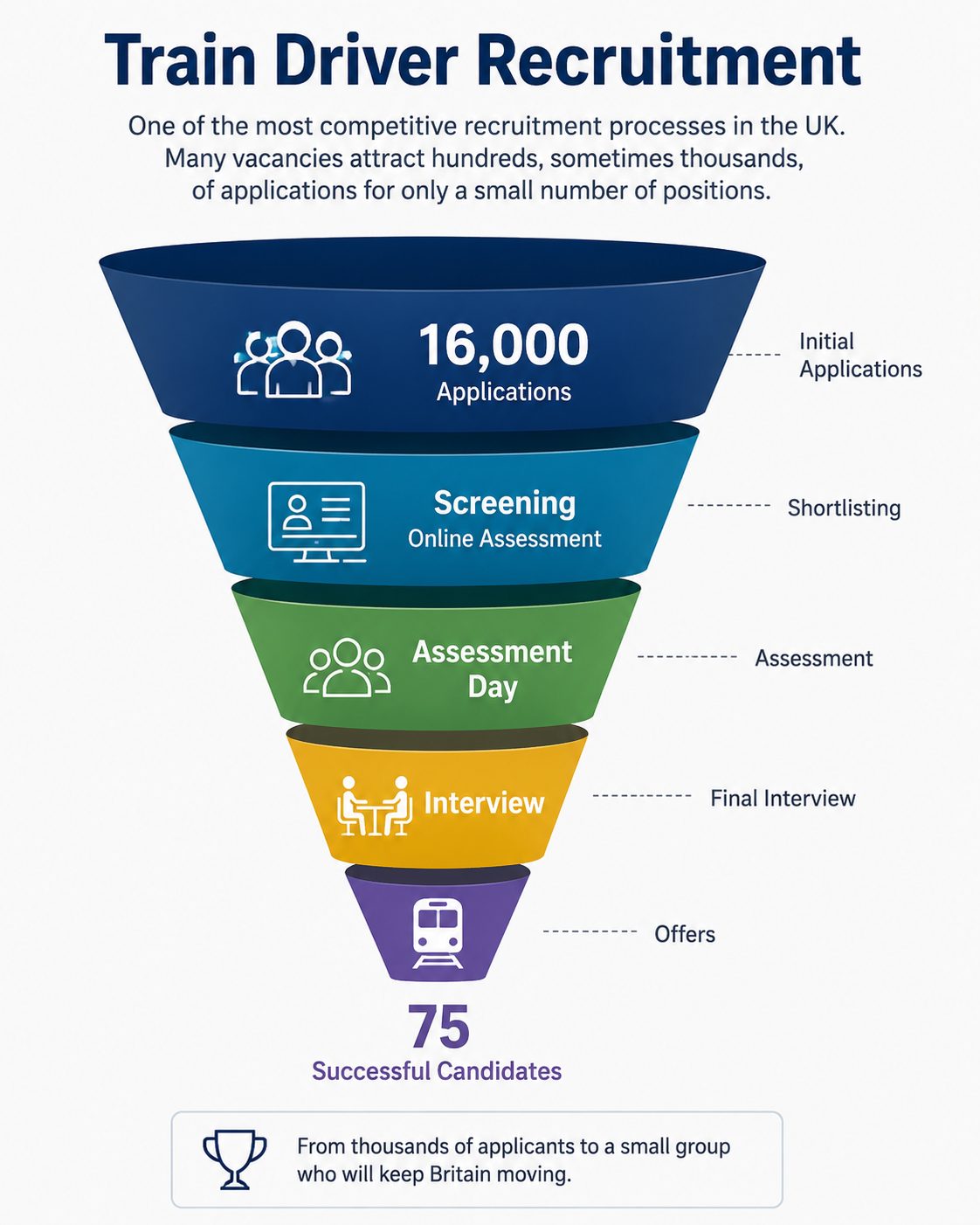
Most trainee driver roles are advertised directly by Train Operating Companies and, in some cases, freight operators. They may appear on company careers pages for only a short period, particularly in high-demand locations. Some campaigns attract very large numbers of applicants, which means the first hurdle is often not talent alone but readiness at the point of application.
Location makes a real difference. A depot in a large city may attract applicants from a wide commuting area, while a vacancy in a smaller location may still be competitive but draw from a narrower pool. Shift patterns, depot access, route requirements and relocation practicality all affect whether a role is genuinely suitable. Candidates sometimes apply widely without checking these points carefully, then struggle later when availability or travel expectations are tested.
It is also worth remembering that recruitment is cyclical. A TOC may recruit heavily for one period, then pause. That does not mean the route has closed to you. It means timing matters. Strong candidates use quiet periods to improve their evidence, sharpen interview performance and build a better understanding of the role.
What employers are really assessing
A trainee train driver vacancy is an entry route, but it is not an entry-standard job in the usual sense. Employers are recruiting for future safe performance in a role that demands concentration, rule adherence, emotional control and consistent decision making over long periods.
That is why the selection process usually goes beyond a CV. Depending on the operator, candidates may face an initial sift, online assessments, psychometric testing, structured interviews and a medical. Each stage is there for a reason. The employer is not looking for someone who simply wants the job. They are looking for someone who can show behavioural evidence aligned to a safety-critical environment.
This catches out applicants who rely on generic interview answers or broad claims such as being hardworking and reliable. Those qualities are not enough on their own. Recruiters want evidence of following procedures under pressure, maintaining standards when tired or distracted, communicating clearly, managing routine without complacency and taking responsibility for safety.
How to judge whether a vacancy suits you
Not every trainee train driver vacancy is the right one to pursue immediately. That is not negative thinking. It is professional judgement.
Start with the practical basics. Can you reliably reach the depot for very early turns, late finishes and weekend working? Is your work history stable and explainable? Can you present clear examples from previous roles that demonstrate concentration, compliance, hazard awareness and calm decision making? If the answer to several of these is no, the issue may not be motivation but readiness.
Then consider your background properly. Many successful applicants come from operations, logistics, emergency services, customer-facing transport, engineering, manufacturing and military service because those environments often produce useful evidence for safety-critical recruitment. That does not exclude applicants from other sectors, but it does mean you may need to work harder to translate your experience into relevant examples.
Preparing before trainee train driver vacancies UK open
The best time to prepare is before a role appears. Once a campaign goes live, there is rarely enough time to build a credible application from scratch.
A strong starting point is your CV. For train driver recruitment, this should not read like a generic employment history. It should highlight punctuality, procedural discipline, responsibility, communication, lone working, shift work, concentration and safety awareness where those genuinely apply. Employers do not need inflated language. They need relevant evidence presented clearly.
Interview preparation matters just as much. Structured interviews in this sector often test how you behaved in real situations, not how well you understand buzzwords. Good preparation means identifying examples that show consistency, rule compliance, learning from mistakes, teamwork, customer responsibility and calm thinking under pressure. Weak preparation usually shows up as vague storytelling, overlong answers or examples that have no obvious operational relevance.
Assessment stages also deserve respect. Psychometric tests are not a formality and should never be treated casually. The purpose is to assess suitability for a demanding role, so your approach should be honest, disciplined and properly prepared. That means understanding test formats, practising concentration and working on consistency, rather than looking for shortcuts.
Common mistakes applicants make
One of the most common mistakes is applying because the salary or job title looks attractive, without understanding the lifestyle and standards involved. Train driving offers long-term career value, but it also demands shift resilience, personal discipline and a serious attitude to safety.
Another mistake is using the same application for every operator. TOCs may recruit to similar core standards, but the context still matters. Depot location, route characteristics, passenger environment and operational culture can influence how you present your fit. A more targeted application tends to read as more credible.
Some candidates also underestimate the medical and standards-based nature of the process. Others overestimate the value of enthusiasm alone. Motivation is useful, but evidence carries more weight. A calm, well-prepared applicant with relevant examples usually comes across more strongly than someone who is highly enthusiastic but poorly structured.
What makes an application more competitive
Competitive does not mean flashy. In this field, it usually means credible, focused and aligned to the role.
Recruiters respond well to applicants who understand what the job involves and can explain why their background supports that pathway. That includes showing a stable approach to work, respect for rules, attention to detail and realistic commitment to depot-based operations. It also helps if your answers show maturity. Safety-critical employers are rarely impressed by bravado. They are looking for control, consistency and judgement.
There is also value in early-stage rail learning and CPD where it is relevant and reputable. Foundational study can help candidates understand industry language, operational expectations and the behavioural standards linked to the role. It does not replace recruitment performance, but it can help applicants present themselves with greater clarity and seriousness.
A realistic view of competition
Trainee train driver vacancies often attract far more applicants than available places. That can feel discouraging, but it should be interpreted correctly. A rejection does not always mean you are unsuitable for the career. It may mean your timing, evidence, application quality or assessment readiness was not strong enough on that occasion.
This is where a systematic approach helps. Review what stage you reached, where your preparation may have been thin and what can be improved before the next opportunity. For some candidates, the priority is CV quality. For others, it is interview structure, psychometric readiness or a more realistic understanding of depot suitability.
Specialist preparation can be useful because generic careers advice often misses the standards of train driver recruitment. Train Driver Foundation, for example, focuses specifically on helping candidates prepare in a way that reflects rail selection expectations rather than broad employability advice. That kind of role-specific support can be valuable if used properly - not as a shortcut, but as structured preparation.
Should you wait for the perfect vacancy?
Usually, no. But you should wait for the right vacancy.
There is a difference. Chasing every advert can lead to poor applications and weak preparation. Waiting indefinitely for an ideal depot can leave you inactive for too long. A better strategy is to define your realistic travel area, understand the operators within it, prepare thoroughly and be ready to act when a suitable campaign opens.
This approach keeps you selective without becoming passive. It also helps maintain quality. In a competitive field, a well-prepared application to the right role is far more useful than five rushed applications to roles you have not thought through.
The people who progress in this sector are rarely the ones guessing their way through it. They are the ones who treat the process seriously, prepare early and keep improving between opportunities. If you are watching trainee train driver vacancies UK-wide, focus less on speed alone and more on becoming the kind of candidate those vacancies are designed to find.