



A career in rail is not simply about finding a vacancy and submitting a CV. UK rail careers, particularly trainee train driver roles, sit within a safety-critical industry where employers need evidence of judgement, reliability, concentration and a disciplined approach to rules. The opportunity is real, but so is the competition. A structured approach gives you a stronger foundation than applying widely without understanding what the role requires.
For many candidates, train driving is the end goal. Others begin in station operations, customer-facing roles, depot environments, engineering, signalling or freight. The right route depends on your existing experience, location, shift flexibility and the kind of operational responsibility you want to hold.
What UK rail careers can offer
Rail attracts people who want purposeful work with clear standards and long-term development. It can suit career changers from logistics, emergency services, aviation, manufacturing, the Armed Forces and other regulated environments because those sectors often build habits that transfer well: following procedures, communicating clearly, managing risk and staying composed when circumstances change.
The sector is broad. Train Operating Companies, freight operators, infrastructure organisations and rail supply businesses require people in operations, maintenance, customer service, control, planning and technical disciplines. Not every role provides a direct route into a driving grade, and candidates should not assume that any rail job automatically leads there. However, relevant operational experience can help you understand the working environment and demonstrate commitment to the industry.
Train driving remains distinct. It is a role built around personal responsibility, sustained attention, route and traction learning, rule compliance and independent decision making. Drivers work shifts that can include early starts, late finishes, weekends and public holidays. The role can be highly rewarding, but it is not the right fit for everyone. Being honest about that before applying is a sign of maturity, not a lack of ambition.
The main route into a trainee train driver role
Most aspiring drivers enter through a trainee train driver vacancy advertised by an individual TOC or operator. Recruitment windows may be limited, geographically specific and highly competitive. Eligibility criteria vary, so read each advert carefully rather than relying on forum commentary or assumptions from a previous campaign.
Candidates are commonly expected to meet requirements around age, right to work, travel distance from the depot, shift availability, medical fitness and background checks. A practical commuting plan matters. If a roster requires an early sign-on, an unreliable journey to the depot can become a genuine operational concern.
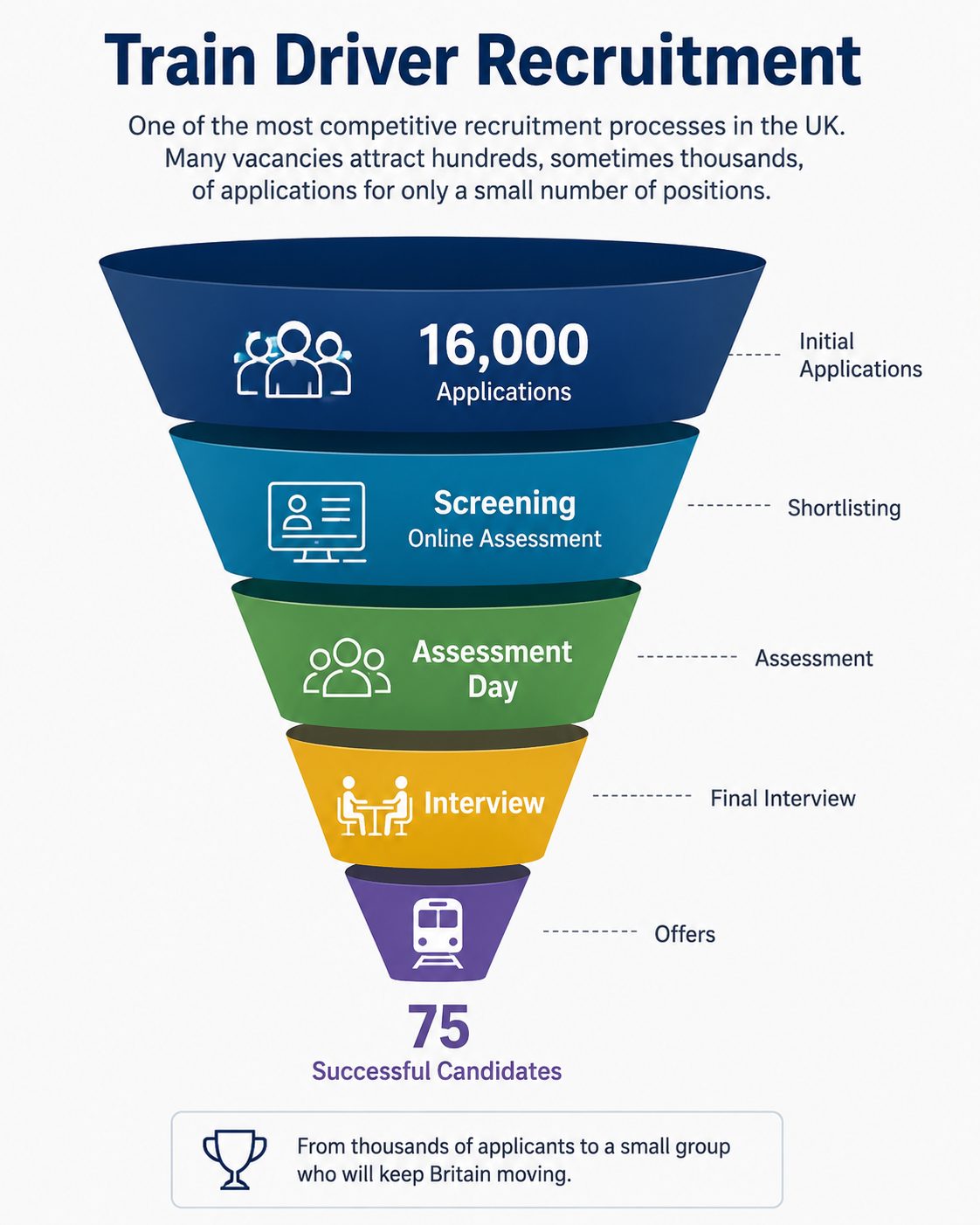
The selection process is designed to assess whether candidates are suitable for a safety-critical environment, not simply whether they are enthusiastic about trains. It often includes an application review, online or supervised psychometric assessments, structured interviews, medical assessment and other employer-specific stages. Progression is not based on one impressive answer. Recruiters look for consistent evidence that your behaviour, judgement and working style align with the demands of the role.
Start with realistic eligibility
Before investing significant time in preparation, establish whether you can meet the practical conditions of the vacancy. Consider your distance from the relevant depot, your ability to work irregular hours, your health and your willingness to follow strict procedures every day. Family commitments and caring responsibilities do not automatically rule someone out, but shift work needs a workable support plan.
This early check prevents a common mistake: focusing entirely on assessment practice while overlooking a stated requirement in the job advert. It also helps you decide whether train driving is the right immediate target or whether another rail role would better match your circumstances.
Build a CV around evidence, not aspirations
A generic CV rarely communicates readiness for a trainee driver process. Your CV should make it easy for a recruiter to identify examples of safety awareness, accountability, concentration, communication, rule adherence and reliable performance.
That does not mean forcing railway language into every sentence. A warehouse supervisor, bus driver, engineer, service leaver or hospitality manager can all have relevant evidence when it is explained properly. Describe the situation, the standard you were working to, the action you took and the outcome. Be specific about how you checked work, escalated concerns, managed competing demands or maintained attention during repetitive tasks.
Avoid exaggeration. Railway recruiters are experienced at testing claims during structured interviews, and credibility matters more than dramatic wording. A clear, accurate CV provides a strong base for every stage that follows.
Preparing for assessments with integrity
Psychometric assessments are an important part of many trainee driver recruitment processes. They may assess areas such as concentration, checking accuracy, reactions, memory, rule application and situational judgement. Their purpose is to help employers assess suitability for safety-critical work.
Preparation is worthwhile when it familiarises you with the format, helps you manage time and shows you where you need further practice. It should not be treated as a way to bypass the assessment or present an artificial version of yourself. The aim is to perform calmly and accurately, using your genuine ability under test conditions.
Create a practice routine rather than relying on a single intense session. Work in a quiet environment, follow instructions exactly and review errors without making excuses. If you lose focus after a period of repetition, that is useful information. You can then build concentration gradually through timed exercises and better study habits.
Sleep, hydration and travel planning also affect performance. These are basic considerations, yet candidates sometimes undermine weeks of preparation by arriving rushed, tired or unclear about the assessment location. Treat every selection stage as a professional commitment.
Structured interviews reward clear examples
A structured interview is not a casual conversation about why you like rail. Questions are usually designed to gather evidence against defined behaviours and competencies. You may be asked about safety, following procedures, working independently, responding to problems, communication or dealing with pressure.
Prepare examples from your work and life that show these behaviours in action. Good examples have a clear beginning, explain your personal responsibility and show why your actions were appropriate. They should also include reflection. If something did not go to plan, explain what you learned and how you changed your approach.
Candidates often make two errors. The first is giving a vague team answer that never explains what they personally did. The second is choosing a dramatic incident that does not show sound judgement. A straightforward example of noticing a concern, following the correct process and communicating it promptly can be more persuasive than an overcomplicated story.
Develop operational understanding before you apply
You do not need to arrive with railway experience to become a trainee driver. You do, however, need a credible understanding of the operational mindset the role demands. Learn what safety-critical work means in practical terms: consistency, fatigue awareness, professional communication, respect for rules and the confidence to stop and seek clarification when something is uncertain.
Relevant CPD can strengthen this understanding, particularly for candidates moving from outside rail. Training in operational thinking, risk-based decision making, personal track safety, traction and rolling stock can help you engage with the industry more intelligently. It is not a substitute for an employer's training programme, but it can demonstrate that you have taken responsibility for your development.
For service leavers, operational discipline and experience of working within defined procedures can be valuable. The key is translating that experience into language that is relevant to rail, without assuming the sectors are identical. Explain the behaviours you developed and how they support your suitability for a civilian safety-critical role.
A practical plan for progressing into rail
Treat your preparation as a sequence. First, identify suitable roles and confirm your eligibility. Next, produce a targeted CV that reflects the standards of safety-critical work. Then prepare for assessments and interviews with regular, honest practice. Finally, keep learning while you wait for vacancies, rather than pausing your development between applications.
Track the roles you apply for, the closing dates, the requirements and your outcomes. If an application is unsuccessful, do not immediately assume you are unsuitable for rail. Review whether the role was the right fit, whether your evidence was strong enough and whether a specific stage needs more preparation. Recruitment processes can be demanding, and improvement is often gradual.
Specialist support can be useful where it is focused on the actual requirements of trainee driver recruitment. Train Driver Foundation helps candidates build that readiness through targeted CV guidance, assessment preparation, interview support and operationally relevant learning.
A rail career is built long before the first day of training. The candidate who understands the responsibility, prepares with care and approaches every stage professionally is giving themselves the right platform to progress.