
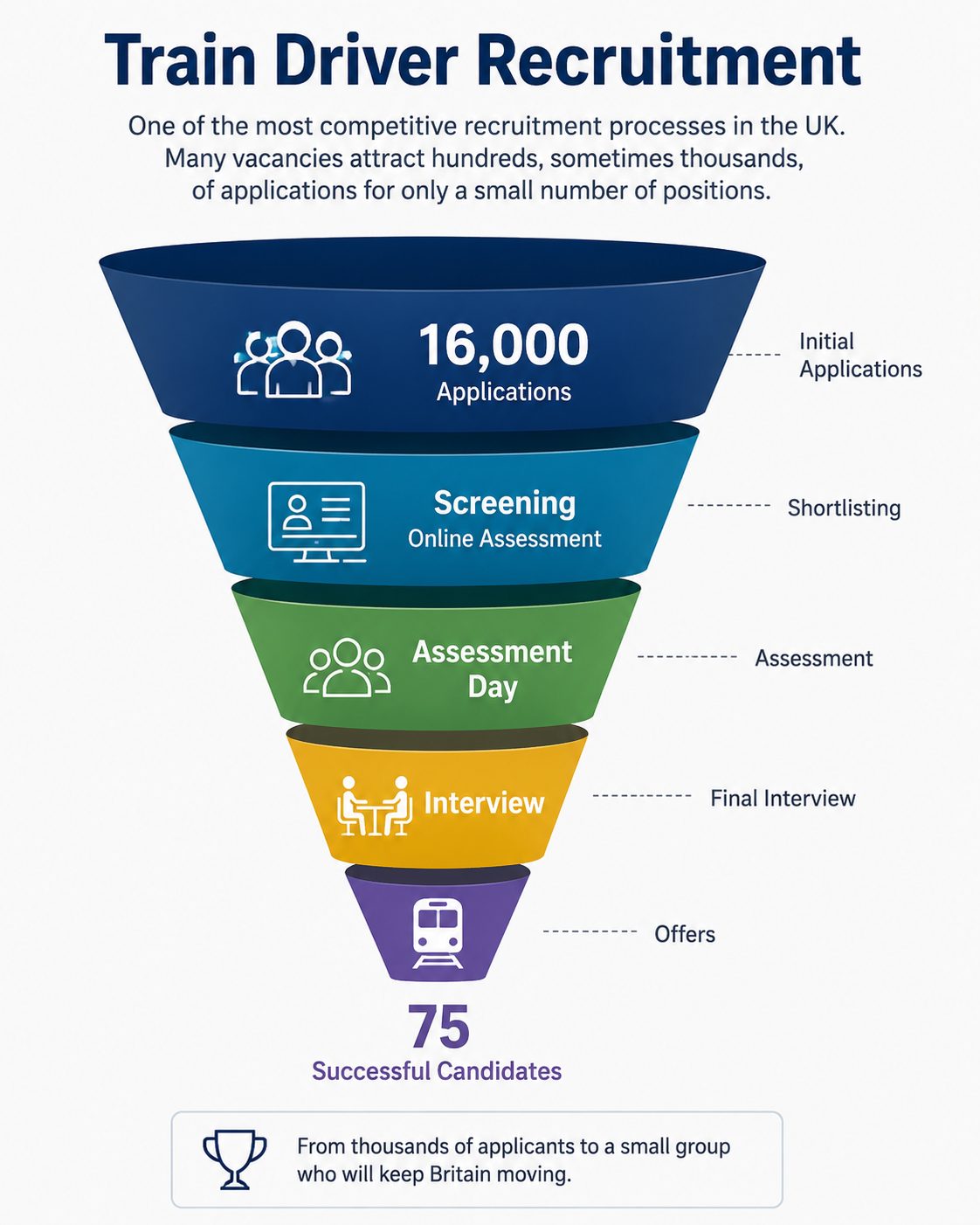



If you are applying for trainee train driver or other safety-critical rail roles, the process can feel less like a normal job search and more like a staged assessment of your judgement, discipline and readiness. That is exactly why a clear UK rail recruitment process guide matters. Rail employers are not only hiring for motivation - they are selecting for safety, consistency and the ability to perform under strict standards.
The strongest candidates usually understand one point early: recruitment is not a single interview. It is a sequence of filters, and each one is designed to test something different. A good CV may get you through the first gate, but it will not carry you through psychometric testing, a structured interview or a medical. Preparation has to match the stage.
What the UK rail recruitment process is really assessing
For trainee train driver positions, employers are not simply looking for people who like trains or want a better salary. They are assessing whether you can work safely, follow rules precisely, stay focused during routine tasks, make sound decisions under pressure and remain professional in a highly regulated environment.
That changes how you should approach the process. Candidates sometimes focus too heavily on enthusiasm and not enough on evidence. A recruiter may appreciate your interest in the railway, but what they really need to see is behavioural proof - examples from your work history that show concentration, responsibility, communication, rule compliance and calm decision making.
This is especially relevant for career changers. You do not need previous rail experience to present a strong application, but you do need to translate your existing experience properly. Work in the Armed Forces, logistics, emergency response, transport, manufacturing or customer operations can all provide relevant examples if framed with the right operational language.
Stage 1 - Checking eligibility before you apply
Before sending applications, make sure you meet the essential entry requirements for the role. These vary between employers, but the basics are usually straightforward: age requirements, right to work, location or willingness to relocate, education standards and the practical ability to travel to depots for early, late or weekend shifts.
This part is often underestimated. Candidates can spend weeks preparing only to discover that depot distance, shift availability or previous assessment history creates a genuine issue. It is far better to identify those constraints at the start. Being realistic here is not negative - it is professional.
You should also review the role profile carefully. Some vacancies are specifically trainee positions, while others may expect existing operational competence or prior safety-critical experience. If a vacancy asks for evidence of shift work, lone working or rule-based decision making, treat that as a strong signal for what later interview questions will focus on.
Stage 2 - Application form and CV screening
The application stage is where many candidates lose momentum. The mistake is assuming that a generic CV and a brief statement of interest are enough. Rail recruitment teams often work through large application volumes, so relevance matters more than broad career history.
Your CV and application should show dependable employment patterns, clear responsibilities and evidence of safety, standards and accountability. If you have worked in environments where procedure mattered, incidents had consequences or concentration was critical, those points should be visible. Vague statements such as "hard-working" or "good under pressure" carry little weight unless supported by examples.
Tailoring is important, but accuracy matters just as much. Do not overstate responsibilities, inflate technical knowledge or try to sound more railway-experienced than you are. Recruitment for safety-critical roles is built around consistency. If your application says one thing and your interview examples say another, that weakens trust very quickly.
Stage 3 - Online assessments and psychometric testing
A central part of any UK rail recruitment process guide is the testing stage, because this is where many capable applicants are filtered out. These assessments are used to measure areas such as concentration, attention control, rule adherence, reaction, memory, verbal reasoning and behavioural suitability for safety-critical work.
Candidates often ask whether these tests can simply be revised for in the usual sense. The honest answer is no, not entirely. You cannot cram your way into the mindset required for sustained concentration or disciplined response patterns. What you can do is become familiar with test formats, reduce avoidable errors, improve your confidence and practise working accurately under timed conditions.
That distinction matters. Preparation should be about readiness, not shortcuts. If you have never completed timed psychometric exercises before, even basic familiarity can improve your performance because it reduces hesitation and confusion. On the other hand, too much last-minute practice the night before can leave you mentally tired. It depends on your baseline confidence and how accustomed you are to formal testing.
Stage 4 - Structured and manager interviews
If you progress beyond testing, the interview stage usually becomes more evidence-led than many applicants expect. This is not generally the place for broad opinions about why rail is interesting. Structured interviews are designed to assess past behaviour and likely future conduct in a safety-critical role.
Expect questions around rules, concentration, conflict, communication, dealing with disruption, taking responsibility and maintaining standards when under pressure or working alone. Good answers are specific. They describe the situation, your actions, your reasoning and the outcome. Weak answers stay too general or drift into team achievements without making your individual contribution clear.
You should also be ready for motivation questions. Employers want to know why this role suits you, why you understand its realities and whether you are applying with realistic expectations. Saying you want a stable career is fine, but it should not be your only point. Show that you understand shift work, ongoing competence standards, personal responsibility and the disciplined nature of the role.
Stage 5 - Medical, drugs and alcohol screening, and background checks
Passing interview does not mean the process is complete. Safety-critical railway roles require medical clearance, and this can include vision, hearing, general health checks and screening for substances. There may also be employment history checks, reference checks and, depending on the role, other forms of vetting.
This stage is best approached with openness and preparation. If you wear glasses, have a medical condition or have questions about standards, it is sensible to understand what may be reviewed. Trying to guess your way through medical suitability helps no one. Employers are assessing fitness for a safety-critical environment, not looking for perfection in every area.
The practical point here is to keep documentation organised. Gaps in employment, incorrect dates or delayed paperwork can slow progress. Administrative discipline matters more than many candidates realise.
Common reasons good candidates fall short
Not all unsuccessful applicants are poor candidates. Quite often, they are underprepared candidates who misread what is being assessed. Some talk convincingly about motivation but cannot evidence operational discipline. Others prepare heavily for interviews but neglect psychometric practice. Some have the right experience but present it in language that does not align with rail expectations.
Another issue is rushing applications. Because trainee driver roles attract high interest, people sometimes apply quickly without checking depot location, roster implications or the competency focus of the advert. A better approach is to be selective and prepared rather than reactive.
How to prepare properly for the UK rail recruitment process
The most effective preparation is staged. Start with eligibility and role fit, then move to CV quality and application wording, then assessment readiness, then interview evidence. Treating the process as one large task usually leads to gaps.
It also helps to build your understanding of rail professionalism before vacancy day. That does not mean trying to access restricted information or sounding overly technical. It means understanding the demands of safety-critical work, strengthening your examples of responsibility and improving your confidence with structured selection methods. For many applicants, especially first-time rail candidates, this is where specialist preparation can add real value.
If you are coming from another industry, spend time translating your background. A military leaver might focus on procedural compliance, resilience and disciplined communication. A bus driver may highlight passenger safety, timetable responsibility and vigilance. A warehouse supervisor may draw on rule adherence, incident management and operational leadership. The experience does not need to be identical to rail to be relevant.
Final thoughts on staying competitive
The rail recruitment process is demanding because the job is demanding. That should not discourage you. It should help you prepare with the right mindset. The strongest applicants are rarely the ones who rely on enthusiasm alone. They are the ones who understand each stage, respect the standards and present clear evidence that they can meet them.
If you approach the process methodically, improve the quality of your examples and prepare for each filter on its own terms, you give yourself a far stronger chance of progressing. In a competitive field, professionalism before the application is often what sets candidates apart.