



A trainee driver vacancy is never simply a vacancy for someone who can operate a train. UK train driver employers are appointing people to work safely, independently and consistently within a specific railway operation, depot and timetable. That is why two adverts with the same job title can have different eligibility rules, recruitment stages and expectations of candidates.
For applicants, the right approach is not to treat every operator as interchangeable. Understand what type of employer you are applying to, what its operation demands and whether the role fits your practical circumstances. Then build an application that shows the professional behaviours required in safety-critical work.
The main UK train driver employers
Most trainee train driver opportunities are offered by Train Operating Companies, usually known as TOCs. These employers run passenger services on parts of the national rail network. Their operations can range from intensive commuter routes with frequent station stops to long-distance services, regional routes and rural branch lines.
The working environment matters. A driver based at a busy urban depot may work a high-volume service with close headways, varied stopping patterns and early or late turns. A regional or intercity operation may involve longer journeys, different traction knowledge and a wider route portfolio. Neither is automatically easier. Each requires concentration, rule compliance, situational awareness and the ability to manage fatigue and routine over a long career.
Freight operators are another important group of train driver employers. Freight driving has its own operating profile, including variable schedules, longer-distance work and services that may run at less conventional times. Candidates should not assume that experience in passenger-facing roles is essential for every driving pathway, but they should be ready to explain why the realities of the operation suit them.
There are also metro, light rail and underground-style systems, along with certain specialist railway employers. Their entry routes, medical standards, assessment processes and training arrangements may differ from those used for mainline rail roles. Read the advert carefully rather than applying assumptions from one part of the industry to another.
Why employers recruit differently
Safety-critical recruitment has a common foundation. Employers need evidence that a candidate can follow rules, retain concentration, make measured decisions, communicate clearly and work reliably under pressure. However, each company is entitled to set its own requirements for a particular vacancy.
One employer may prioritise applicants who live within a stated travelling time of the depot. Another may require a full driving licence, a minimum period of work experience, evidence of shift-work readiness or availability for an assessment date. Some campaigns are open to external applicants, while others may initially focus on internal colleagues who already understand the business.
These requirements are not administrative obstacles. They often reflect operational reality. Train drivers can start and finish at times when public transport is limited, and reliability is fundamental. If a depot is a substantial distance from home, consider the earliest possible sign-on, the latest finish, disruption to roads and whether the arrangement remains realistic over several years.
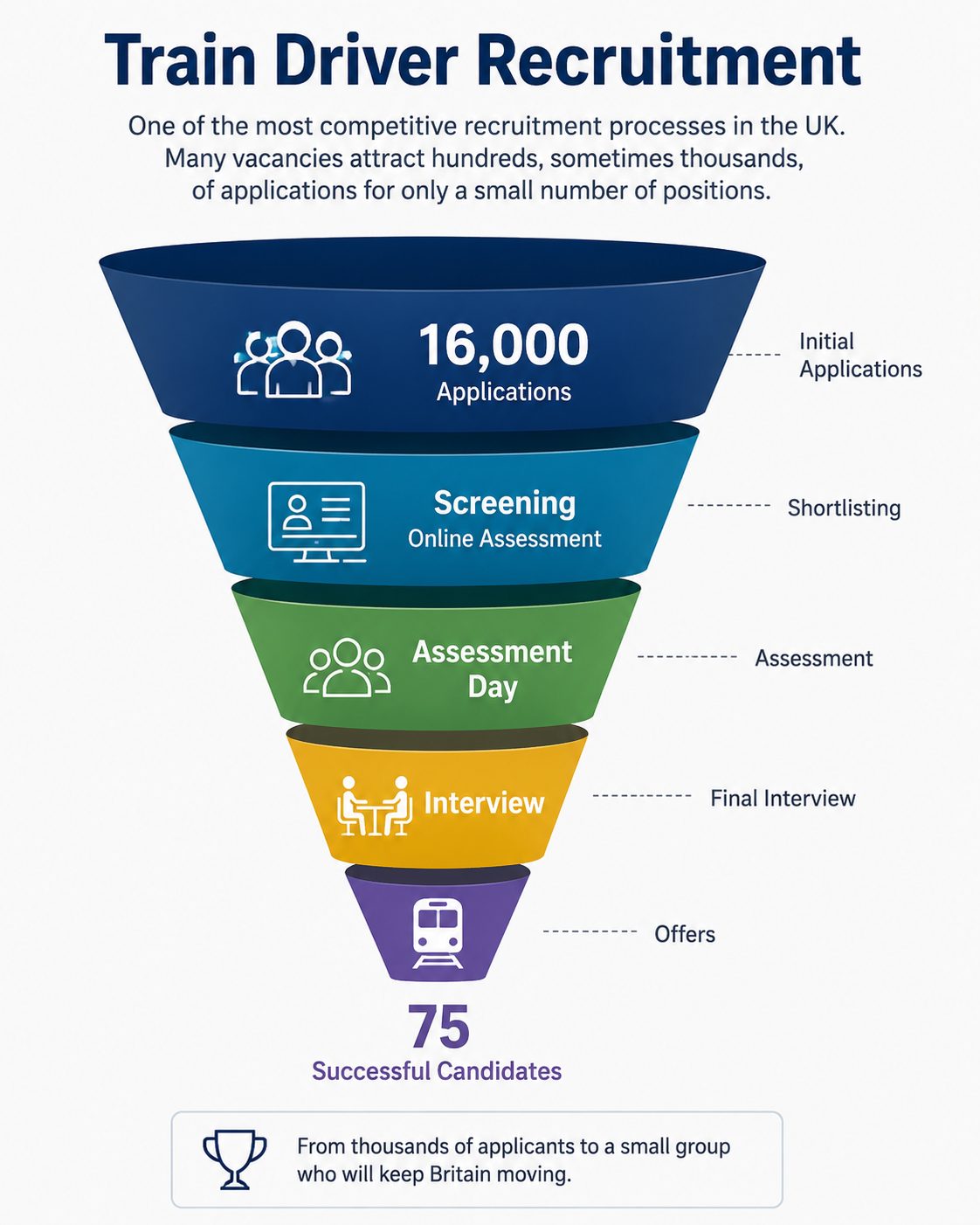
Recruitment methods also vary. A typical process may include an online application, an initial sift, online assessments, psychometric testing, an interview and a medical assessment. Some employers add a telephone conversation, an assessment centre or a manager-led stage. The sequence may change between campaigns, so rely on the information provided for that role rather than on old forum posts or another applicant's experience.
The depot is part of the job offer
Applicants often focus on the company name while overlooking the depot. In practice, the depot determines much of your day-to-day working life: your route knowledge, traction, roster patterns, travelling requirements and colleague network. It is sensible to research the location, broad service pattern and realistic commute before investing heavily in an application.
This does not mean trying to second-guess confidential operational details. It means demonstrating mature judgement. If asked why you want a particular position, a convincing answer connects your interest in train driving with the demands of that employer's operation, rather than relying on pay, prestige or a vague interest in trains.
How to assess whether an employer suits you
Start with the written vacancy. Check the depot, eligibility criteria, closing date, location expectations and whether the role is trainee, qualified driver or a talent pool for future vacancies. A talent pool can be useful, but it is not the same as an immediate job offer. Treat it as a competitive recruitment process with no assumptions about timing.
Next, assess your availability honestly. Train driving commonly involves nights, weekends, public holidays and very early starts. Think beyond whether you could manage this for a few weeks. Consider childcare, caring responsibilities, sleep patterns, commuting and the support arrangements you would need at home. Employers value candidates who understand that reliability is an operational commitment.
Then consider your evidence. Strong applicants can give clear examples of working to procedures, maintaining attention during repetitive tasks, identifying risks, responding calmly to changes and taking responsibility for standards. That experience can come from rail, the Armed Forces, logistics, emergency services, manufacturing, aviation, driving roles, retail operations or other structured environments. The value lies in what you did, why it mattered and the outcome.
Avoid forcing every past role into a railway story. A concise example of accurate handover, controlled decision making or speaking up about a safety concern is more credible than generic claims that you are hardworking. Selection panels need evidence of behaviour, not slogans.
Preparing for different recruitment stages
Your CV and application form should be tailored to the actual vacancy. Use the employer's language where it genuinely reflects your experience, particularly around safety, rules, teamwork, customer impact, reliability and shift work. Do not copy phrases without supporting evidence. A recruiter should be able to see quickly how your work history meets the stated criteria.
Psychometric assessments require a different type of preparation. They are designed to assess relevant abilities and behavioural preferences in a structured way, not to reward shortcuts. Familiarisation can help you understand question formats, manage time and approach the session in a calm, professional state. It cannot replace careful reading, honest responses and the concentration expected in the assessment itself.
For structured interviews, prepare examples using a clear sequence: the situation, your responsibility, the action you took and the result. Keep the focus on your own judgement. Where a situation involved a mistake, pressure or disagreement, explain what you did to control risk and what you learned. Mature reflection is often more useful than trying to present a flawless record.
Medical standards are also part of the process. They exist because the role is safety-critical. Do not self-diagnose or rule yourself out based on informal advice, but do answer health questions accurately and engage openly with the employer's occupational health process. Requirements and decisions are individual to the role and assessment.
Build a focused employer strategy
Applying widely can be sensible, but unfocused applications tend to show. Keep a simple record of the employers, depots, closing dates, requirements and stages for each campaign. This helps you avoid missing a time-sensitive invitation and prevents preparation for one company's interview from becoming a generic answer for another.
It is also worth developing your railway knowledge at the right level. You should understand the purpose of a TOC, the safety-critical nature of the role and the lifestyle involved. You do not need to recite technical rules or make claims about procedures you have not been trained to use. Employers are recruiting potential trainee drivers, not candidates who pretend to be qualified already.
Where you identify a gap, address it systematically. That may mean improving the way you present safety experience on your CV, practising timed assessment formats, building stronger interview examples or completing relevant CPD learning. Specialist preparation from Train Driver Foundation can help candidates organise this work around the standards commonly assessed in driver recruitment, while keeping ownership of the application with the candidate.
Choose readiness over speculation
Vacancies can be infrequent, competitive and tied to local operational need. The most useful response is not to chase rumours about the next campaign. It is to become ready before the right employer opens recruitment: understand your preferred depot area, keep your evidence current and prepare for every stage with the seriousness the role deserves.
The right UK train driver employer is not simply the first one to advertise. It is the one whose operational demands you can meet reliably, whose location works in real life and whose standards you are prepared to uphold from application through to training and beyond.