



If you are asking what do train driver tests involve, you are usually at the point where the role has stopped feeling like a vague career idea and started to feel real. That is when the process can seem more demanding than many applicants expect. Train driver selection is designed to assess whether you can operate safely, stay focused for long periods, follow rules precisely and make sound decisions under pressure.
That matters because trainee train driver recruitment is not based on enthusiasm alone. Train Operating Companies need evidence that a candidate has the underlying aptitude, behavioural fit and operational discipline for a safety-critical role. The tests are there to reduce risk, not to catch people out. When you understand that purpose, the process makes far more sense.
What do train driver tests involve in practice?
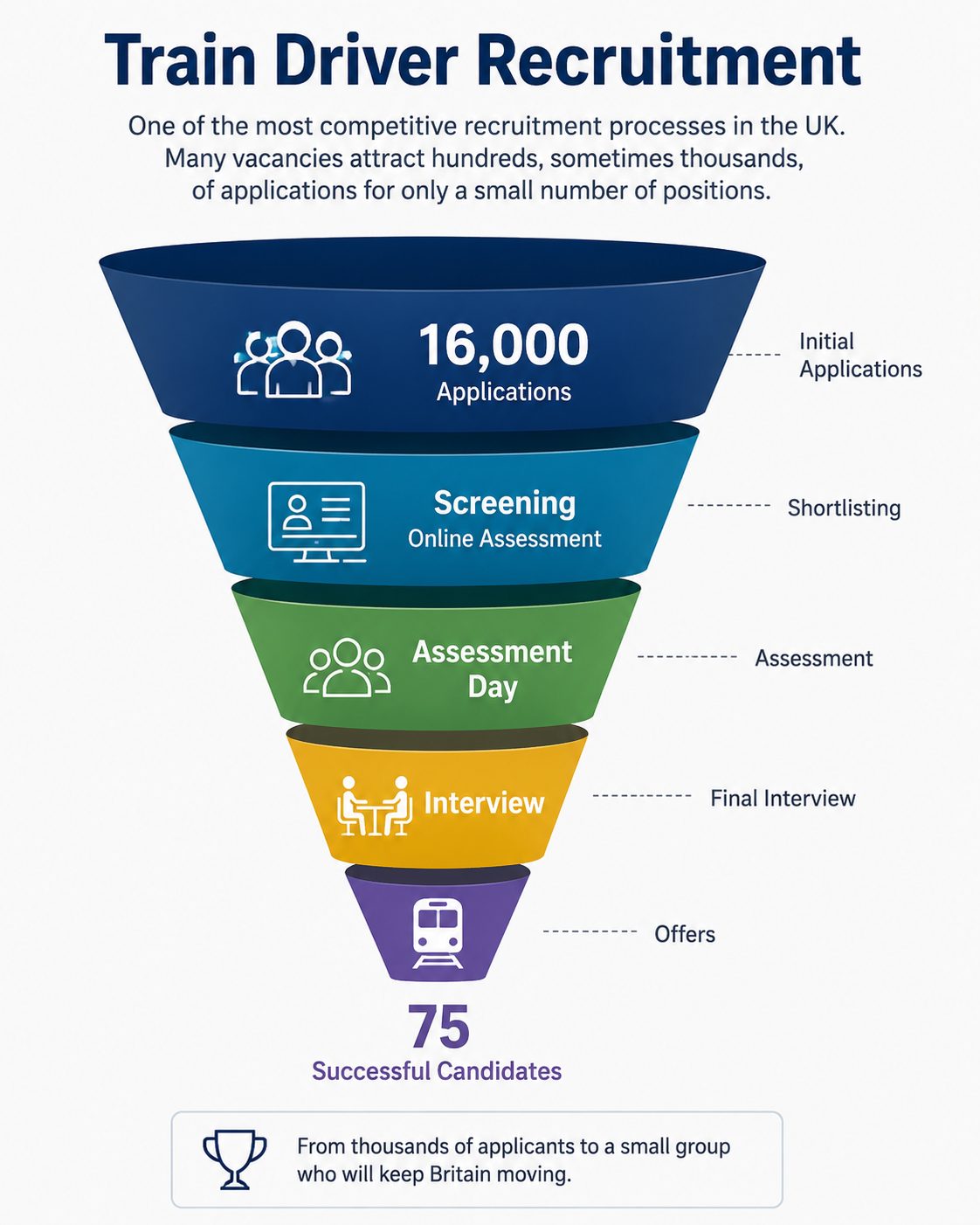
In practice, train driver tests usually involve several stages rather than one single exam. The exact sequence can vary by employer, but most candidates will face an application sift, online assessments or psychometric tests, a structured interview, and a medical. Some campaigns also include manager interviews, concentration exercises or additional assessments linked to the operator's process.
The key point is that each stage is testing something different. One part may look at attention and concentration. Another may explore how you deal with rules, responsibility and routine. Another may assess whether your work history shows the right behaviours for a safety-critical environment. Strong candidates prepare for all of it, not just the test stage they find most intimidating.
The application stage is already part of the assessment
Many applicants think the testing starts later, but the written application is often your first assessment. Recruiters will look closely at how well you match the essential criteria and whether your employment history demonstrates reliability, responsibility and rule-based working.
This is where transferable evidence matters. If you have worked in the Armed Forces, transport, logistics, manufacturing, emergency response or another regulated environment, you may already have relevant examples. Timekeeping, working alone, staying calm under pressure, following procedure and reporting accurately all carry weight. The challenge is presenting those behaviours clearly rather than assuming the employer will infer them.
A weak application can stop the process before the formal tests begin. A strong one shows that you understand the role and can evidence the competencies it requires.
Psychometric tests and aptitude assessments
When people ask what do train driver tests involve, this is usually the part they mean. Psychometric and aptitude assessments are commonly used because they measure abilities linked to safe train driving performance. These are not general intelligence tests in the casual sense. They are targeted assessments looking at concentration, attention control, rule adherence, memory, information processing and response accuracy.
Some tasks assess how consistently you can focus over time. Others test your ability to notice patterns, compare information quickly or work accurately under time pressure. There may also be exercises designed to measure coordination or your ability to manage more than one stream of information at once.
This is one area where candidates need to be realistic. Good preparation helps, especially if you are unfamiliar with timed assessment formats, but preparation is not the same as trying to game the process. The purpose is to help you perform at your true level by reducing preventable errors caused by nerves, misunderstanding instructions or poor pacing.
It also depends on your starting point. Someone who has not sat a formal assessment for twenty years may need practice simply to rebuild confidence. Someone from an operational background may already be comfortable with procedural testing, but still need to sharpen speed and consistency.
Concentration and sustained attention matter more than many expect
A common misunderstanding is that train driving is all about reactions. In reality, sustained concentration is often more important than quick instinct. Much of the role involves maintaining consistent attention during routine running, monitoring signals, speed, route knowledge and operating conditions without lapsing into complacency.
That is why selection processes often include tests that feel repetitive or mentally draining. They are designed that way for a reason. Employers want to know whether you can remain accurate when the task becomes monotonous, because real operational safety depends on that ability.
Candidates sometimes find this frustrating because the test does not always feel obviously relevant. Yet the capacity to stay mentally engaged through repetition is one of the most important features of safety-critical work.
Structured interviews assess behaviour, judgement and fit
The interview stage is not just a conversation about why you want the job. It is usually a structured assessment against defined competencies and behaviours. You may be asked about times you followed strict procedures, dealt with distraction, took responsibility for safety, worked alone, managed fatigue or responded to an incident calmly.
This is where vague answers cause problems. Saying that you are safety-conscious is not enough. You need specific, credible examples that show what the situation was, what action you took and what the outcome was. The strongest responses are usually grounded in real working practice rather than rehearsed motivational statements.
Interviewers are also listening for maturity and realism. They want to see that you understand the role involves early starts, shift work, rules, routine, personal accountability and a long training period. Candidates who romanticise the job or focus only on lifestyle benefits can come across as underprepared.
What do train driver tests involve beyond exams and interviews?
They also involve checks on whether you are medically fit for the demands of the role. Because train driving is safety-critical, the medical stage is taken seriously. This may include eyesight and colour vision checks, hearing assessment, alcohol and drugs screening, and a broader occupational health review.
The purpose is not to make the process harder than necessary. It is to confirm that you can carry out the duties safely and reliably. Standards are set around operational risk, so honesty matters. If a candidate tries to minimise or hide a relevant issue, that can create far greater problems later.
There may also be background checks, including right to work, identity, work history and, where relevant, criminal record considerations. Again, the principle is suitability for a safety-critical role with a high level of trust and responsibility.
Why the process feels demanding
Train driver recruitment is competitive, and the standards are high because the consequences of poor performance can be serious. That does not mean the process is unfair. It means employers are looking for evidence that a person can operate safely day after day, not just impress on one good afternoon.
This is also why some very capable people do not progress at the first attempt. A candidate may have strong motivation but limited evidence at interview. Another may have suitable work behaviours but struggle with timed psychometric formats. Another may simply underestimate how much preparation is needed.
The process rewards readiness. Not perfection, but readiness.
How to prepare properly
The most effective preparation is specific. Start by understanding the role in operational terms, not just as a career move. Then review your work history and identify evidence of concentration, rule compliance, independent working, incident response, communication and personal responsibility.
For assessment stages, practise the type of tasks you are likely to face so that the format does not become the main obstacle. Focus on accuracy before speed, then improve pacing. Read instructions carefully. Build stamina for timed concentration work. If you have been out of formal recruitment for a while, give yourself enough time to settle into that mode again.
For interviews, prepare examples that are genuine and structured. It helps to think in terms of behaviour and consequence. What did you notice, what decision did you make, what procedure did you follow, and what was the result? If your answer does not show action and accountability, it probably needs work.
Candidates often benefit from preparation that reflects actual train driver recruitment standards rather than generic interview coaching. That is one reason specialist support can be useful, provided it stays grounded in realistic expectations and proper process.
A final word on mindset
If you are serious about becoming a trainee train driver, treat every stage as part of a professional suitability assessment, because that is exactly what it is. The tests are not there to create mystery. They are there to assess concentration, judgement, discipline and fitness for a role where safety comes first.
Approach the process with respect, patience and structure. With the right preparation, what feels complicated at first becomes much easier to understand - and much easier to face with confidence.