
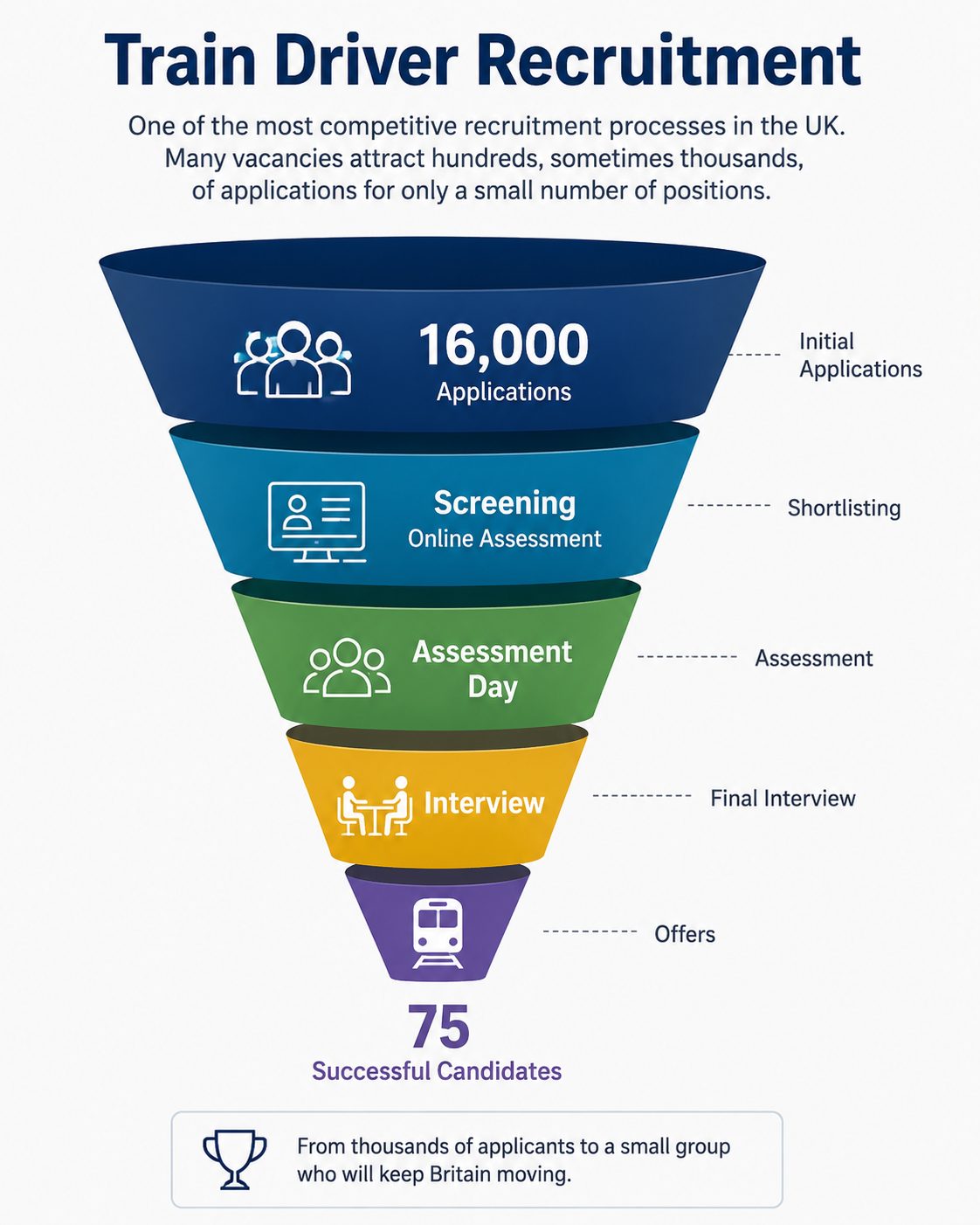


Submitting an application for a trainee train driver role is a significant first step, but it is not the point at which recruitment decisions are made. If you are asking what happens after a train driver application, the honest answer is that the process can move through several distinct stages, often with pauses between them. Each Train Operating Company (TOC) sets its own campaign timetable, but the underlying purpose remains consistent: to identify candidates who can meet the demands of a safety-critical operational role.
The waiting period can feel uncertain, particularly when vacancies attract a high volume of applications. Use that time carefully. The strongest candidates do not wait for an invitation before they begin preparing for assessments, structured interviews and the professional standards expected in rail.
What happens after a train driver application is submitted?
Most applications first pass through an online recruitment system. You may receive an automatic acknowledgement confirming that your application has been received. This is not usually an indication that it has been reviewed or that you have progressed; it simply confirms successful submission.
The employer will then conduct an initial eligibility and application sift. This may consider your right to work, location, availability, work history, qualifications where required, and the quality of the information you have provided. For train driver recruitment, the application is also an early test of care and professionalism. Incomplete dates, vague responsibilities, unexplained gaps or contradictory answers can weaken an otherwise suitable application.
A TOC may contact successful candidates by email, through the recruitment portal, or occasionally by telephone. Check the email address used for your application regularly, including junk and spam folders. Recruitment invitations can have short response windows, and missed deadlines may mean losing your place in the campaign.
Not every applicant receives detailed feedback at this stage. That can be frustrating, but it is common in high-volume recruitment. A rejection does not necessarily mean you are unsuitable for a future role. It may reflect the strength of the applicant pool, the number of available places, location requirements or a specific point in your application that can be improved.
The likely stages after an initial sift
The exact order differs between employers and campaigns. Some TOCs use online assessments early, while others begin with a recorded interview, a situational questionnaire or an assessment-centre invitation. You may also be placed in a talent pool or held at a particular stage until the employer is ready to progress the next group.
Online and psychometric assessments
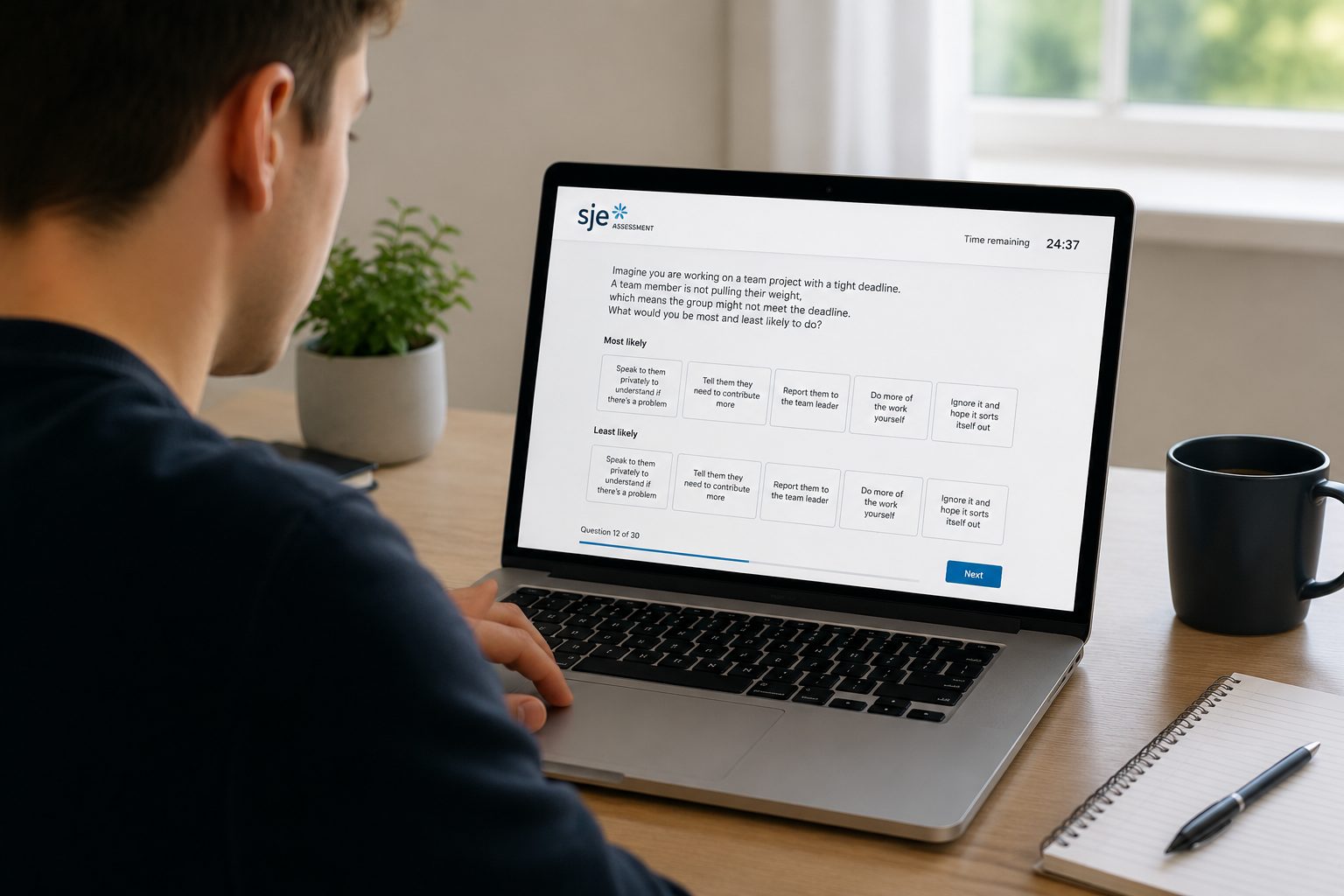
Candidates who pass the initial sift are commonly asked to complete online assessments. These can assess attention, concentration, rule application, working accuracy, reaction to information, memory, judgement and behavioural preferences relevant to safety-critical work.
Treat every assessment as a formal part of the selection process. Read instructions closely, complete any practice material properly, and take the test in a quiet setting where you will not be interrupted. Do not rush because you assume speed is the only measure. Accuracy, consistency and following instructions matter greatly.
Good preparation is not about trying to find a shortcut or second-guess a scoring system. It is about understanding the types of task you may face, becoming comfortable with timed working, and arriving able to give your natural best performance. Practising under realistic conditions can also help you identify where concentration drops or where nerves affect your pace.
If you need an adjustment because of a disability, health condition or neurodivergence, raise this with the recruiting employer as early as possible. Reasonable adjustments are considered individually, so do not leave the conversation until the day of an assessment.
Structured interview or recorded interview
A successful assessment stage may be followed by an interview. This could be live, recorded, online or held in person. The format varies, but train driver interviews are normally structured around evidence rather than general impressions.
Expect questions about safety, following rules, concentration, working independently, managing routine, responding to problems, communication and personal responsibility. Employers will want clear examples from your own experience, whether that comes from transport, the Armed Forces, customer operations, manufacturing, emergency services or another disciplined working environment.
Use specific examples rather than broad claims. Saying that you are safety-focused is less convincing than explaining a situation where you noticed a risk, followed the correct process, communicated appropriately and checked that the issue had been resolved. Keep your answer factual, organised and honest. If an example involved a mistake, focus on what you did, what you learned and how your actions changed afterwards.
Recorded interviews deserve the same standard of preparation as a face-to-face meeting. Test your equipment, choose a professional setting, dress appropriately and allow enough time. Looking at the camera when answering can help, but clarity and substance matter more than trying to appear overly rehearsed.
Assessment centre and final selection activity
Some campaigns include a later-stage assessment centre or additional selection event. You may complete further individual exercises, interviews or group-based activities. Where group tasks are used, the aim is not to dominate the conversation. Employers are likely to observe whether you listen, communicate clearly, contribute constructively and remain focused on the task.
Train driving is often independent work, but it is not isolated work. Drivers operate within a wider railway system and must communicate reliably with colleagues, control and other operational staff. Showing calm cooperation and respect for procedure is more valuable than trying to be the loudest person in the room.
Medical checks, references and background screening
A conditional offer or provisional progression may lead to pre-employment checks. These commonly include references, right-to-work checks and employment history verification. You may also need to declare relevant health information and attend a railway medical assessment.
The medical process is designed to establish whether you can safely perform the role. Requirements can include checks relating to vision, hearing, colour perception, general health, medication and other factors relevant to safety-critical duties. Be accurate when completing forms. Trying to minimise or conceal relevant information can create serious difficulties later.
A medical outcome is not something to guess at from online discussion forums. Individual circumstances differ, and the employer's occupational health process is the appropriate route for questions about your situation. If you have a pre-existing condition or take prescribed medication, gather accurate information from your clinician if requested, but do not assume that an automatic outcome applies.
At this point, you may also be asked for referee details. Contact potential referees in advance, confirm their current contact information and ensure your employment dates match what you supplied in the application. Small inconsistencies can delay checks while they are clarified.
Why waiting times vary so much
Train driver recruitment is not always a straight line from application to start date. A TOC may be recruiting for a future training course, building a reserve of suitable candidates, coordinating assessment capacity or waiting for operational requirements to be confirmed. This can create long periods with no visible update.
It is reasonable to follow up politely if the stated timescale has passed, but avoid repeated messages. One concise enquiry through the advertised recruitment channel is usually enough. Continue in your current role, maintain a reliable work record and avoid making major decisions, such as resigning, until you have a formal written offer and a confirmed start arrangement.
Use the interval to strengthen the areas you can control. Review your application examples, practise psychometric-style tasks ethically, research the realities of shift work and build your understanding of operational decision-making. CPD learning can be particularly useful when it develops genuine awareness of risk, rules, communication and personal accountability rather than simply adding a certificate to your CV.
How to stay ready while recruitment progresses
Keep a simple record of every stage: the vacancy reference, submission date, contact received, deadline and result. This makes it easier to manage multiple applications without confusing one employer's requirements with another's.
Prepare a small bank of interview examples drawn from real work situations. Cover safety, concentration, customer or colleague communication, working under pressure, following a process, dealing with unexpected events and learning from feedback. Revisit the examples regularly so you can explain them naturally without sounding scripted.
It is also worth reviewing the practical realities of the role. Train driving can involve early starts, late finishes, weekend duties, sustained concentration and periods of working alone. A credible candidate understands these demands and can explain why they suit their working style and responsibilities.
The period after applying is not passive time. It is your opportunity to demonstrate the same discipline that the role requires: stay organised, respond promptly, prepare honestly and keep building evidence that you are ready for a safety-critical railway career.