

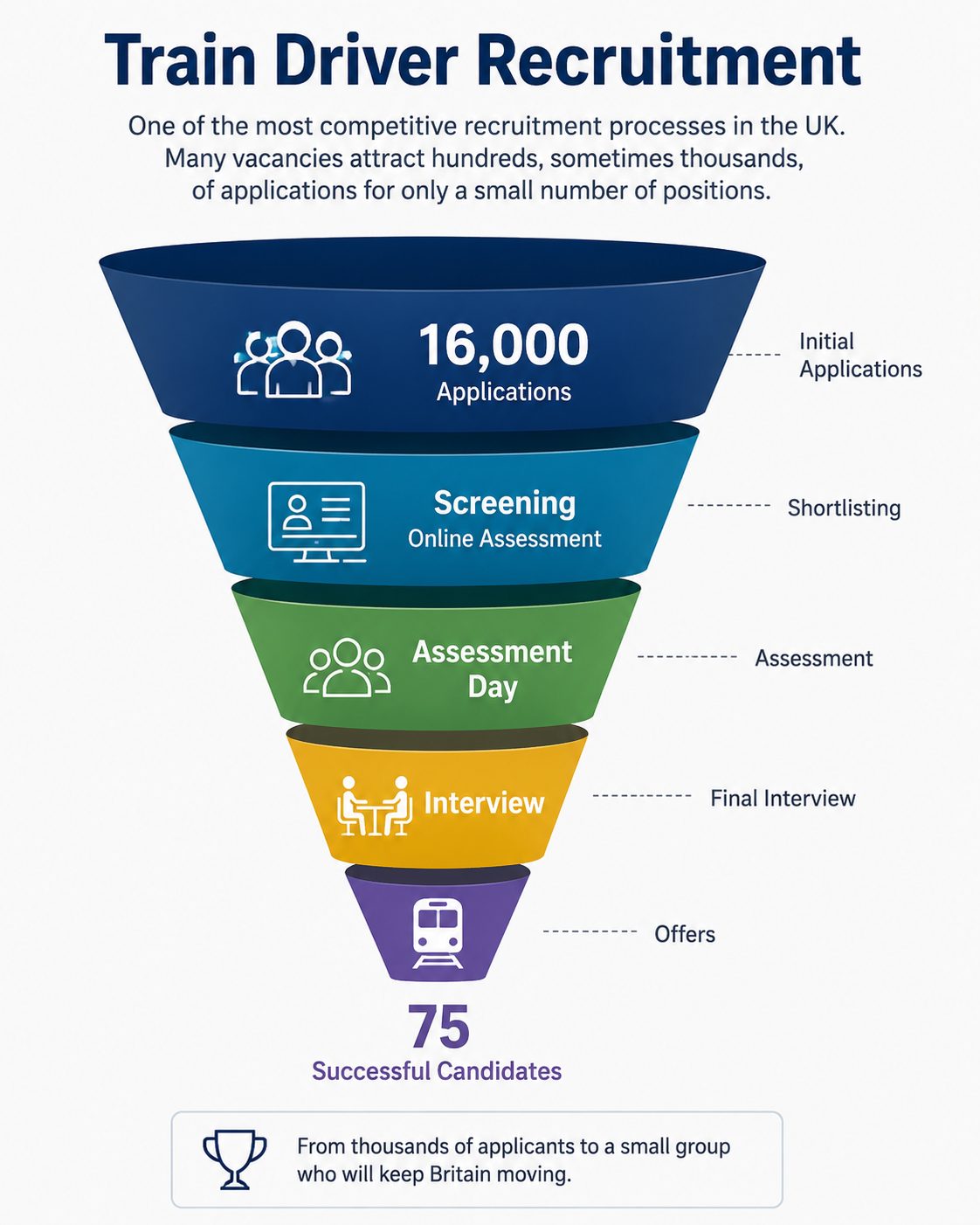




One vacancy can attract hundreds, sometimes thousands, of applicants. That is the first reason why train driver applications fail - not because candidates lack ambition, but because train driving is a safety-critical role with strict standards, limited intake numbers and very little room for vague or poorly evidenced applications.
If you are applying for trainee train driver roles, it helps to see the process for what it is. This is not a general recruitment exercise where enthusiasm alone carries weight. Train Operating Companies are looking for evidence of suitability for a highly disciplined operational job. That means your CV, application form, assessments and interview answers all need to point in the same direction.
Why train driver applications fail at the first stage
Most failed applications happen before testing or interview. Candidates often assume the first stage is simply an eligibility check, but it is usually more selective than that. Recruiters are not just asking whether you can apply. They are asking whether your application shows enough relevant evidence to justify moving you forward.
A common problem is generic wording. Many applicants write broad statements about being hardworking, reliable and keen to start a new career. Those qualities matter, but they are not enough on their own. In a train driver recruitment process, employers usually want examples that demonstrate concentration, rule adherence, responsibility, calm decision making, lone working and consistent performance over time.
Another issue is weak alignment with the role itself. Some applicants clearly want a stable career, better pay or a respected profession, but their application does not show understanding of what train driving involves day to day. Early starts, fatigue management, strict procedures, safety responsibility, repetitive tasks and sustained vigilance are all part of the job. If your application reads as though you are attracted by the outcome rather than the operational reality, that can work against you.
The role fit problem many candidates miss
Not every strong worker is a strong train driver candidate. That is not a criticism. It is simply the nature of safety-critical recruitment.
Employers are looking for behavioural fit as much as background. A candidate with experience in transport, the Armed Forces, emergency response, manufacturing, logistics or other operational environments may have highly relevant evidence, but only if they present it properly. On the other hand, someone with an impressive employment history can still fall short if they do not demonstrate the right decision-making style, discipline or safety mindset.
This is where many applications become too surface level. Candidates list responsibilities instead of showing how they carried them out. They say they worked under pressure, but do not explain how they maintained standards. They mention customer service, but leave out examples of following procedures, managing distractions or taking accountability when mistakes carried consequences.
For trainee roles, direct rail experience is not always necessary. What matters more is whether you can show transferability. That means translating your previous work into evidence that fits the expectations of a train driver selection process.
Poor evidence is a major reason applications are rejected
A strong application is specific. A weak one is full of claims.
Recruiters regularly see phrases like excellent communicator, great team player and works well independently. Those statements do very little unless backed up with clear examples. In train driver recruitment, evidence carries weight because the role itself is evidence-driven. The job depends on standards, rules, observations and measured judgement.
If you have worked shifts, handled safety checks, followed compliance procedures, reported incidents, managed fatigue-sensitive work or operated in environments where errors had consequences, those points matter. But they need to be written in a way that shows relevance. Simply saying you worked in a busy environment will not separate you from the field.
There is also a balance to strike. Some candidates over-write and include every detail of their career history, hoping quantity will help. Usually it does not. A well-targeted application is better than a long one. The goal is not to say everything. The goal is to show the right things.
Why train driver applications fail after the form is submitted
Getting through the application stage does not mean the hardest part is over. Some candidates have a decent CV and application form but struggle once the selection process becomes more structured.
Psychometric tests are one hurdle. These are not there to reward guesswork or quick fixes. They assess underlying suitability in areas linked to safe performance, such as attention, concentration, rules-based thinking and behavioural consistency. Candidates sometimes fail because they underestimate the standard required, leave preparation too late or misunderstand what proper preparation looks like.
Structured interviews are another pressure point. Applicants often have suitable examples but present them badly. They drift off topic, answer too generally or fail to explain their actions and judgement clearly. In a train driver interview, vague stories are rarely enough. Employers want concise, relevant examples that show how you behaved, why you made a decision and what standard you maintained.
This is why preparation needs to be role-specific. Generic interview advice may help with confidence, but train driver recruitment is more exact than many candidates expect.
Common mistakes in CVs and application forms
The biggest mistakes are usually avoidable. One is failing to tailor the document to the vacancy. Another is relying on job titles to do the work. A supervisor, driver, dispatcher, technician or service professional may all have relevant experience, but recruiters will not infer the details for you.
Another mistake is weak employment explanation. Gaps in employment, short stays in roles or career changes are not always a problem, but they should make sense. If your timeline feels unclear, it can raise concerns about consistency or commitment. That does not mean every non-linear career path is a disadvantage. It means clarity matters.
Attention to detail also matters more than some applicants realise. Spelling, grammar and formatting errors will not always eliminate a candidate on their own, but in a competitive process they can contribute to the impression that the application was rushed. For a role built on concentration and standards, that impression is not helpful.
There is also the issue of copying what other applicants do. Candidates sometimes use online advice that is too generic or based on assumptions about what sounds impressive. The result is applications full of the same phrases, none of which prove suitability. Employers are far more persuaded by grounded evidence than polished clichés.
Competitive hiring means good is not always enough
One hard truth is that some applications fail even when the candidate is capable. Vacancy numbers are limited. The pass mark is not always just about being competent enough to do the role eventually. It can also be about being more clearly job-ready than the next applicant.
That matters because it changes how you should think about preparation. The aim is not merely to avoid obvious mistakes. It is to present a stronger case than a large number of serious competitors. In some campaigns, especially in the UK, a perfectly respectable application may still fall short if others provide sharper examples, clearer alignment and better interview performance.
This is frustrating, but it is also useful. It means rejection does not always signal lack of potential. Sometimes it signals that your evidence, positioning or preparation was not yet strong enough for that particular intake.
What stronger candidates do differently
The strongest candidates usually understand the process before they start. They check role requirements carefully, build a CV around relevant evidence and prepare in a structured way for each stage. They do not treat the recruitment process as one single hurdle. They treat it as a sequence of different assessments, each looking for something specific.
They also prepare with realism. They understand that train driving is demanding, repetitive in places, highly procedural and built around public safety. They can explain why that environment suits them. Not in rehearsed slogans, but through examples from previous work and personal discipline.
Importantly, stronger candidates tend to reflect on their own gaps. If they are weak on structured interview technique, they work on it. If they have never translated their operational experience into train-driver-relevant language, they learn how. If their CV is broad but unfocused, they tighten it.
That is where specialist preparation can help. A train-driver-focused approach is different from generic job search advice because it centres on the standards, behaviours and evidence expected in this category of recruitment.
A rejection is feedback, even when it feels final
A failed application can feel like a closed door, especially when vacancies are infrequent and competition is high. But if you are serious about the career, the more useful response is to treat rejection as information.
Ask yourself where the likely weakness was. Did the application show clear evidence of safety-critical behaviours? Did your examples demonstrate responsibility, concentration and standards? Did you prepare properly for psychometric testing and structured interview questions? Did your motivation sound informed by the realities of the role?
These are practical questions, not motivational slogans. The candidates who improve usually take this approach. They review, adjust and come back stronger rather than repeating the same application with slightly different wording.
If train driving is the right fit for you, the process is worth taking seriously. The standard is high for a reason. Better preparation does not guarantee a result, but it does give your application a better chance of showing what employers actually need to see.